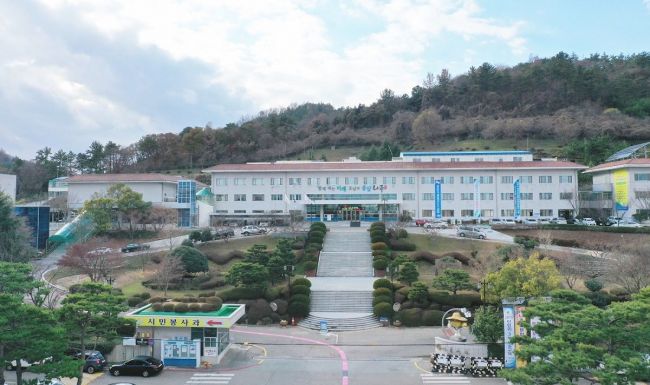
[Naju=Asia Economy Honam Reporting Headquarters Reporter Kim Yukbong] Naju City, Jeollanam-do, officially expressed its opposition to the solar power generation project on reclaimed farmland in Jangdong-ri, Donggang-myeon.
On the 15th, through a statement in the name of the mayor, the city stated, “There is a concern that local community conflicts and confusion may intensify regarding the recent promotion of the Donggang reclaimed farmland solar power project,” and “After comprehensively reviewing related laws and regulations, it is very difficult to proceed with the project.”
This statement was issued as conflicts have been escalating among farmland owners, tenant farmers, companies, and residents due to the recent large-scale solar power project being promoted on 544 hectares (1,645,600 pyeong) of reclaimed farmland in Jangdong-ri, Donggang-myeon, created following the completion of the Yeongsan River estuary bank in 1981.
Farmland owners who have signed lease contracts with companies support the project, as solar power facilities can generate higher profits compared to traditional agricultural production.
On the other hand, tenant farmers, farmers’ associations, and youth groups opposing the project are concerned about the reduction in high-quality farmland rice production, decline in forage crops leading to the collapse of the livestock industry base, landscape damage, and land degradation.
The sharp conflict between supporters and opponents originated from the government’s amendment to the “Farmland Act” in July 2019, which allows the installation of solar power facilities on land reclaimed from public waters where soil salinity exceeds a certain level.
The problem lies in the fact that farmland suitable for farming can be classified as salt-damaged farmland depending on soil salinity measurement results.
According to the “Regulations on the Installation of Solar Energy Generation Facilities on Reclaimed Public Waters” related to the Farmland Act (Article 9, Paragraph 1), whether farmland is salt-damaged is determined by the salinity measurement of the subsoil (30 to 60 cm from the surface).
In conclusion, if the subsoil salinity measurement is 5.5 ds/m (decisiemens per meter) or higher, the land is classified as salt-damaged farmland, allowing the installation of solar power facilities.
However, considering that there have been no reports of salt damage on the farmland so far, the city plans to apply the salinity value measured in the “topsoil” (less than 30 cm from the surface) as the soil salinity.
Generally, soil salinity is determined by subsoil measurements, but there is an exception (Article 9, Paragraph 2) allowing the application of topsoil measurements at the discretion of the mayor or county governor.
The city stated, “The reclaimed farmland is well-maintained with land leveling and irrigation facilities, making it valuable as high-quality farmland worthy of preservation,” and “Temporary use permits for other purposes of farmland will be denied according to the Farmland Act.”
It added, “Projects generating 3 MW (megawatts) or more require approval from the Ministry of Trade, Industry and Energy, but the final approval is decided by referring to the opinions of the local government and related agencies,” and “We will actively raise issues related to local residents’ acceptance and problems arising from the project to relevant ministries.”
The city also clarified regarding the Naju City logo engraved on a private company’s solar power promotion booklet.
The city said, “There has been no consultation with the project operator regarding the reclaimed farmland solar power project, and there is currently no solar power project plan at the Naju City level.”
It emphasized, “Large-scale solar power projects are long-term endeavors that can take several years from planning to approval and completion,” and “We express concern over the intensifying conflicts within the region due to reckless project promotion and clearly convey that proceeding with the project is difficult.”
Mayor Kang stated, “I hope that no further confusion and conflict will arise through this statement,” and “I hope this will be an opportunity to reaffirm the reputation of Donggang reclaimed farmland as the nation’s top-quality farmland and a representative high-quality brand rice production area of Naju.”
© The Asia Business Daily(www.asiae.co.kr). All rights reserved.
![Clutching a Stolen Dior Bag, Saying "I Hate Being Poor but Real"... The Grotesque Con of a "Human Knockoff" [Slate]](https://cwcontent.asiae.co.kr/asiaresize/183/2026021902243444107_1771435474.jpg)











