Government Selects 61 'On-Site Close Contact' Tasks in 4 Areas to Address Local Economy and Livelihood Issues
Focused Promotion of Regional Projects with Significant Economic Impact
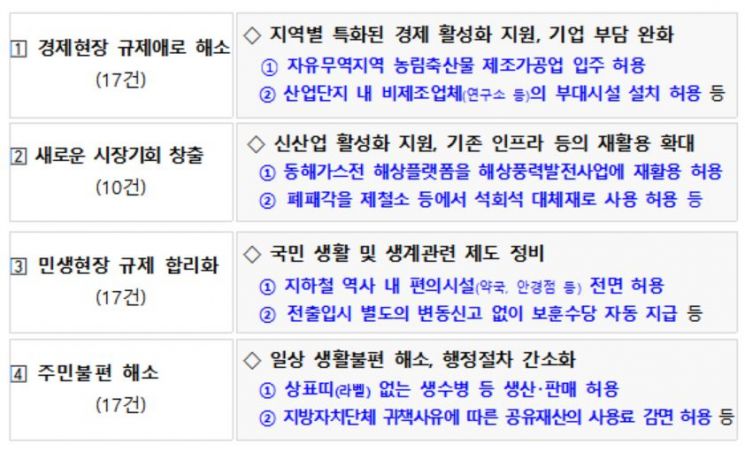
[Asia Economy Reporter Lim Cheol-young] The government has allowed pharmacies and optical shops to be established inside subway stations and permitted the production and sale of water bottles without brand labels through regulatory innovation. Moving forward, to revitalize local economies, the government will allow agricultural, forestry, and livestock product manufacturing and processing industries to enter free trade zones and open the way to recycle offshore platforms from the Donghae gas field for offshore wind power projects. Additionally, it will prohibit requiring or presenting appearance-related conditions unrelated to job duties to both female and male workers during recruitment.
On the 15th, the Office for Government Policy Coordination and the Ministry of the Interior and Safety announced that they had finalized 61 regulatory innovation measures for local economies and public welfare based on suggestions from local sites over the past year through inter-ministerial collaboration. The region-centered regulatory innovation reflects diverse local voices and emphasizes "on-site" issues. The government has prioritized and promoted these efforts to produce tangible regulatory innovation outcomes that citizens can feel. Since the inauguration of the Moon Jae-in administration, 130 local field-oriented improvement tasks have been confirmed and improved in three phases based on local government proposals.
This plan is based on various local cases over the past year and was developed through close collaboration within the government, making nationwide dissemination and application possible. The government has finalized a total of 61 regulatory improvement tasks across four areas: economic sites, market opportunities, public welfare sites, and resident inconveniences.
First, entry of agricultural, forestry, and livestock product manufacturing and processing industries into free trade zones will be permitted. While there were no entry restrictions for general manufactured goods manufacturing and processing industries within free trade zones, manufacturing and processing industries using imported agricultural, forestry, and livestock products (63 tariff concession items) as raw materials have been restricted. This has made it difficult to attract new high value-added agricultural, forestry, and livestock product manufacturing investments, hindering the revitalization of free trade zones, which have been more stagnant compared to the past. In particular, three local governments (Busan, Gyeongnam, Jeonnam), focusing on attracting investment to the hinterlands of Busan Port and Gwangyang Bay, jointly requested the government to ease these regulations last October. The government plans to fully allow entry of manufacturing and processing industries using imported agricultural, forestry, and livestock products (63 tariff concession items) as raw materials after preparing supplementary measures to protect domestic farms and prevent tariff evasion.
Installation of ancillary facilities for non-manufacturing companies such as research institutes within industrial complexes will also be possible. Until now, the scope of ancillary facilities in industrial complexes was defined only for manufacturing companies, and non-manufacturing companies (such as research institutes) were unable to install ancillary facilities allowed for manufacturers, such as prototype production spaces and cafeterias. The government plans to expand the range of companies eligible to install ancillary facilities in industrial complexes from manufacturing companies to include non-manufacturing companies.
◆ Path Opened for Offshore Platform Recycling = Furthermore, the path to recycle offshore platforms from the Donghae gas field for offshore wind power projects will be opened. Until now, artificial structures installed for seabed mineral extraction were required to be dismantled and restored within one year after the mineral extraction rights expired, except in exceptional cases. Since offshore wind power projects using floating structures are being promoted off the coast of Ulsan, recycling the Donghae gas field offshore platforms was impossible, and dismantling was expected to incur huge additional costs. The government plans to amend the Submarine Mineral Resources Development Act by June to allow recycling of the Donghae gas field offshore platforms for offshore wind power and other uses.
Waste shells can also be used as substitutes for limestone in steel mills. Although waste shells such as oyster shells have similar components to limestone, they had to be treated as waste, making recycling impossible. In particular, in areas like Tongyeong City, Gyeongnam, which produces most of the domestic farmed oysters, large-scale disposal of waste shells in fishing villages due to landfill costs has caused serious environmental damage.
The government plans to newly designate waste shells as a "recyclable type" so they can be used as limestone substitutes in steel mills. This measure is expected to enhance the utilization of waste resources and reduce the burden on fishermen caused by waste disposal.
◆ Full Permission for Pharmacies and Optical Shops Inside Subway Stations = Following the allowance of convenience facilities inside subway stations, a system will be established to automatically pay veterans' allowances without separate reporting. Large city subway station facilities are considered civil engineering structures excluded from the Building Act, and most do not have a "building register" that confirms the building's use. When permitting convenience facilities in subway station stores, local governments required a "building register" to verify the building's use (neighborhood living facilities), leading to inconsistent administrative processing standards depending on local governments and industries.
Accordingly, the government will prepare a "separate management register" that can verify the use of subway store facilities and take measures to fully allow the establishment of convenience facilities such as pharmacies and optical shops. This is expected to correct inconsistent administrative practices for large city subway store facilities and eliminate management blind spots.
Additionally, a system will be established to automatically pay veterans' allowances without separate change reports upon moving in or out. Unlike other welfare allowances such as childcare allowances, veterans' allowances required mandatory "change reports" when moving between local governments to receive payments. Failure to report changes after moving often resulted in non-payment, and retroactive payments were not possible. The government plans to improve the system so that veterans' allowances are paid without change reports upon moving through administrative system linkage.
◆ Production and Sale of Water Bottles Without Brand Labels Allowed = The government has also permitted the production and sale of water bottles without brand labels. Water bottles have been regulated to attach important information labels on the container body surface so consumers can easily check product information. However, since the plastic material of water containers and labels differ, separate label removal was required for recycling.
The government has allowed label structures that are easy to separate or changes in label attachment locations so that separate separation work between container and label is unnecessary, minimizing daily inconveniences in waste disposal processes that have surged recently due to the COVID-19 situation.
Furthermore, it has become possible to reduce shared property usage fees due to local government responsibility. Previously, in cases of shared property usage restrictions caused by natural disasters, extension of usage periods and fee reductions were possible for users, but in cases caused by local government responsibility, only usage period extensions were allowed, and fee reductions were not. This led to situations where users' rights to use shared property were infringed despite no fault of their own in frontline administrative sites. To resolve these inconveniences, the government has improved the system to allow fee reductions even when shared property usage is restricted due to local government responsibility.
Requiring appearance-related conditions unrelated to job duties for both female and male workers during recruitment will also be prohibited. The current Act on Gender Equality in Employment and Work-Family Balance Support prohibits presenting or requiring physical conditions such as appearance, height, weight, or marital status that are unnecessary for job performance when recruiting female workers. Considering gender equality rights, the government plans to apply this provision to all workers regardless of gender and pursue legal amendments.
Going forward, the Office for Government Policy Coordination plans to focus on solving local issues with significant economic ripple effects this year, together with the Ministry of the Interior and Safety, which discovers and innovates regulations with local governments and residents. They plan to comprehensively discover related tasks to support region-specific industrial support and expand local job creation tailored to local conditions. In addition, besides central government regulations, local government autonomous regulations (ordinances and rules) that cause excessive inconvenience or burden to citizens and businesses will also be revised.
© The Asia Business Daily(www.asiae.co.kr). All rights reserved.

















