[Asia Economy reporters Seulgina Jo and Minyoung Cha] SK Telecom, which is undergoing a corporate split for the first time in 37 years since its founding, will launch an ICT investment-specialized company with about 100 employees within this year to serve as an intermediate holding company. The surviving entity will focus on AI and digital infrastructure businesses based on existing telecommunications, while the newly established company is expected to actively pursue domestic and international investments centered on non-telecommunications sectors such as semiconductors.
Even after the governance restructuring, SK Hynix, with a market capitalization of around 100 trillion won, will remain a grandchild company under the holding company. However, with the investment company newly established taking the forefront, the shackles that have hindered aggressive investments and mergers & acquisitions (M&A) in the semiconductor sector will be somewhat loosened. The split ratio is being considered as 6 to 4 between the surviving and the new company.
◇ SKT Chooses Spin-off, Considering 6 to 4 Split Ratio
The governance restructuring plan disclosed by SK Telecom on the afternoon of the 14th centers on a spin-off into the surviving company, ‘AI & Digital Infrastructure Company,’ and the newly established ‘ICT Investment-specialized Company.’
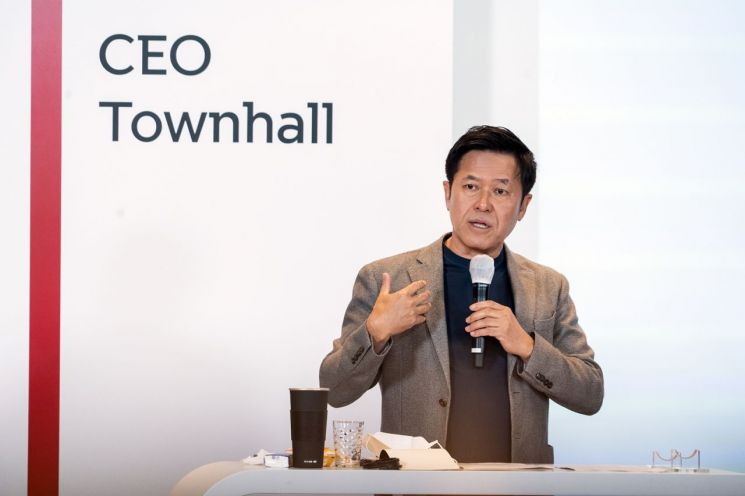
Park Jung-ho, CEO of SK Telecom, stated at a CEO town hall meeting held for employees immediately after the public announcement, "The split ratio will be 6 to 4 between the surviving and the new company," adding, "We aim to grow both companies to an operating profit scale of 1 trillion won." The names of the two companies have not yet been finalized. Specific subsidiary allocations and decisions on treasury stock cancellation will be confirmed before June. Subsequently, shareholder meetings are expected in August to September, followed by the split and listing in November.
Accordingly, the burden of acquiring additional SK Hynix shares under the revised Fair Trade Act, effective next year (raising the equity requirement for newly listed subsidiaries from 20% to 30%), will be eliminated. If SK Telecom’s governance restructuring is not completed within this year, it would have to purchase nearly an additional 10% stake in SK Hynix, estimated to require about 9 trillion won. This is why this year is considered the last chance for SK Telecom to transition into an intermediate holding company. Currently, SK Group’s governance structure flows from the owner family → SK Inc. → SK Telecom → SK Hynix.
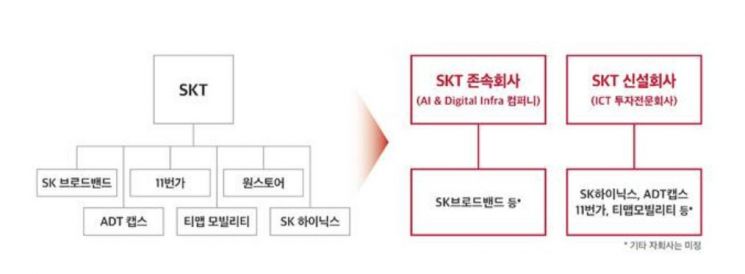
This spin-off emphasizes separating telecommunications and new growth areas that SK Telecom has been pursuing, establishing management structures and investment foundations suitable for each sector. In particular, it can be interpreted as a declaration to intensify investments in semiconductors and new ICT businesses through the newly established ICT investment company. The investment company, launching with about 100 employees by the end of this year, will be responsible for expanding non-telecom new businesses such as semiconductors, mobility, and commerce. Among existing SK Telecom subsidiaries, SK Hynix, 11st, ADT Caps, and T map Mobility are expected to be placed under this new company.
Meanwhile, the surviving company, led by AI and digital infrastructure, will have SK Broadband and others under its umbrella, focusing on existing telecommunications and IPTV businesses. It plans to expand AI technology applications across all ICT sectors and accelerate new businesses such as cloud, data centers, and AI-based subscription services.
◇ "No Merger Plan with SK Inc." Clarified... Subsidiary IPOs Expected to Gain Momentum
CEO Park confirmed there is "no merger plan" between the new company and SK Inc., reflecting shareholders’ concerns. In this case, SK Hynix, which will be under the new company, will remain a grandchild company of SK Inc. Under current Fair Trade Act regulations, grandchild companies can only acquire companies with 100% equity and are barred from establishing joint ventures, which means SK Hynix’s business expansion will still be limited.
However, SK Telecom explains that the new company can take over these roles, so there will be no difficulties in investing in the semiconductor business. This draws more attention to CEO Park’s future investment moves, who is known as a dealmaker in M&A, having led the acquisition of the former Hynix during the semiconductor crisis.
Market analysts also predict that SK Telecom will cancel all of its 12% treasury shares. Namgon Choi, a researcher at Yuanta Securities, said, "If treasury shares are canceled, the current governance structure will be maintained without additional restructuring after the spin-off," adding, "This will completely block the possibility of a merger with SK Inc." This is also seen as a way to prevent the ‘treasury share magic’ trick often seen in corporate succession processes of large conglomerates. Hongshik Kim, a researcher at Hana Financial Investment, also analyzed, "It is highly likely that SK Telecom’s management will cancel the 12% treasury shares to avoid the stigma of the treasury share magic."
Subsidiaries such as ADT Caps and 11st, which will be under the new company, are also expected to gain more momentum for IPOs. The strategy is to create a virtuous cycle of ‘profit generation and reinvestment’ by receiving high valuations for subsidiaries. The securities industry estimates that the total corporate value of new business subsidiaries will exceed 20 trillion won.
© The Asia Business Daily(www.asiae.co.kr). All rights reserved.


















