[Asia Economy Reporter Kim Heung-soon] A private economic research institute has forecast that South Korea's economic growth rate will rise to the mid-3% range this year. The analysis suggests that strong export performance driven by the rapid recovery of the global economy will lead a favorable economic growth trend.
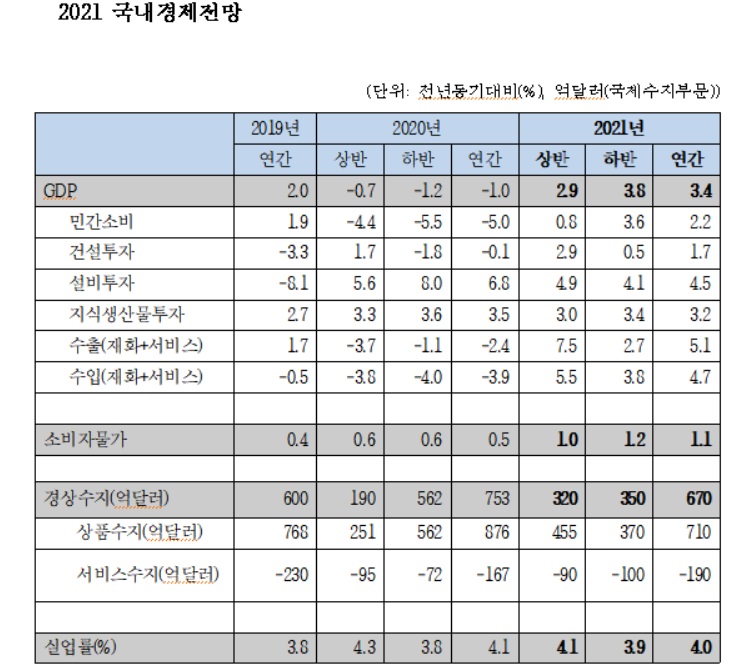
The Korea Economic Research Institute (KERI), under the Federation of Korean Industries, projected an economic growth rate of 3.4% for this year in its "KERI Economic Trends and Outlook: Q1 2021 Report" released on the 15th. Last year, South Korea's economic growth rate was -1.0%.
Expansion of Export Growth, Steady Recovery of Facility Investment, Limited Recovery of Construction Investment
Private Consumption Constrained by COVID-19 Resurgence and Weakened Income Base
KERI predicted that the expansion of export (goods + services) growth will lead domestic growth this year. Exports, which recorded a negative growth of -2.4% last year, are expected to see a significant increase in growth rate this year due to increased trade volume influenced by large-scale economic stimulus measures by major countries and active vaccine distribution.
Improved trade conditions such as rising prices of key export items like semiconductors, along with a significant increase in exports of non-core items like biohealth, are expected to expand the export growth rate to 5.1%.
Facility investment is also analyzed to continue its recovery trend. Aggressive investment in the IT sector, including semiconductors, is ongoing, and investment in eco-friendly sectors is also on the rise, leading to an expected growth rate of about 5.0% in facility investment. Construction investment is expected to shift from last year's negative growth to positive growth due to large-scale housing supply measures. However, recovery in construction investment is anticipated to be limited due to persistent building regulations and opposition to public reconstruction projects.
Private consumption is forecasted to grow by only 2.2%, as the resurgence of COVID-19, which has materialized despite the start of vaccine distribution, prolonged weakening of household income base, and the repayment burden of rapidly increased household debt, collectively impact consumption.
Consumer Price Inflation Rate 1.1%, Current Account Surplus $67 Billion
Won-Dollar Exchange Rate at Around 1,140 Won, Dollar Strength Trend Continues
Managing the Fourth Wave of COVID-19 and Rapid Vaccine Distribution Are Crucial
The consumer price inflation rate is expected to slightly rise from 1.0% last year to 1.1% this year. Despite expectations of economic recovery, recovery in international oil prices, and rising housing costs such as rent, the downward pressure on demand caused by the continued decline in nominal wage growth and the resurgence of COVID-19 is expected to keep real inflation at about 1.1%.
The won-dollar exchange rate is forecasted to remain around 1,140 won, with the dollar strength trend continuing. KERI identified smooth handling of the ongoing COVID-19 resurgence and the speed of vaccine distribution as the biggest risk factors for this year's economic growth. If the current COVID-19 resurgence stabilizes within the first half of the year and herd immunity is formed within this year through active vaccine distribution, the current favorable growth trend can be maintained. However, if the situation worsens with an increase in confirmed cases and delays in vaccine distribution, the growth rate could return to negative territory.
© The Asia Business Daily(www.asiae.co.kr). All rights reserved.
![Clutching a Stolen Dior Bag, Saying "I Hate Being Poor but Real"... The Grotesque Con of a "Human Knockoff" [Slate]](https://cwcontent.asiae.co.kr/asiaresize/183/2026021902243444107_1771435474.jpg)











