April 14 Political Affairs Committee Subcommittee Agreement Between Ruling and Opposition Parties
Ruling Party: "Will Definitely Pass in April National Assembly"
1.9 Million People Targeted... 5 Million Including Immediate Family
Retroactive Application Not Possible
[Asia Economy Reporter Oh Ju-yeon] The bill to enact the Public Officials Conflict of Interest Prevention Act has passed the National Assembly's Political Affairs Committee's bill review subcommittee. It has been eight years since the bill was first proposed, and just over a month since a prompt passage was urged in March to prevent a recurrence of the Korea Land and Housing Corporation (LH) scandal.
Due to the public outrage over 'real estate speculation' following the LH scandal, both ruling and opposition parties agreed on the necessity of the bill. However, with the April 7 by-elections approaching, the subcommittee met five times last month, but the bill's passage was delayed. At the subcommittee meeting held on March 31, key issues included the scope of public officials, whether to include journalists and private school faculty, and the scope of job-related confidential information. This time, all were resolved through bipartisan agreement.
On the 14th, the second bill review subcommittee of the Political Affairs Committee approved the Public Officials Conflict of Interest Prevention Act by bipartisan consensus.
The scope of application, which was a contentious issue, includes public officials, employees of public institutions, local council members, and their immediate family members. Additionally, the definition of 'public institutions' was expanded to include 'government-affiliated agencies.'
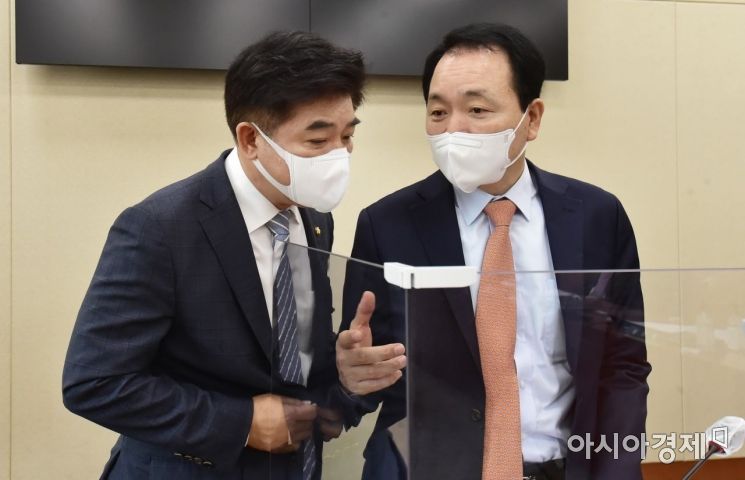 Sung Il-jong, Chairman of the Subcommittee on Legislative Review of the Political Affairs Committee, and Kim Byung-wook, a member of the Democratic Party of Korea, attended the meeting of the 2nd Subcommittee on Legislative Review of the Political Affairs Committee regarding the Anti-Interference Bill held at the National Assembly on the 13th. They are seen talking before the start of the meeting. Photo by Yoon Dong-joo doso7@
The opposition party, which was skeptical about including journalists and private school faculty among public officials, decided not to include them in this Conflict of Interest Prevention Act. Instead, these groups will be regulated for conflict of interest situations under the Private School Act and media-related laws, respectively.
The scope of job-related confidential information was also expanded to 'non-public information obtained through official duties.' Furthermore, the regulations will apply for three years after retirement, prohibiting the use of non-public information acquired during official duties.
Kim Byung-wook, the ruling party's secretary, explained to reporters that "the ban on family hiring will be extended to subsidiaries of affiliated agencies, and special-related business operators will be included among those restricted from transactions."
He added, "Employees of public institutions whose main duties involve land and real estate must report ownership and additional purchases within 14 days when acquiring related land and real estate. Also, public officials who become aware of development activities conducted by their public institution must report the relevant details within 14 days," noting that these provisions were newly introduced.
If the Conflict of Interest Prevention Act passes the National Assembly in April, approximately 1.87 million public officials and employees of public institutions will be subject to the law. Including immediate family members, the number is expected to exceed 5 million.
The ruling party intends to ensure the final passage of the Conflict of Interest Prevention Act in the National Assembly this month.
On the same day, the Democratic Party issued a statement emphasizing, "We will focus on the review and approval by the Legislation and Judiciary Committee and the passage in the plenary session to ensure the Conflict of Interest Prevention Act is passed in the April National Assembly."
Park Sung-jun, the party's floor spokesperson, said, "The reality is that public officials have abused their authority and superior positions to pursue private interests, undermining public trust in the public service. The enactment of the Conflict of Interest Prevention Act is designed to restore public trust in the public service and eradicate public officials' pursuit of private interests. We will definitely open the path to eradicating public officials' pursuit of private interests and restoring public trust."
However, with retroactive application excluded, it has become difficult to recover unjust profits from LH New Town speculation under the Conflict of Interest Prevention Act.
Jung Jinkyo, a member of the Justice Party and the Political Affairs Committee, consistently emphasized reflecting public sentiment demanding the recovery of unjust profits obtained through LH New Town speculation by including a 'retroactive legislation' clause. However, the direction was ultimately set to exclude even 'quasi-retroactivity.' On the 13th, Rep. Jung stated, "If the timing of realizing profits from real estate, etc., is used as the criterion, legislation with quasi-retroactivity is fully possible." He also warned that without including such provisions, the bill cannot be said to properly reflect the public's demands.
In response, Rep. Kim said, "The principle of non-retroactivity of laws applies," adding, "Since the Conflict of Interest Prevention Act is a general law, recognizing retroactivity is not desirable."
© The Asia Business Daily(www.asiae.co.kr). All rights reserved.

















