Gyeongnam Province to Hold Results Report Meeting on the 'Joint Research for Establishing Southeast Region Development Plan' on the 14th
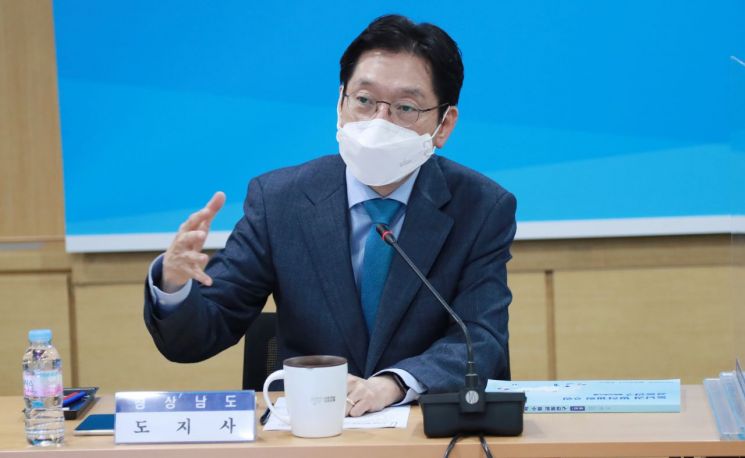
[Asia Economy Yeongnam Reporting Headquarters Reporter Park Saeyan] Gyeongsangnam-do held a result report meeting on the 'Joint Research on the Establishment of the Dongnam Region Development Plan,' which will serve as an indicator for the creation of the 'Bu-Ul-Gyeong (Southeast Region) Megacity,' at the provincial government office on the 14th.
Governor Kim Kyung-soo presided over the meeting, attended by provincial officials and researchers including Hong Jae-woo, director of the Gyeongnam Research Institute, to review the contents of the joint research results and discuss future promotion plans.
Since 2019, Governor Kim has advocated for the creation of the 'Bu-Ul-Gyeong Megacity,' emphasizing the need for a super-regional development strategy that transcends city and provincial boundaries.
While local areas face the risk of extinction, the metropolitan area suffers from severe problems caused by overpopulation, such as overheated competition, housing, and traffic congestion.
To overcome these issues and promote sustainable development for both the region and the entire country, flexible and balanced development by region is necessary.
The 'Dongnam Region Development Plan Establishment Research' was jointly conducted by research institutes from the three cities and provinces of Bu-Ul-Gyeong from March last year to March this year.
The research results consist of an analysis of the regional status and conditions, the necessity and basic concept of promoting the megacity, and an implementation plan.
In his opening remarks, Governor Kim proposed changing the name from the existing 'Dongnam Region Megacity' to 'Bu-Ul-Gyeong Megacity' for nationwide understanding. He explained, "The Bu-Ul-Gyeong Megacity is a strategy to connect the four major hub cities?Busan, Ulsan, Changwon-centered eastern Gyeongnam, and Jinju-centered western Gyeongnam?and the four major regions into one megacity through a network."
Governor Kim urged, "With Mayor Park Hyung-joon's inauguration, please accelerate the previously delayed parts with a sense of speed, and not only the joint promotion team but also establish consultative bodies that can raise consensus among the citizens of Bu-Ul-Gyeong cities and provinces to speed up the promotion of the megacity and the metropolitan special alliance."
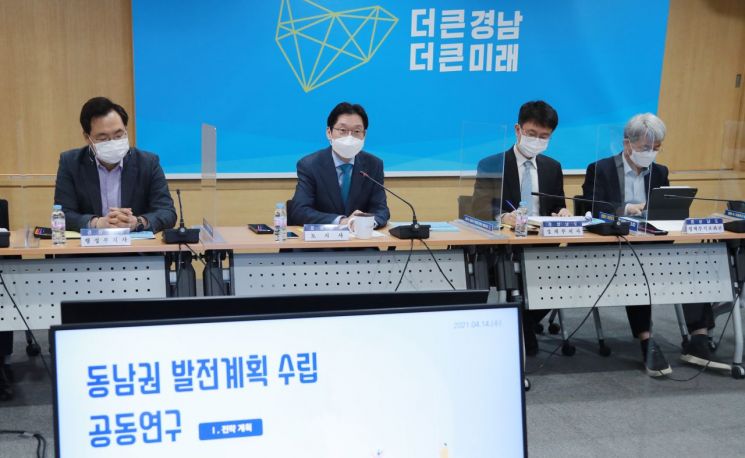
According to the reported research results, a basic spatial structure concept was proposed to form a single economic zone based on a one-hour living zone among Busan, Ulsan, and Gyeongnam.
It involves forming a cluster centered on the four major hub cities of the Dongnam region?Busan, Ulsan, Changwon, and Jinju?beyond administrative districts, and building an expandable metropolitan network between cities by flexibly connecting small and medium-sized cities as needed.
The 'Dongnam Region Development Plan' was prepared by setting administrative, living, economic, and cultural communities as four strategic directions, deriving 30 tasks in 14 fields, and 110 major projects.
To form an 'administrative community,' the establishment of a (tentatively named) Dongnam Region Metropolitan Special Alliance was proposed according to the revised Local Autonomy Act.
This is because an administrative organization is needed to efficiently perform common current issues and joint affairs in the Bu-Ul-Gyeong region.
For the 'living community,' 11 tasks were derived in five fields: transportation, education, disaster safety, welfare and health, and food.
Major tasks include building metropolitan transportation infrastructure to establish a one-hour living zone, strengthening cooperation among Dongnam region universities and industry-academia-research, establishing a lifelong learning system, and building a joint response system for metropolitan disaster and air quality management.
For the 'economic community,' projects centered on key tasks such as establishing a Northeast Asia logistics platform, building a Dongnam region hydrogen economy zone, and smart and digital transformation of Dongnam region's main industries were proposed.
The 'cultural community' includes major tasks in three fields: Expo, culture, and tourism, such as establishing a joint response system for the 2030 Busan World Expo in the Dongnam region, building the Dongnam region Asian cultural hub, and creating and systematizing the Dongnam region metropolitan tourism belt.
In addition, since February, the province has been operating the Bu-Ul-Gyeong Metropolitan Special Alliance Gyeongnam Support Group to discover and structure major affairs and identify delegated affairs that the metropolitan special alliance can perform among national affairs.
Currently, plans are being prepared to link Gyeongnam's regional development strategies for Namjung region, Jirisan region, South Coast region, Baekdudaegan, etc., with the Bu-Ul-Gyeong Megacity strategy.
© The Asia Business Daily(www.asiae.co.kr). All rights reserved.
![Clutching a Stolen Dior Bag, Saying "I Hate Being Poor but Real"... The Grotesque Con of a "Human Knockoff" [Slate]](https://cwcontent.asiae.co.kr/asiaresize/183/2026021902243444107_1771435474.jpg)

















