6th Social Relations Ministers' Meeting · 2nd Human Investment and Talent Development Council
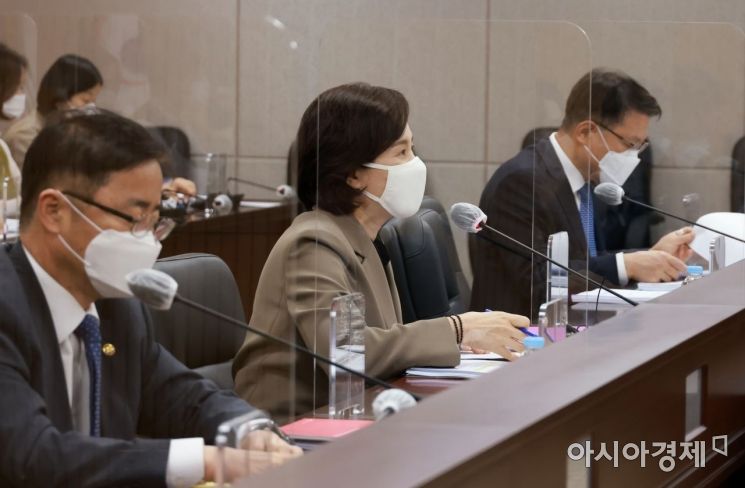
[Asia Economy Reporter Han Jinju] The government will lift restrictions on course registration by department and improve the ratio of university enrollment increases to nurture talent in the 'Big 3' future industries?future cars, biohealth, and system semiconductors?as well as in the artificial intelligence (AI) field.
On the 14th, the Ministry of Education will hold the 6th Social Relations Ministers' Meeting and the 2nd Human Investment and Talent Development Council at the Government Complex Sejong. Nine ministries, including the Ministry of Education, Ministry of Economy and Finance, and Ministry of Science and ICT, have formed a special team under the Human Investment and Talent Development Council to seek institutional improvement measures.
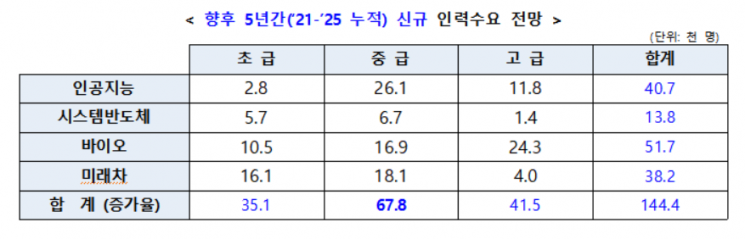
To systematically nurture talent specialized in the Big 3 and AI fields, improvements in talent development systems across new industrial sectors, including these fields, will be promoted. The demand for manpower in the Big 3 and AI sectors is expected to reach 144,000 over the next five years, and as technological competition intensifies, the demand for mid- to high-level talent is rapidly increasing.
The government plans to lower barriers between departments and universities through innovation-sharing universities, providing opportunities for anyone to learn the latest technologies regardless of their major. Restrictions on course registration between departments will be eased, and the number of course seats will be increased to expand choices.
A 'Korean-style Kaggle' will be established where students and researchers solve tasks presented by companies and institutions to cultivate talent with problem-solving skills. The Korean-style Kaggle refers to a space that shares the latest theories or knowledge to solve tasks proposed by companies and provides a place to find talent needed by companies.
To increase human exchanges between universities and companies, incentives for industry-academia cooperation participation will be strengthened. Connections between job information platforms will also be expanded to link small and medium-sized enterprises with excellent talent.
Guidelines will be prepared regarding ownership of joint research results and compensation issues related to startups arising from technology-based entrepreneurship, and specialized personnel for technology commercialization within universities will also be nurtured.
To continuously nurture talent, the project period will be extended, and university autonomy will be supported to prevent interruptions in talent development. For the 'Big 3 + AI' fields, until the National Competency Standards (NCS) are developed, they will, in principle, not be applied in educational settings to minimize gaps with the field.
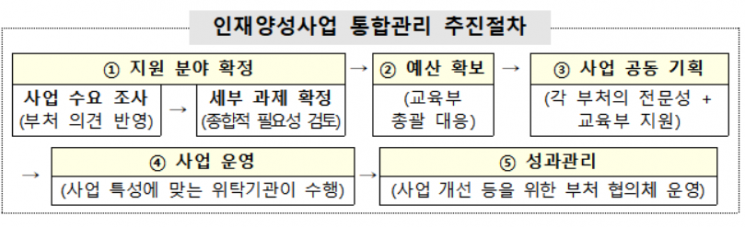
Unified standards for cross-ministerial talent development management projects will be established to create consistent regulations for talent development projects and reduce confusion on the ground. The Ministry of Education will be responsible for overall project management, while each ministry will practically execute the projects. Employment status of talent nurtured through the projects will be tracked and managed, and project restructuring will be promoted based on the achievement of goals.
Training for incumbent workers in the future car sector and system semiconductor design education will be expanded, and specialized talent in bio-production processes, industrial convergence, and AI will also be nurtured.
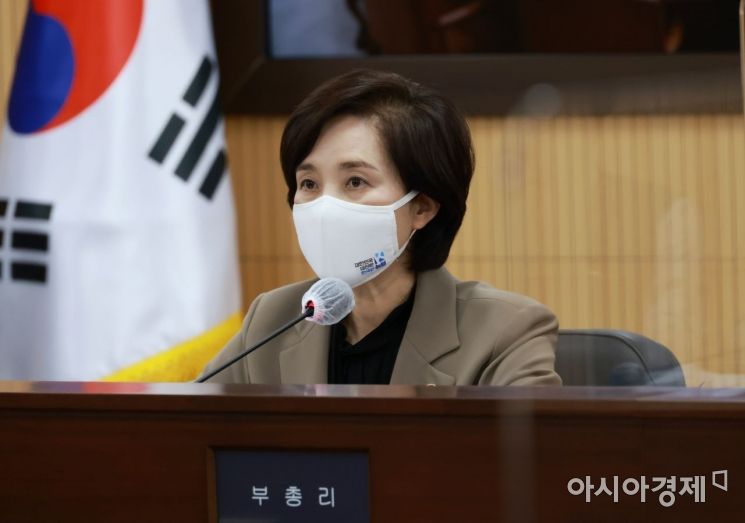
On the same day, the government also discussed the 'Top 10 Human Investment Tasks: Core Achievements and Future Plans,' which includes additional support for costs through the National Tomorrow Learning Card to help citizens acquire digital capabilities during the digital transformation process.
Support will be provided to foster high-level master's and doctoral talent to lead the development of AI, software fields, and key industries. Two new AI graduate schools and two industrial AI graduate schools will be selected, and Innovation Squares will be expanded.
Programs to nurture talent leading the biohealth and environmental industry sectors, which are new growth engines, will also be operated. For biohealth, 2,545 people will be nurtured by supporting specialized graduate schools, and in the environmental industry sector, 52 specialized graduate schools and 5 specialized high schools will be operated.
Work-study dual systems will be established at each school stage, digital convergence training content for incumbent workers will be developed, and training costs will be supported. A shared platform will be designated so that small and medium-sized enterprises and training institutions can conduct training in digital new technology fields by utilizing existing joint training center bases such as large companies and universities.
© The Asia Business Daily(www.asiae.co.kr). All rights reserved.
![Clutching a Stolen Dior Bag, Saying "I Hate Being Poor but Real"... The Grotesque Con of a "Human Knockoff" [Slate]](https://cwcontent.asiae.co.kr/asiaresize/183/2026021902243444107_1771435474.jpg)


















