[Asia Economy Reporter Jeong Hyunjin] An analysis has revealed that South Korea ranks in the lower tier among OECD member countries in terms of corporate institutional competitiveness, which evaluates laws and environments related to business activities.
On the 14th, the Federation of Korean Industries (FKI) announced that South Korea ranked 26th out of 37 OECD countries in an analysis of corporate institutional competitiveness among OECD nations. The FKI extracted institutional scores from the World Economic Forum (WEF), the International Institute for Management Development (IMD) national competitiveness indices, and the Cornell Global Innovation Index, calculated scores by country, and ranked OECD countries accordingly.
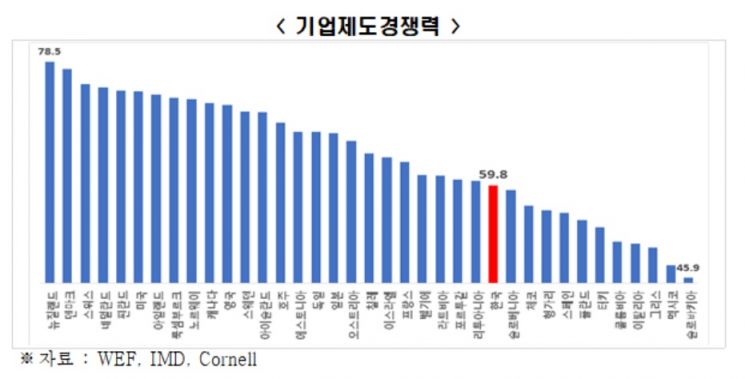
The FKI reported that South Korea's corporate institutional competitiveness was not only lower than the major five countries (G5) but also ranked below Portugal (24th), whose GDP is about one-seventh that of South Korea. This contrasts with South Korea’s overall national competitiveness rankings, which were high: 10th in WEF (2019), 17th in IMD (2020), and 9th in Cornell (2020).
In detailed sectors, South Korea’s corporate institutional competitiveness remained in the lower ranks. In the labor sector, analyzing 10 items including severance pay costs and labor market flexibility, South Korea ranked 28th. Among these, South Korea’s severance pay cost was the fourth highest among OECD countries. Labor market flexibility was also low, ranking 25th.
In the taxation sector, South Korea ranked 26th. This sector evaluated five items including the proportion of corporate tax relative to GDP, the highest corporate tax rate, and the proportion of government subsidies relative to GDP. Notably, South Korea’s corporate tax proportion relative to GDP was 4.21%, the seventh highest among surveyed countries, and the highest corporate tax rate was 25%, ranking 16th.
In the regulatory sector, which examined seven items such as the contribution of regulation to corporate competitiveness, quality of regulation, and corporate regulatory burden, South Korea ranked 25th. The contribution of regulation to corporate competitiveness (35th), quality of regulation (26th), and corporate regulatory burden (25th) all hovered in the lower ranks. Shareholder protection regulation ranked 8th, which the FKI attributed to excellent shareholder protection in cases of conflicts of interest between management and shareholders.
In the policy efficiency sector, which comprehensively evaluated 16 items including government responsiveness to economic changes, policy stability, and transparency, South Korea ranked 23rd. Government responsiveness to economic changes was 28th, and policy stability was 25th, indicating insufficient policy flexibility and consistency.
In the innovation sector, analyzing 12 detailed items such as startup costs, startup procedures, and intellectual property protection, South Korea ranked 19th, a relatively high position compared to other sectors. Startup procedures and preparation periods ranked 3rd and 8th respectively, showing strengths in administrative procedures, but startup costs (36th), intellectual property protection (29th), and startup support legislation (27th) ranked low.
The FKI also analyzed corporate institutional competitiveness including China, Hong Kong, and Singapore, which are competitors to South Korea, and found Hong Kong and Singapore ranked 1st and 2nd respectively, with South Korea at 28th. Yuh Hwan-ik, head of the FKI Corporate Policy Office, emphasized, "We must identify and boldly improve weak areas in regulation, labor, and taxation to strengthen corporate institutional competitiveness."
© The Asia Business Daily(www.asiae.co.kr). All rights reserved.
![Clutching a Stolen Dior Bag, Saying "I Hate Being Poor but Real"... The Grotesque Con of a "Human Knockoff" [Slate]](https://cwcontent.asiae.co.kr/asiaresize/183/2026021902243444107_1771435474.jpg)
















