The Government Plans to Dispatch Researchers to the IAEA's Waste Safety Department in the First Half of the Year
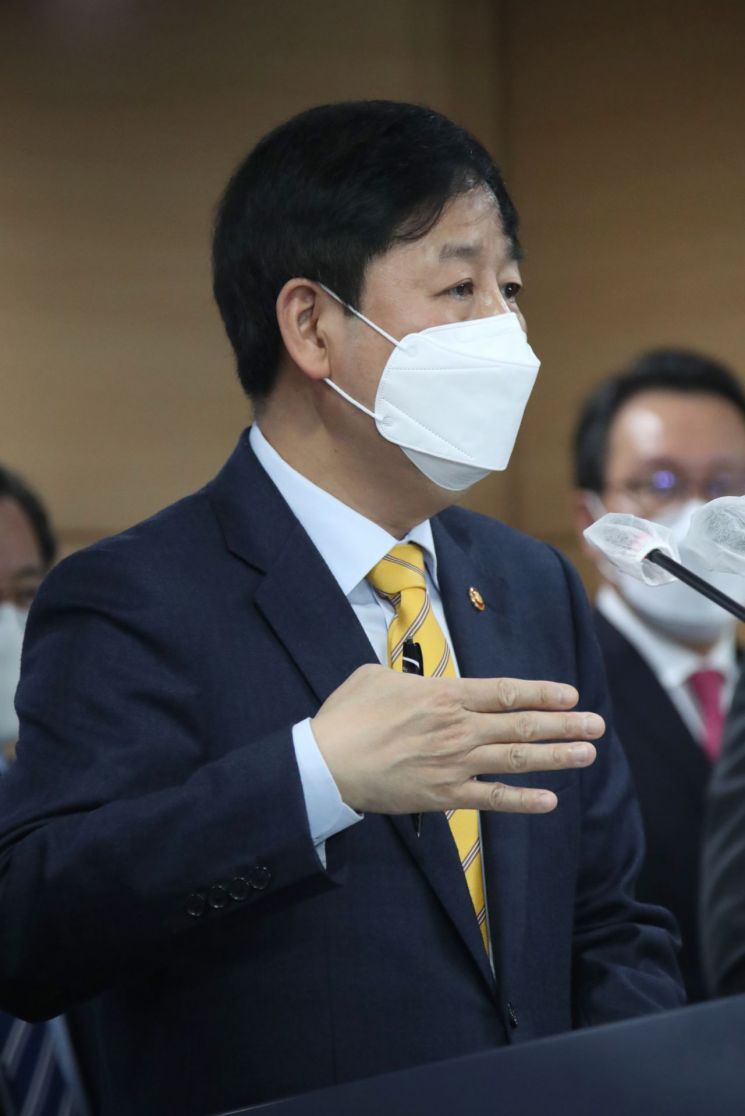 On the morning of the 13th, Koo Yoon-chul, Minister for Government Policy Coordination, announced the government's measures after an emergency vice-ministerial meeting at the Government Complex Seoul regarding the Japanese government's decision to discharge radioactive contaminated water from the Fukushima Daiichi Nuclear Power Plant accident into the sea. 2021.4.13 [Image source=Yonhap News]
[Sejong=Asia Economy Reporters Haeyoung Kwon and Sunhee Son] The government strongly denied reports that the United States and the International Atomic Energy Agency (IAEA) expressed support for Japan's decision to discharge contaminated water from its nuclear power plant. The government plans to apply pressure through international cooperation, including participation in the IAEA inspection team and joint lawsuits with neighboring countries.
On the 14th, Koo Yoon-chul, Director of the Office for Government Policy Coordination, said in an interview with MBC and YTN radio, "The positions of the United States and the IAEA do not indicate support for Japan's decision, but rather emphasize thoroughly monitoring and verifying Japan's decision to discharge the water in accordance with international nuclear safety standards."
After the Japanese government announced the day before that it would release 1.25 million tons of contaminated water stored at the Fukushima nuclear power plant site into the ocean, the U.S. State Department immediately issued a statement saying, "It appears that Japan has chosen an approach based on internationally accepted nuclear safety standards." Rafael Grossi, IAEA Director General, also stated, "We welcome Japan's announcement on the decision regarding the treated water stored at the Fukushima Daiichi Nuclear Power Plant."
Notably, both the U.S. and the IAEA cited the Japanese government's term ‘treated water’ rather than ‘contaminated water,’ which drew attention.
However, Director Koo emphasized again, "If you look at the English wording, it is about verifying (monitoring) the discharge method," adding, "Korea also intends to participate and verify objectively." When asked about prior consultations with the U.S., he said, "The U.S. seems to think the impact is minimal because it is geographically distant from Japan's maritime area," effectively confirming the U.S.'s passive stance on this issue.
The government’s main concern is that, despite being a neighboring country directly affected by Japan's discharge of contaminated water into the ocean, no prior consultation was conducted. Director Koo criticized, "There are various methods such as long-term storage until contamination levels drop, atmospheric release, and electrolysis, but Japan chose the easiest and least costly method, ‘marine discharge.’ The decision lacked sincerity and was a unilateral notification."
The government is placing its hopes on international cooperation. First, it plans to dispatch a Korean expert to the IAEA’s Waste Safety Section within the first half of the year. The Waste Safety Section is responsible for evaluating waste discharge, including contaminated water from the Fukushima nuclear power plant. The government intends to strengthen monitoring by sending one researcher from the Korea Institute of Nuclear Safety.
Additionally, the government plans to have domestic experts participate when the IAEA forms an inspection team in the future. The government has expressed its willingness to participate several times by presenting a pool of Korean experts to the IAEA and reportedly received positive responses from IAEA officials. A government official explained, "To prove that Japan’s discharge is not problematic, we must accept IAEA verification," adding, "We are consulting with Japan and the IAEA through various channels, including the Ministry of Foreign Affairs, to ensure our participation when the inspection team is formed."
If potential damage is confirmed during future monitoring, the government is prepared to pursue litigation. Director Koo said, "I understand that China has also strongly expressed opposition," and added, "We are actively considering filing a case with the International Tribunal for the Law of the Sea."
© The Asia Business Daily(www.asiae.co.kr). All rights reserved.
![Clutching a Stolen Dior Bag, Saying "I Hate Being Poor but Real"... The Grotesque Con of a "Human Knockoff" [Slate]](https://cwcontent.asiae.co.kr/asiaresize/183/2026021902243444107_1771435474.jpg)
















