Nasmedia Announces 2021 Internet User Survey
Increased Evening and Weekend Usage Compared to Previous Year
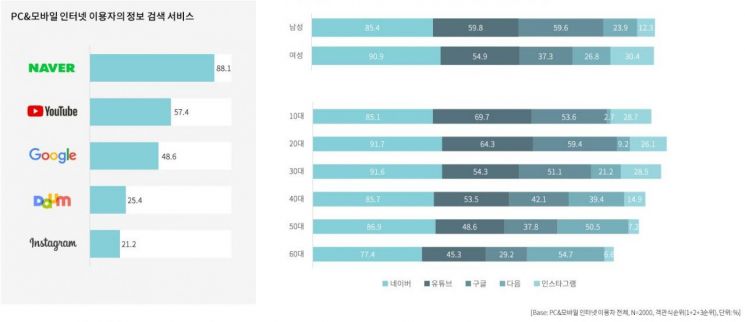
[Asia Economy Reporter Cha Min-young] A survey revealed that one out of every two users aged 40 to 60 searches for information on YouTube. Unlike in the past when only specific age groups such as those in their 20s and 30s used YouTube as a search platform, middle-aged and older users have become familiar with YouTube, leading to a diversification of its uses beyond just watching videos.
On the 14th, KT Group's digital media rep Nasmedia released the results of the '2021 Internet User Survey (NPR),' which analyzed the main service usage behaviors and advertising acceptance behaviors of domestic PC and mobile internet users. NPR is conducted once annually, and this year, a survey was conducted over four days from December 26 to 29, 2020, targeting 2,000 people.
The ranking of information search services showed Naver (88.1%), YouTube (57.4%), and Google (48.6%) at the top. Naver maintained a usage rate of over 80% across all age groups and was still analyzed as a core search channel for lifestyle information, politics, economy, and product reviews.
A notable change was YouTube's advancement as a search channel. YouTube, which previously had search functions used mainly by specific age groups, is now interpreted as a platform where information exploration across various fields is conducted, similar to portal sites like Naver, thanks to the positive response from users in their 40s to 60s. Specifically, 53.5% of people in their 40s, 48.6% in their 50s, and 45.3% in their 60s reported using YouTube for information searches.
For online video viewing channels, YouTube maintained its top position with an overwhelming user ratio of 91.8%. Netflix ranked second with 46.1%, rising one step from the previous year, followed by Naver (31.5%) and Instagram (31.2%). Excluding YouTube, paid services were led by Netflix, while free services were led by Naver as the main video viewing platforms.
The high usage frequency of Naver and YouTube is also expected to extend to online shopping activities. It was found that 76.7% of online shoppers use open markets (telecommunication sales brokerage services). Naver operates shopping services through telecommunication sales brokerage. YouTube indirectly provides shopping services through video feeds and ads below videos. The environment is configured so that users can directly connect to product purchase or app download pages while watching videos.
Compared to last year's survey, internet usage after 6 p.m. and on weekends has also increased. Responses indicating internet use after 6 p.m. rose by an average of 7 percentage points, and weekend internet usage time increased by 12% compared to the previous year. This is interpreted as an increase in internet use at home after work due to strengthened social distancing measures amid COVID-19. Weekend internet usage time also increased as going out became difficult.
Lee Ji-young, head of DTLab at Nasmedia's Connect Business Division, said, “It now appears that entertainment, information exploration, and shopping are commonly conducted in one space on top services like Naver and YouTube.” She added, “Such usage behavior means that an environment has been created where various marketing touchpoints can occur within a single service, from product exploration to the purchase stage.”
© The Asia Business Daily(www.asiae.co.kr). All rights reserved.

















