Bond Investment, Volatility Protection Needed with High-Yield Bonds
[Asia Economy Reporter Minji Lee] "You can achieve successful investment simply by allocating assets between stocks and bonds. Since market volatility can increase at any time due to the sharp rise in indices, asset allocation is more important than ever."
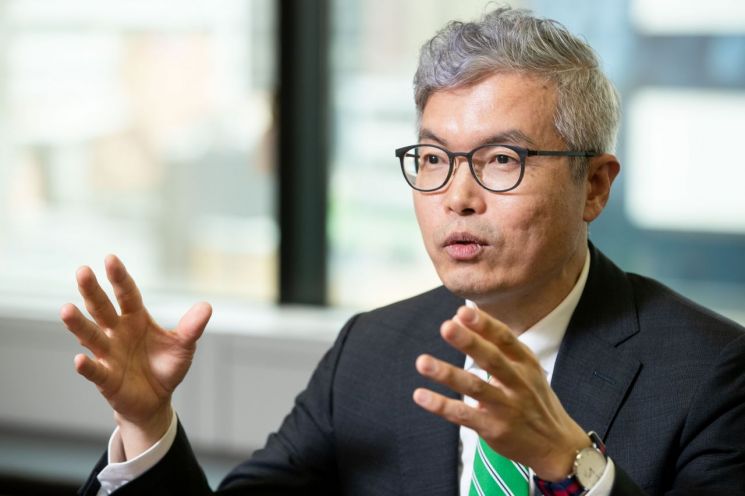
In a recent interview with Asia Economy, CEO Bae Insu emphasized that the most important aspect of investing is "setting your own asset allocation ratio and consistently maintaining it." He noted that domestic investors tend to pursue capital gains from asset fluctuations rather than earning income through stable assets like bonds, often putting all their money into stocks. However, asset allocation is essential to maintain steady returns.
According to CEO Bae's philosophy, if you allocate 60% of your assets to stocks for aggressive investment, the remaining 40% should be managed in stable assets such as bonds. When stock returns increase and exceed 60% of the total assets, a rebalancing process to adjust the ratio is necessary. Simply setting the initial allocation at 60 to 40 does not complete diversification; adjusting the increased asset ratio according to returns is required to consistently achieve high profits. CEO Bae stated, "Even if the market crashes, if you maintain your asset allocation well, stable assets like bonds will help defend against risks," and added, "Setting asset allocation guidelines but then putting all your money into one side just because stock returns are high is the most dangerous behavior to avoid."
If you are looking for bond investment options, high-yield bonds are worth considering. High-yield bonds refer to corporate bonds issued by non-investment grade companies. The main investment targets are bonds issued by companies in the U.S. and Europe, where the high-yield bond market is large. Assuming an investment period of over 10 years, an annual return of 5-6% can be expected. Recently, due to the short-term adverse effect of the COVID-19 pandemic, many sound companies suddenly lost their investment-grade status and became "Fallen angels," causing the high-yield bond market size to soar to 240 trillion KRW, far exceeding the usual level of 10-17 trillion KRW.
CEO Bae stated, "During historically volatile periods in the global stock market, such as the Lehman crisis, high-yield bonds fully recovered within three years and generated high profits," and argued, "This year is an optimal time for high-yield bond investment as fallen angels are transitioning into rising stars in the credit recovery phase."
For individuals interested in investing in high-yield bonds, public funds or exchange-traded funds (ETFs) listed overseas can be considered. The most important factor in high-yield bond investment is whether liquidity can be maintained until the end if a default occurs among fallen angels. CEO Bae explained, "If a company's investment grade unexpectedly falls, general funds can respond more actively than ETFs to manage returns," and added, "Since high-yield bonds are sensitive to credit changes, it is also important to choose funds managed by firms with professional research organizations."
© The Asia Business Daily(www.asiae.co.kr). All rights reserved.
!["The Woman Who Threw Herself into the Water Clutching a Stolen Dior Bag"...A Grotesque Success Story That Shakes the Korean Psyche [Slate]](https://cwcontent.asiae.co.kr/asiaresize/183/2026021902243444107_1771435474.jpg)
















