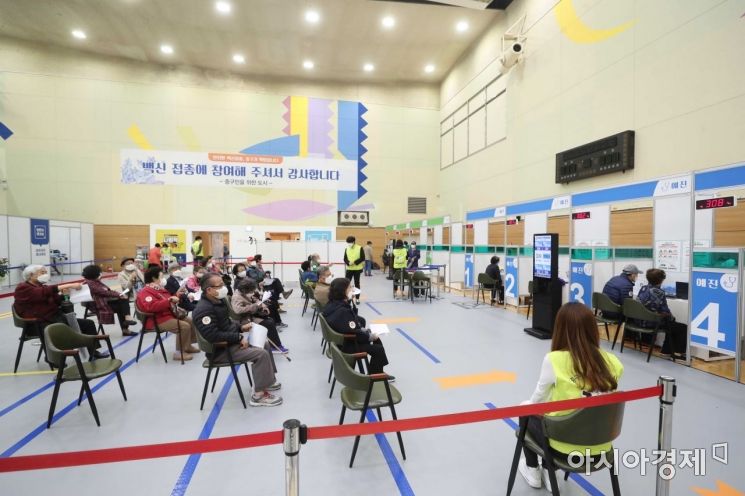
 On the 12th, as the spread of COVID-19 continues, seniors aged 75 and older are waiting to receive the Pfizer vaccine at the Jung-gu COVID-19 Vaccination Center set up at Chungmu Sports Center in Jung-gu, Seoul. Photo by Mun Ho-nam munonam@
[Asia Economy Reporter Ji Yeon-jin] Stocks related to food ingredients have been fluctuating since the beginning of the year. Although they were considered one of the most affected industries last year due to the suspension of group catering services amid the COVID-19 pandemic, the start of COVID-19 vaccinations and growing expectations for a return to normal life have driven an upward trend.
According to the Korea Exchange on the 13th, Hyundai Green Food's stock price rose 10.39% up to the previous day this year. During the same period, Shinsegae Food increased by 10.02%, and CJ Freshway jumped 23.54%. These food ingredient stocks suffered a direct hit in performance and saw significant stock price declines last year as group catering services, including those at schools, were halted due to COVID-19. The annual stock returns for Hyundai Green Food, Shinsegae Food, and CJ Freshway last year were -24.16%, -7.3%, and -31.47%, respectively.
These stocks have shown price movements similar to the vaccination trends this year. There is an expectation that once the pandemic ends and group catering services resume, their performance will significantly improve. However, the securities industry believes that the performance of these stocks will also depend on each company's post-COVID-19 strategy. Due to COVID-19, companies have explored the possibility of remote work. If remote work becomes widespread, group catering may no longer serve as a 'cash cow' as it did in the past.
In fact, food ingredient companies have started mid- to long-term restructuring. In particular, Shinsegae Food has reorganized its mid- to long-term business strategy to expand its dining-out and bakery businesses based on its home meal replacement (HMR) and meal kit manufacturing lines. The company plans to open 100 No Brand Burger franchise stores by the end of this year. Shim Eun-joo, a researcher at Hana Financial Investment, said, "Synergies are expected from royalty income proportional to the number of franchise stores and increased operating rates of manufacturing plants (supplying patties, hamburger buns, lettuce, etc.). Expanding the number of franchise stores by 100 is estimated to improve operating profit by 8 to 10 billion KRW, and performance improvement will accelerate from the end of this year when the franchise openings are completed."
© The Asia Business Daily(www.asiae.co.kr). All rights reserved.
![Clutching a Stolen Dior Bag, Saying "I Hate Being Poor but Real"... The Grotesque Con of a "Human Knockoff" [Slate]](https://cwcontent.asiae.co.kr/asiaresize/183/2026021902243444107_1771435474.jpg)
















