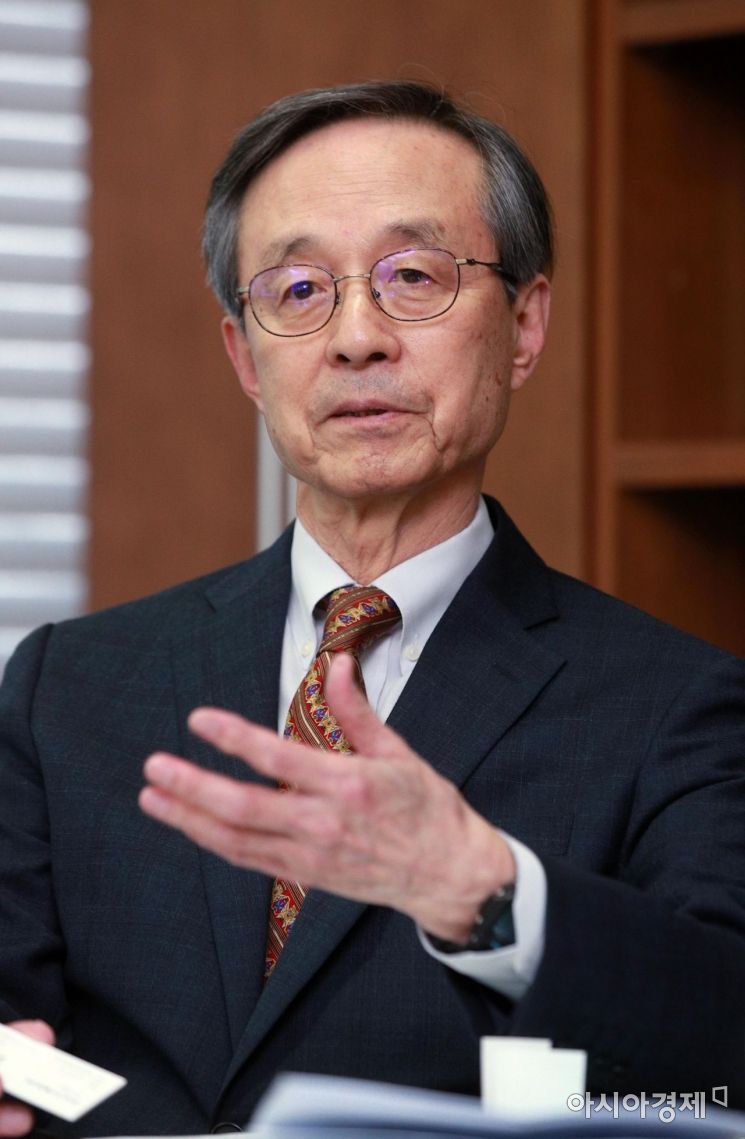
[Asia Economy Reporter Lee Ji-eun] "This administration abandoned the Korea-Japan comfort women agreement without alternatives, swayed by anti-Japanese sentiment, and consistently took a low-profile stance toward China, accepting the ‘3-No Position.’"
Han Seung-joo, Chairman of the Asan Institute for Policy Studies, recently expressed his regrets about the Moon Jae-in administration’s diplomacy in a three-person interview with Asia Economy contributor Professor Hwang Jae-ho of Hankuk University of Foreign Studies’ International Studies Department and this newspaper’s reporter. Han, who served as Minister of Foreign Affairs under the Kim Young-sam administration and as the first Ambassador to the United States under the Roh Moo-hyun administration, criticized current Korean diplomacy as ‘3 Nos (No Talent, No Procedure, No Policy) and 1 Yes (Code)’ in his book published last January titled ‘Is There Diplomacy in Korea?’
Han particularly pointed out the acceptance of the ‘3-No Position’ as a problem in Korean diplomacy. The 3 Nos refer to the decisions not to deploy additional THAAD (Terminal High Altitude Area Defense) systems considering Korea-China relations, not to join the U.S. missile defense system, and not to participate in the Korea-U.S.-Japan military alliance. Han stated, "Reducing joint military exercises with the U.S., signing military agreements under the name of peace with North Korea that weakened security, and underestimating North Korea’s nuclear capabilities while exaggerating its denuclearization intentions to facilitate North Korea-U.S. summits were all problems of the Moon administration’s diplomacy."
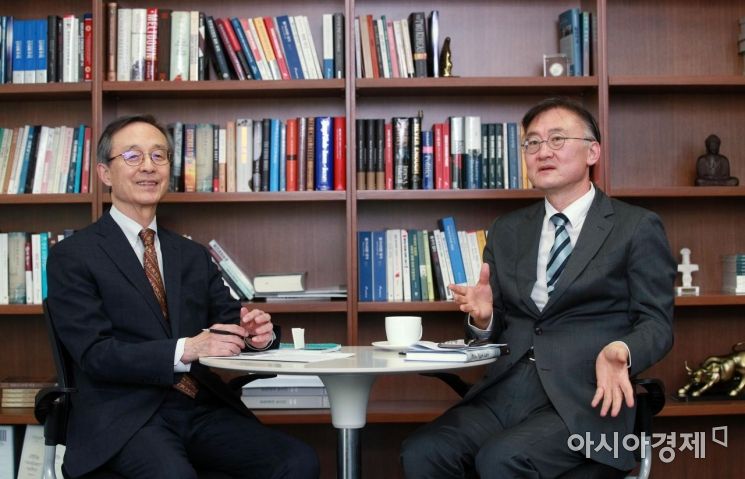 Han Seung-joo, Chairman of the Asan Institute for Policy Studies (left), and Hwang Jae-ho, Professor at Hankuk University of Foreign Studies. Photo by Hyunmin Kim kimhyun81@
Regarding the attitude Korea should take toward China, its largest trading partner and the key to resolving the North Korean nuclear issue, Han advised, "China often uses the expression ‘teaching lessons’ to neighboring countries, but it should be made clear that such policies are not always effective," and added, "Even when making concessions, it is important to do so with dignity." However, he also expressed caution about participating in the Quad, saying, "The Quad (Quadrilateral Security Dialogue) could provoke China more than THAAD." The Quad is an informal security forum involving the U.S., India, Australia, and Japan, regarded as part of the U.S. strategy to contain China.
Han offered a concrete forecast on the direction of the U.S.-China power struggle based on his past diplomatic experience. Tony Blinken, U.S. Secretary of State, and Yang Jiechi, a member of the Communist Party’s Political Bureau responsible for foreign affairs, who attended the U.S.-China Alaska talks, are figures Han interacted with during his tenure as Ambassador to the U.S. Han said, "It was unexpected that Secretary Blinken, who was usually quiet and scholarly, responded strongly to Yang’s remarks at this meeting," and analyzed, "This can be understood as President Joe Biden’s effort to reinforce the perception of a ‘strong America,’ and from this perspective, the U.S. is likely to take a tougher stance in dealing with China."
© The Asia Business Daily(www.asiae.co.kr). All rights reserved.
![Clutching a Stolen Dior Bag, Saying "I Hate Being Poor but Real"... The Grotesque Con of a "Human Knockoff" [Slate]](https://cwcontent.asiae.co.kr/asiaresize/183/2026021902243444107_1771435474.jpg)

















