KCC Postpones Submission of Revised Mobile Subsidy Law Including Separate Disclosure System
Samsung and LG Exit Phone Business Removing Incentive to Increase Subsidies
Raising Additional Subsidy Rates Raises Concerns Over Small Store Competitiveness
Met with Opposition from Distribution Industry
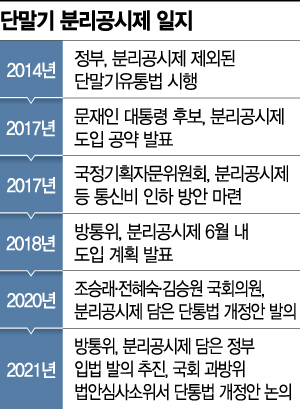
[Asia Economy Reporter Cha Min-young] The Korea Communications Commission (KCC) is pushing to include a separate disclosure system in the Act on the Improvement of the Distribution Structure of Mobile Devices (Device Distribution Act), but it has yet to make any progress due to the major variable of LG Electronics withdrawing from the smartphone market. As Samsung Electronics solidifies its dominant position, the fundamental purpose of the separate disclosure system?to induce competition among manufacturers through subsidies during the distribution process?is being shaken. The supplementary measure to raise the current 15% additional subsidy rate has also faced opposition from the mobile telecommunications distribution industry, which fears weakening the competitiveness of small stores.
KCC’s Full Commission Meeting Postponed Again
According to the KCC and the mobile telecommunications industry on the 12th, the submission of the KCC’s amendment to the Device Distribution Act to the full commission meeting, which was expected in mid-month, has been postponed again. Although the possibility of submitting the amendment to the full meeting has been reviewed several times since the end of last month, as mentioned in the KCC’s annual report, it is believed that disagreements between the relevant ministries and the industry have not been resolved.
The KCC’s legislative proposal must go through collecting opinions from related agencies, internal full commission approval, review by the Regulatory Reform Committee and the Ministry of Government Legislation, and submission to the Cabinet meeting. This process typically takes 5 to 7 months. A KCC official explained, "The timing set for March was calculated backward considering the time required for the legislative process."
The core content is the separate disclosure system that divides manufacturer subsidies and carrier subsidies. Currently, manufacturer and carrier subsidies are combined without disclosure and divided into carrier distribution network incentives and customer support funds. The aim is to disclose individual subsidies to induce competition among manufacturers. KCC Chairman Han Sang-hyuk also expressed his intention to introduce the separate disclosure system earlier this year at the National Assembly, stating that "introducing a separate disclosure system for devices is appropriate."
One of the key points of the amendment is the plan to raise the additional subsidy rate as a supplementary measure. This would allow distribution networks to voluntarily increase the subsidies given to customers to attract subscribers from the incentives paid by carriers and manufacturers. The plan to raise the current maximum 15% of the publicly disclosed subsidy to up to 30% is being strongly considered.
Legislative Effectiveness Diminished Amid Samsung’s Dominance
The problem lies in the shaken legislative effectiveness of the separate disclosure system. With LG Electronics’ decision to withdraw from the smartphone business on the 5th, Samsung Electronics no longer has an incentive to increase subsidies. There is also a possibility that manufacturer subsidies may disappear altogether. Apple, a competitor, is known to have never provided manufacturer subsidies from the start. If Samsung’s subsidies are exposed, it could lead to the disclosure of device prices, raising concerns about trade secret violations.
The plan to raise the additional subsidy rate from the current 15% has also drawn criticism from mobile phone retailers and agencies. They argue that this will only strengthen the competitiveness of large-scale distribution stores and accelerate the decline of small stores. The ‘rich get richer, poor get poorer’ phenomenon among online stores and large hub stores is also a concern raised in the National Assembly.
Since January, as rumors of LG Electronics’ smartphone withdrawal became more concrete, discussions on the Device Distribution Act have lost momentum in the National Assembly. The legislative bills proposed by lawmakers Cho Seung-rae, Kim Seung-won, Jeon Hye-sook, and Yoon Young-chan were discussed at the Information and Communications Broadcasting Law Review Subcommittee of the National Assembly’s Science, ICT, Broadcasting and Communications Committee on the 23rd of last month but the final decision was postponed. Lawmakers in favor of the separate disclosure system argue that competition should be revitalized through improvements rather than extreme measures such as abolishing the Device Distribution Act, while opponents counter with claims that the act is ineffective.
An industry insider said, "As manufacturers’ device prices rise, efforts are being made not to lower the retail price itself but to implement pricing policies within the distribution network, which seems to be causing various side effects," adding, "It is questionable how effective the separate disclosure system and the additional subsidy rate plan will be as measures for customers."
© The Asia Business Daily(www.asiae.co.kr). All rights reserved.
![Clutching a Stolen Dior Bag, Saying "I Hate Being Poor but Real"... The Grotesque Con of a "Human Knockoff" [Slate]](https://cwcontent.asiae.co.kr/asiaresize/183/2026021902243444107_1771435474.jpg)
















