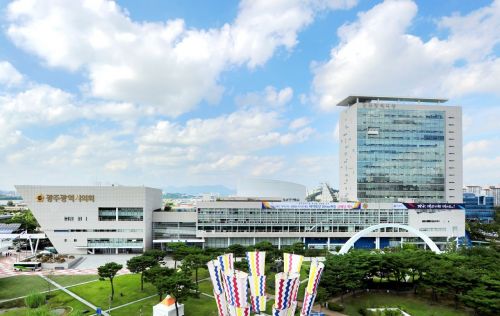
[Asia Economy Honam Reporting Headquarters, Reporter Park Seon-gang] Gwangju Metropolitan City announced on the 11th that it will invest 265.9 billion KRW this year to promote projects such as building air industry infrastructure, reducing fine dust, establishing a resource circulation system, creating a green city, managing clean water quality, and eco-friendly sewage management.
By sector, the projects include ▲32 projects in environmental urban infrastructure and natural environment conservation with a budget of 12.4 billion KRW ▲34 air quality improvement projects with 56.7 billion KRW ▲59 projects for waste reduction and resource circulation system establishment with 41.4 billion KRW ▲72 urban green space expansion projects with 87.6 billion KRW ▲32 healthy water environment creation projects with 49.8 billion KRW ▲12 eco-friendly sewage management projects with 6.6 billion KRW.
First, aiming for a carbon-neutral society by 2045, the city will accelerate the creation of a green advanced city, Gwangju, by presenting comprehensive plans and directions for the future in various fields such as the comprehensive climate change response plan, basic fine dust reduction plan, resource circulation implementation plan, park and green space comprehensive plan, water demand management and river project comprehensive plan, and basic sewage maintenance plan.
In the environmental urban infrastructure and natural environment conservation sector, the Bitgreen Industrial Complex Clean Air Industry Cluster, which was successfully attracted last year, will begin construction this year and be developed into an innovation technology development and demonstration complex for fine dust response related to the air industry by next year.
Jangnok Wetland, designated as a national wetland protection area last December, will have a conservation plan established with citizen participation, and simultaneously, an urban ecological corridor restoration project connecting Jangnok Wetland, Eodeungsan, and Bokryongsan will be carried out.
Additionally, the Pyeongchon Village Nuri-gil will be created within this year, and support will be provided for operating ecological tourism programs to establish a foundation for revitalizing ecological tourism utilizing ecological resources and cultural assets.
In the air quality improvement sector, projects will be implemented to support citizens in practicing carbon neutrality, including reducing emissions from 9,010 diesel vehicles in operation, supporting the installation of about 7,500 low-NOx boilers for households, converting 142 children's school vehicles to LPG, and distributing 1,238 electric vehicles.
In the resource circulation sector, to ensure stable household waste disposal, the construction of a metropolitan sanitary landfill will be expedited in phases, and public sorting facilities such as metropolitan household resource recovery centers will be expanded.
Furthermore, for apartment complexes jointly charging food waste fees, support will be provided for household-based volume-based waste fee systems (RFID), and installation of food waste reducers will be supported in apartment complexes and social welfare facilities to help reduce food waste.
In the green space expansion sector, large-scale green spaces will be created, including urban parks that serve as healing spaces for Gwangju citizens, the Gwangju Ecological Cultural Village, a tourist attraction linked with traditional culture, and the establishment of a municipal arboretum to expand forest welfare infrastructure.
At the same time, small-scale green spaces such as increasing green areas by utilizing leftover land and green paths to improve the walking environment will be implemented to make Gwangju full of greenery.
In the water and sewage management sectors, the citizen-participatory Gwangju Stream maintenance project will be linked with the Gwangju Stream Arirang Cultural Waterway creation project to be carried out smoothly, while simultaneously renovating aging sewage pipelines and improving odor prevention facilities at sewage treatment plants to minimize citizen inconvenience.
In addition, environmental policies that generate synergy when working with citizens will be promoted through projects such as green product distribution promotion, green lifestyle practice activation, low-carbon green apartment creation, and operation of the carbon point system, encouraging active citizen participation and practice expansion.
A climate environment platform will also be established to provide educational opportunities covering everything from theory to practice for citizens to realize carbon neutrality.
Park Nam-ju, Director of the Environmental Ecology Bureau of the city, said, “Major projects such as building clean air industry infrastructure, creating the Arirang cultural waterway, establishing a municipal arboretum, and constructing the UNESCO Global Geopark East Asia platform are underway,” adding, “While ensuring smooth progress of these projects, we will also discover and promote new projects so that all citizens can enjoy a healthy environment and a happy life.”
© The Asia Business Daily(www.asiae.co.kr). All rights reserved.
![Clutching a Stolen Dior Bag, Saying "I Hate Being Poor but Real"... The Grotesque Con of a "Human Knockoff" [Slate]](https://cwcontent.asiae.co.kr/asiaresize/183/2026021902243444107_1771435474.jpg)











