[Asia Economy Reporter Suyeon Woo] South Korea's economic policy instability was found to be the second highest among 20 major countries. The uncertainty of South Korea's economic policy was significantly higher than that of Brazil, which experienced presidential impeachment, or Ireland, which faced turmoil due to Brexit.
On the 12th, the Korea Economic Research Institute measured economic policy instability based on the economic policy uncertainty index of 20 major countries from 2016 to 2020. South Korea ranked second highest in instability among the 20 countries, following the United Kingdom.
The United Kingdom was identified as the country with the highest economic policy instability from 2016 to January 2020 due to Brexit negotiations. South Korea, ranked second, has seen increasing instability since 2006, which has negatively affected not only economic growth but also corporate investment plans and stock prices.
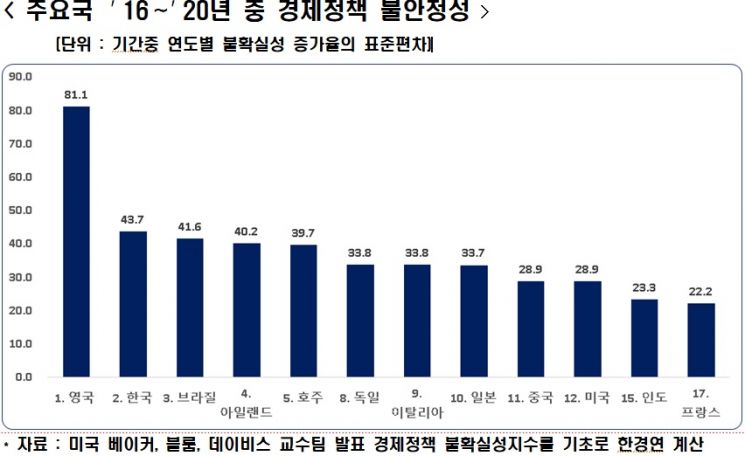
According to the analysis, the top four countries with high economic instability are the United Kingdom, South Korea, Brazil, and Ireland, in that order. The UK and Ireland experienced Brexit negotiations, while Brazil faced political and social turmoil due to the impeachment of President Jos? and the outbreak of COVID-19.
In particular, South Korea's economic policy instability value was 43.7, higher than major competitors such as Germany (33.8), Japan (33.7), China (28.9), and the United States (28.9), and about twice that of France (22.2). Additionally, when measuring economic policy instability in five-year intervals from 2006 to 2020, South Korea and Spain were the only two countries among the 20 whose economic policy instability continuously increased.
When economic policy is unstable, stock price growth rates and economic growth rates slow down, and the growth rate of facility investment also decreases. An empirical analysis of the impact of economic policy instability on stock prices, growth, and investment showed that a 10% increase in economic policy instability results in a 1.6% decrease in stock prices, a 0.1% decrease in GDP, and a 0.3% decrease in facility investment.
The Korea Economic Research Institute pointed out that if economic policy lacks consistency and is difficult to predict, economic agents such as companies and households find it challenging to rationally carry out important economic activities like investment. It cited the holding company system, real estate system, and nuclear power policy?areas where the government has repeatedly changed its stance?as representative examples of inconsistent economic policies.
Choo Kwang-ho, head of the Economic Policy Office at the Korea Economic Research Institute, said, "If economic policies change frequently, it becomes difficult for economic agents, including companies, to properly plan and execute activities that require a long-term perspective, such as investments. Maintaining consistency and increasing predictability in economic policy will enhance economic efficiency."
© The Asia Business Daily(www.asiae.co.kr). All rights reserved.
![Clutching a Stolen Dior Bag, Saying "I Hate Being Poor but Real"... The Grotesque Con of a "Human Knockoff" [Slate]](https://cwcontent.asiae.co.kr/asiaresize/183/2026021902243444107_1771435474.jpg)
















