Statistics Korea 2020 Annual Household Expenditure Survey Results
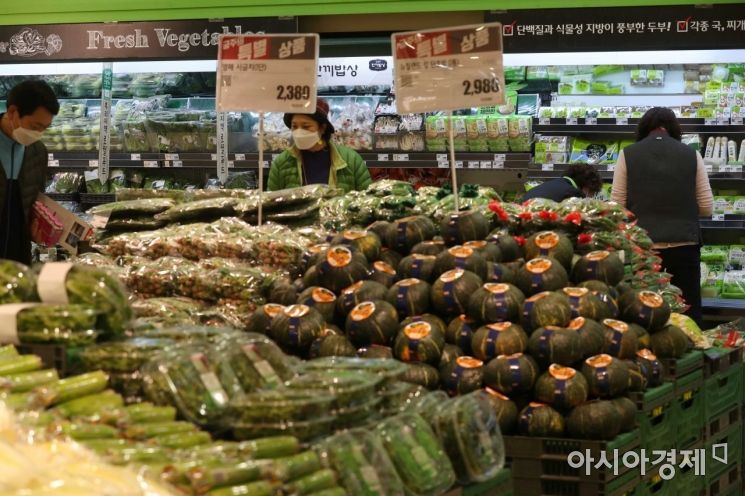 On the 21st, citizens are selecting vegetables at Lotte Mart Seoul Station branch, where a special exhibition for price-stabilized vegetables is being held. Photo by Moon Honam munonam@
[Sejong=Asia Economy Reporter Kim Hyunjung] It was revealed that last year, the expenditure scale of the lowest-income households earning less than 1 million won per month reached an average of 900,000 won. The increase in consumption is largely due to the rise in prices of food and other items with a high expenditure ratio.
According to the '2020 Annual Household Expenditure Trend Survey Results' by Statistics Korea on the 11th, the average monthly consumption expenditure of households nationwide last year was 2.4 million won, a 2.3% decrease from the previous year.
By income bracket, the lowest-income households earning less than 1 million won per month accounted for 9.43% of all households, roughly 1 in 10 households, and their expenditure was 900,000 won, a 3.0% increase from the previous year. They spent almost all the money they earned. Among all income brackets, only households earning less than 1 million won per month increased their consumption expenditure compared to 2019. This is interpreted as due to a higher proportion of essential consumption such as food and non-alcoholic beverages compared to other income groups. The amount spent on food and non-alcoholic beverages, which accounts for 23.4% of total consumption, was 211,000 won, a 17.1% increase from the previous year. Expenditure on housing, water, and utilities (179,000 won) also accounted for 19.9% of the total.
Households earning between 1 million and 2 million won per month, accounting for 14.53% of all households, consumed 1.264 million won, a 1.8% decrease from the previous year. Of their expenditure, 20.7% was spent on food and non-alcoholic beverages (261,000 won), and expenditure on housing, water, and utilities increased by 4.3% from the previous year to 248,000 won.
Households earning 7 million won per month, accounting for 16.71% of all households, consumed an average of 4.338 million won per month, a 3.2% decrease from the previous year. Among the consumption items of the top income group, transportation expenditure was 659,000 won, accounting for 15.2% of total consumption. This is analyzed as an increase in spending on automobile purchases due to government policies such as the reduction of individual consumption tax on cars. The effect of consumption shifting to transportation due to reduced outings from social distancing also included decreases in entertainment and culture (-35.1%) and education (-22.5%). Consumption of food and non-alcoholic beverages surged by 18.3% to 570,000 won, but its share of total consumption was only 13.1%.
By income quintile, the lowest 20% income group (1st quintile) consumed an average of 1.058 million won per month, a 3.3% increase from the previous year, while the highest 20% income group (5th quintile) spent 4.21 million won per month, 0.3% less than the previous year. However, this consumption polarization also reflects differences in household characteristics by quintile. The 1st quintile had an average household size of 1.44 persons and a household head age of 62.3 years, which is high, whereas the 5th quintile had an average household size of 3.35 persons and a household head age of 50.2 years.
© The Asia Business Daily(www.asiae.co.kr). All rights reserved.

















