Seoul Apartment Prices Stabilize but Rise in Areas Dense with Reconstruction Complexes
Gangnam 3 Districts, Nowon-gu, Yangcheon-gu Among Top Growth Rates
Increased Expectations for Oh Se-hoon’s Election Due to 'Deregulation' Before Seoul Mayor Vote
However, Rising Prices May Hinder Reconstruction Deregulation Efforts
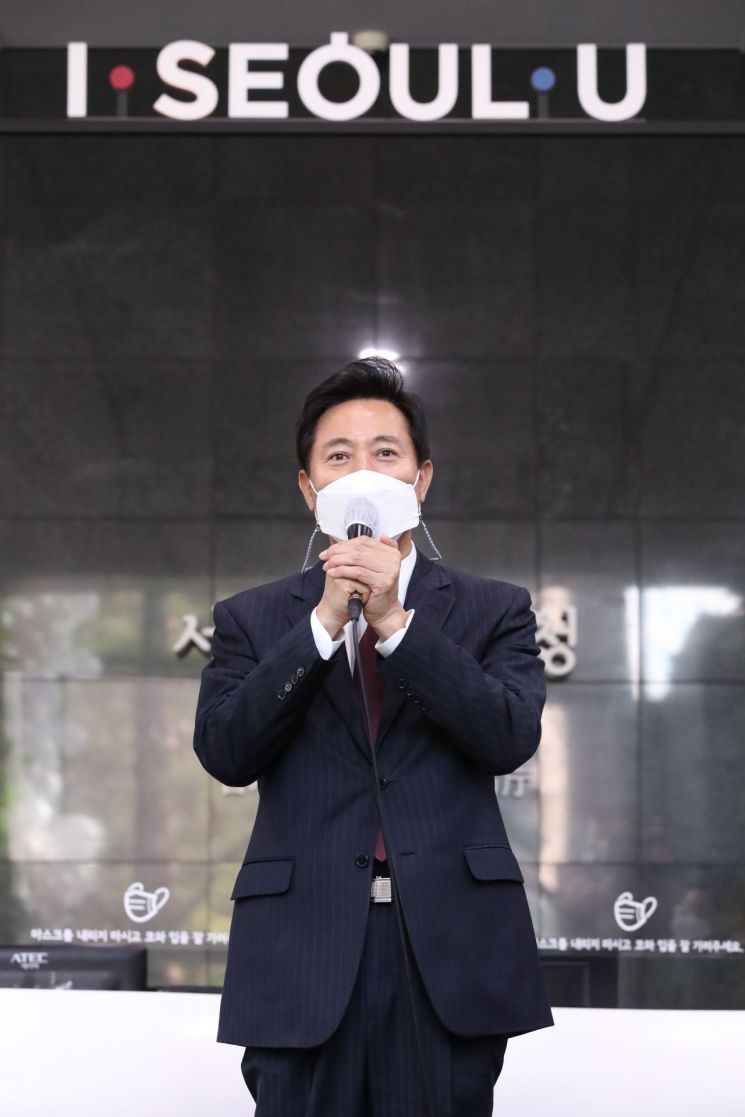
[Asia Economy Reporter Lim On-yu] Although Seoul apartment prices have entered a stabilization phase, the rise in areas densely populated with reconstruction complexes has become prominent following the election of Seoul Mayor Oh Se-hoon. Concerns that Mayor Oh's pledge to "lift regulations within a week" would stimulate housing prices have materialized. There are indications that housing price increases could become a variable in Mayor Oh's regulatory easing efforts.
According to the Korea Real Estate Board on the 11th, Seoul's weekly apartment sale prices rose by 0.05% in the first week of April (based on the survey on the 5th), maintaining the same rate of increase as the previous week. Since the first week of February this year (0.10%), Seoul apartment prices have been steadily reducing their rate of increase, creating a calming atmosphere.
However, the rate of increase grew mainly in areas with many reconstruction complexes. Songpa-gu showed the highest increase, rising from 0.09% last week to 0.1% this week. Gangnam-gu and Seocho-gu (0.08%), Nowon-gu (0.09%), and Yangcheon-gu (0.07%) also ranked high in terms of growth rate.
In Gangnam-gu, prices rose mainly in the Apgujeong and Gaepo-dong reconstruction complexes, while in Seocho-gu, the increase was centered on the Bangbae and Jamwon-dong reconstruction complexes. Songpa-gu continued its strong trend centered on reconstruction apartments in Jamsil and Bangi-dong. In Nowon-gu, buying demand continued in the reconstruction complexes of Sanggye-dong and Wolgye-dong, and despite the recent final rejection of the Mokdong New Town 11 complex in Yangcheon-gu in the safety inspection, expectations of regulatory easing kept the housing price rise from slowing.
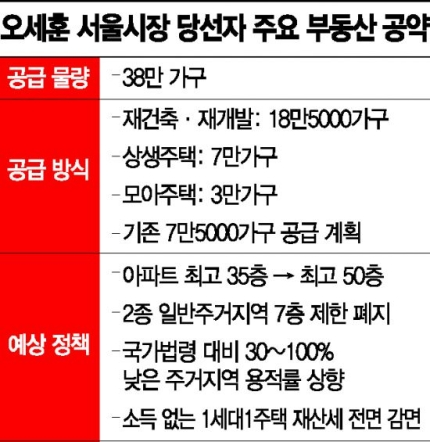
This upward trend is interpreted as being based on expectations of Mayor Oh's election before the April 7 Seoul mayoral election. Mayor Oh promised to ease reconstruction and redevelopment regulations, including lifting the maximum apartment height restriction of 35 floors, abolishing the 7-floor limit in Type 2 general residential areas, and increasing floor area ratios in residential areas that are 30-100% lower than national laws.
A Korea Real Estate Board official said, "During the election process, expectations grew that regulations such as the 35-floor limit along the Han River would be eased, leading to buying movements centered on reconstruction complexes. However, this atmosphere has not spread to existing complexes."
With the election now a reality, concerns are raised that if Mayor Oh strongly drives regulatory easing on reconstruction, it could inadvertently stimulate Seoul housing prices. Rapid housing price increases could negatively affect not only the mayor's re-election but also his 2022 presidential bid. This is a point where policy dilemmas may arise between the regulatory easing demanded by the market and housing prices.
It is also uncertain whether smooth policy cooperation will be achieved with the city council, which is effectively controlled by the ruling party, as well as the government. Easing floor area ratios and abolishing the 7-floor limit in Type 2 general residential areas require amendments to ordinances, which are difficult to relax without the city council's cooperation. If there is confrontation with the government, which is pushing for public-led redevelopment and reconstruction, supply itself?whether private or public?could be shaken.
However, since both Mayor Oh and the government seek to avoid confrontation, there is also a prospect that they will find a compromise rather than outright exclusion.
During his candidacy, Mayor Oh expressed willingness to engage in dialogue, saying, "I understand that city councilors and district councilors also need to supply housing," and "I will narrow differences through frequent conversations." Deputy Prime Minister and Minister of Strategy and Finance Hong Nam-ki also stated at the real estate market inspection meeting on the same day, "The goal of stabilizing housing for ordinary citizens through expanded housing supply will never differ," adding, "Housing supply cannot be done solely by the central government, metropolitan governments, or local governments due to administrative procedures. Mutual cooperation must be supported."
© The Asia Business Daily(www.asiae.co.kr). All rights reserved.
![Clutching a Stolen Dior Bag, Saying "I Hate Being Poor but Real"... The Grotesque Con of a "Human Knockoff" [Slate]](https://cwcontent.asiae.co.kr/asiaresize/183/2026021902243444107_1771435474.jpg)












