[Asia Economy Reporter Su-yeon Woo] As carbon regulations are expected to determine the future manufacturing competitiveness of countries, there are urgent calls for efforts by the government and industry to respond to the carbon neutrality paradigm and compete for leadership in related industries.
The Korea International Trade Association's International Trade and Commerce Research Institute released a report on the 12th titled "Major Countries' Carbon Neutrality Policies and Implications: The Landscape of Manufacturing Competitiveness is Changing," explaining that advanced countries accelerating investments in renewable energy are utilizing cheap renewable energy as a means to enhance competitiveness, causing structural changes in global manufacturing competitiveness.
According to the report, carbon emissions generated during the battery manufacturing process are on average 20% higher in Asia compared to the US or Europe. This is mainly because electricity produced from coal power is used. The report analyzed that if life-cycle carbon regulations are introduced for electric vehicles, a future core industry centered in advanced countries such as Europe, pressure will increase to shift battery supply chains to advanced countries producing electricity based on renewable energy.
The report stated, "As carbon regulations rapidly spread among major countries, advanced countries are enhancing manufacturing competitiveness by utilizing cheap renewable energy," and analyzed, "On the other hand, Korea's manufacturing electricity usage ratio is large at 48%, and renewable energy electricity prices are expensive, so a decline in manufacturing competitiveness is expected when transitioning to a carbon-neutral system."
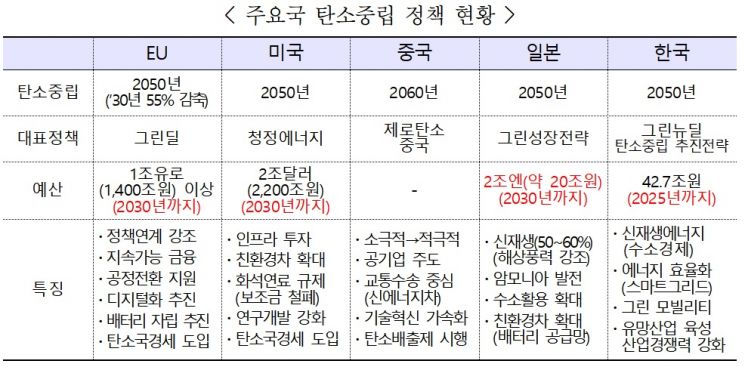
The introduction of carbon border taxes, the 'RE100' campaign to convert 100% of electricity usage to renewable energy, and corporate Environmental, Social, and Governance (ESG) management practices are also weakening the competitiveness of Asia's manufacturing powerhouses. This is because global companies' declarations of carbon neutrality are demanding carbon neutrality from Asian partner companies within the global supply chain.
The report pointed out, "To enhance manufacturing competitiveness, the government must create an institutional foundation that allows manufacturing companies to gradually realize the decarbonization of power sources by expanding investments in renewable energy and enabling them to purchase electricity from renewable energy power producers (third-party PPA) or purchase Renewable Energy Certificates (REC)."
It continued, "Along with renewable power generation, urgent expansion of investments in power infrastructure and decarbonization and low-carbon technologies is needed to utilize it efficiently," emphasizing, "To complement the intermittency of renewable energy, infrastructure capable of supplying affordable green hydrogen must be established, and research and development (R&D) of eco-friendly technologies should be actively supported at the government-wide level."
Jeong Gui-il, a research fellow at the Strategic Market Research Office, said, "Major countries recognize low-carbon and eco-friendly sectors as new growth engines and are striving to secure first-mover advantages," adding, "Our companies must also check the life-cycle carbon emissions of their products and prepare measures to reduce greenhouse gases, making every effort to turn this crisis into an opportunity."
© The Asia Business Daily(www.asiae.co.kr). All rights reserved.

















