Presidential Economic Advisory Body 'National Economic Advisory Council'
Vice Chairman Lee Geun, Interview Since January 2021 Inauguration
 Lee Geun, Vice Chairman of the National Economic Advisory Council, is being interviewed on the 1st at the office of the National Economic Advisory Council in Jongno-gu, Seoul. Photo by Kang Jin-hyung aymsdream@
[Interview = Asia Economy Chief Economic Correspondent Choi Il-gwon, Summary = Reporter Kim Eun-byeol]
Lee Geun, Vice Chairman of the National Economic Advisory Council (NEAC), a presidential advisory body, evaluated the Korean economy as being "close to the welfare state trap." He expressed concern that South Korea, having escaped the middle-income trap after rapid growth, could face stagnation in growth rates even in its status as an ‘advanced developing country’ rather than a developing country. To avoid falling into this trap, he advised that spending should focus more on strengthening social services rather than cash-based welfare.
Although Vice Chairman Lee’s remarks were made before the April 7 by-elections, they have gained attention following the ruling party’s defeat. The Moon Jae-in administration aimed to apply a Nordic-style welfare model in Korea from the early days of its term, but actual welfare tended to focus on cash-based support. Especially due to the COVID-19 pandemic, expenditures on cash welfare increased sharply. His comments emphasize the need to shift economic policy during the remaining term.
In an exclusive interview with Asia Economy on the 1st, Vice Chairman Lee stated, "Europe realized that cash-based welfare led to the ‘welfare state disease’ and shifted direction toward job creation through expanding social services." He added that the priority for the remaining year of the current administration is to "set the agenda for ‘harmonizing growth and welfare’ and establish a conceptual framework for what form welfare should take." This is the first time since his appointment in January that Vice Chairman Lee has given an interview to the media.
Classified as a leading figure of the new Schumpeterian school in Korea, Vice Chairman Lee advocates prioritizing job creation over cash support not only in innovation-driven growth but also in welfare. He emphasized, "Rather than handing out cash, building various social service networks such as childbirth, childcare, and education, and creating jobs through these is one solution to welfare." Increasing jobs leads to higher productivity and contributes to economic growth. He particularly stressed the need for increased female labor participation. He insisted, "Social safety nets should be provided not in cash but through social services like childcare and nursing so that women can work."
Moon administration needs to publicize harmony between growth and welfare during remaining term
Spend money on expanding social services rather than cash welfare
Time to consider efficient spending
He also revealed economic agendas expected at the upcoming G7 summit in June. South Korea has been invited by the UK, the G7 chair this year. Vice Chairman Lee will attend the expert meeting next month as Korea’s representative among the panelists preparing the summit agenda. He said, "The core agenda of this G7 is to establish a transparent international economic system based on rules, free from arbitrary influence or actions by the US and China." The intention is to create rules and minimize diplomatic and economic impacts to avoid the worst-case scenario of having to choose sides between the US and China. Vice Chairman Lee emphasized, "The G7 aims to restore multilateral free trade."
The tasks for the remaining year of the Moon administration include ▲setting and publicizing the agenda for virtuous cycle between growth and welfare ▲checking excessive Anglo-American shareholder capitalism ▲reshoring and establishing an efficient global value chain (GVC) ▲and short- and long-term industrial innovation.
The following is a Q&A with Vice Chairman Lee.
"Korea has escaped the middle-income trap but is close to the welfare state trap"
-You led the International Schumpeter Society (ISS) for two years.
△John Maynard Keynes and Joseph Schumpeter are the two towering figures of 20th-century economics. Keynes mainly advocated short-term macro fiscal policies to boost demand, while Schumpeter emphasized long-term economic growth through supply-side technological innovation that creates new markets and jobs. The long-term solution is to find breakthroughs through innovation. The Schumpeterian school does not only emphasize innovation but proposes a model of creating jobs and providing efficient workfare. Europe initially adopted Keynesian welfare states but realized they fell into welfare state disease and the advanced developing country trap, then shifted toward Schumpeterian approaches.
-Do you mean spending money on creating social services rather than cash?
△Yes. Korea is transitioning from a developmental state to a welfare state but risks falling into the welfare state trap, also called the ‘advanced developing country trap.’ Purchasing power parity (PPP)-based GDP per capita has stagnated at about 70% of the US level. Korea’s labor shortage problem can be solved by increasing female labor force participation. The state must provide a system that ‘raises children’ so women can work. Europe also saw increased female employment participation as the state provided social services. According to the OECD, as of 2019, Korea’s female labor force participation rate was 60.0%, about 20 percentage points lower than Sweden (81.1%), Switzerland (80.2%), New Zealand (76.8%), the Netherlands (76.7%), and Denmark (76.0%). Improving this area is the most urgent need in Korea.
-You have advocated following the Nordic model for years, but it seems to be struggling.
△There has been an overemphasis on cash welfare, which has not worked properly. Cash welfare spends money but does not create quality jobs and tends to reduce work motivation. Public jobs are necessary, but the priority should be to have a blueprint for moving toward social services and consider the direction accordingly.
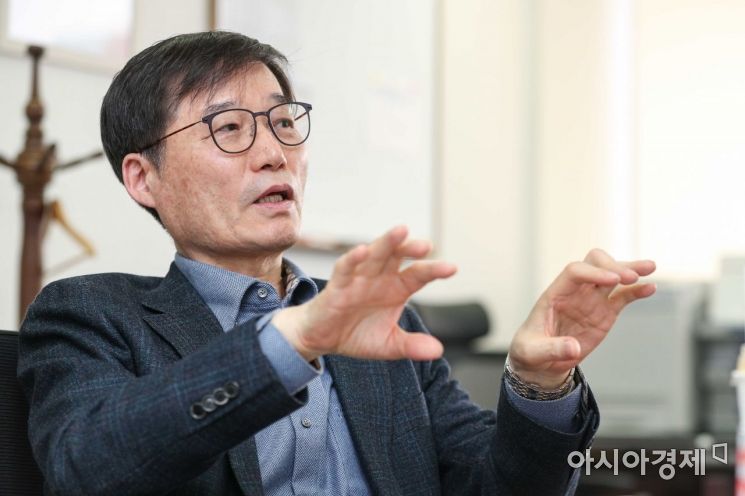 Lee Geun, Vice Chairman of the National Economic Advisory Council, is being interviewed on the 1st at the office of the National Economic Advisory Council in Jongno-gu, Seoul. Photo by Kang Jin-hyung aymsdream@
"G7 aims for a rules-based world order free from US-China influence"
-The global economy has problems after COVID-19, too.
△Externally, it is important that the ‘G2 (US-China)’ hegemony struggle does not cause collateral damage to smaller players. In this regard, at the June G7 meeting, 11 countries (G7 plus South Korea, Australia, India, South Africa) will submit a proposal report on ‘economic resilience.’ The last expert panel meeting before the summit will be held next month, and I will attend as Korea’s representative.
-Are the 11 countries discussing a ‘new GVC’ after COVID-19?
△Yes. After COVID-19, countries have pursued reshoring policies and created an atmosphere of producing products domestically even at a loss to reduce overseas production risks. With the US-China hegemony struggle, countries have been swayed by arbitrary influence or actions of major powers. The four countries invited by the UK besides the G7 all share the experience of economic damage from the US-China conflict. The message is to ask that economic issues not be politicized regardless of whether it is the US or China. The core agenda is the need for transparent international rules free from arbitrary actions by major powers. This corresponds to the last of the G7’s four areas (health, climate change, democracy, new international economic order).
Declare values Korea pursues and align diplomatic and economic policies
EU’s values of democracy, human rights, and free trade align well with Korea
G7 core agenda ‘transparent international economy’... policies to avoid collateral damage in great power conflicts
-Given Korea’s unique situation, might it be in an ambiguous position between the US and China?
△We have basically separated politics and economy, following the principle of ‘economic ties with China, security with the US,’ but this separation became difficult after the THAAD incident. This time, Korea and countries in similar positions want to raise their voices together to separate economic and political issues. If this declaration succeeds, Korea’s burden will be eased. In the process of creating a resilient yet efficient GVC after COVID-19, Korea’s partner is the European Union (EU). This is why Korea needs the New Southern Policy, New Northern Policy, and additionally a New Western Policy. The EU, which used to follow the US as ‘big brother,’ recently declared an independent path based on values of ‘democracy, human rights, and free trade.’ These values align best with Korea. It is not about choosing the US or China but declaring the values Korea pursues and basing diplomatic and economic policies on them to avoid collateral damage in great power conflicts. This is the policy to survive among major powers. We have shared these values with the Blue House and Ministry of Foreign Affairs.
"Discussing Innovation Growth 2.0... Korean capitalism should shift from Anglo-American to Nordic model"
-What special requests did President Moon make after your appointment as vice chairman?
△We discussed Innovation Growth 2.0. In the past, the government developed technology and supplied it to the private sector, but now the private sector’s level is high, so we talked about changing innovation policy to a ‘demand-oriented industrial policy,’ including public procurement. The government would purchase innovative products from companies with high technology but lacking initial demand. Innovation Growth 1.0 was a ‘manufacturing renaissance’ (manufacturing-centered, expanding smart factories), but after COVID-19, the importance of digital platforms has increased. When Korea became an IT powerhouse during ‘Digital Society 1.0,’ high-speed internet infrastructure played a major role, but now that alone is insufficient; digitalization is needed in education, health, and labor markets.
-What have you proposed to the president through the advisory council?
△After my appointment, I presented at the plenary meeting that ‘Korean capitalism should shift from Anglo-American to Nordic capitalism.’ Korean capitalism overcame the middle-income trap in the mid-1980s through innovation-driven catch-up capitalism, and after the financial crisis, it grew as a mixed capitalism (East Asian + Anglo-American), but recently growth rate, employment rate, and distribution have all worsened, resembling Anglo-American capitalism. In the worst case, corporate investment may decline, and foreign-centered shareholder capitalism may dominate. Financial asset ownership polarization worsens distribution, and domestic industry and employment effects may decrease. If left unchecked, it will inevitably become ‘bad capitalism.’
-What means exist to benchmark Nordic capitalism?
△Granting dual-class voting rights upon venture company listings and allocating shareholder voting rights proportional to holding periods. Giving voting rights based on founders and holding periods can provide effective voting rights to capital that enhances long-term corporate value rather than short-term investment.
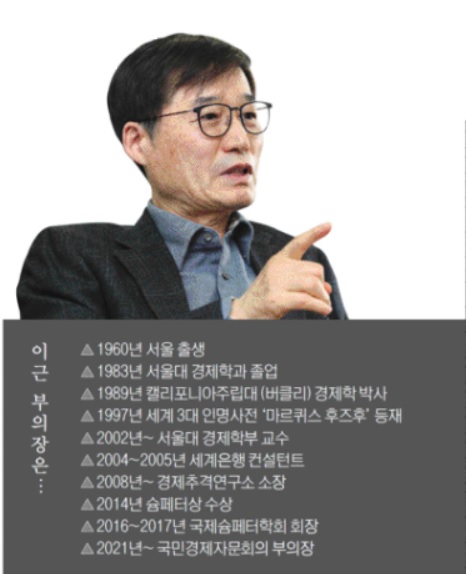
Vice Chairman Lee Geun... ‘Futurist Teacher’ who laid the foundation for the Digital New Deal
He is confident that the digital society will eventually spread to all sectors. He said, "Digital Society 1.0 was centered on high-speed internet infrastructure, and 2.0 is the expansion phase of digital infrastructure. If remote education and medical services through digital systems had been implemented earlier, the impact of COVID-19 would have been less severe." When asked if there will be a 3.0 phase, Vice Chairman Lee replied, "We have started a project on Korea’s future economic development strategy," adding, "We will prepare ideas for the next government by the end of this year, covering the harmony of growth and welfare, Korean companies’ re-growth strategies, and environmental changes."
In the economics community, there was considerable surprise at his appointment as vice chairman because of his moderate political stance. Although the current administration has about a year left, he was selected to set a long-term direction for the Korean economy. The NEAC is a constitutional body advising the president on economic policy, with the president serving as chairperson. Vice Chairman Lee is the de facto head of the council.
He views Korea’s strength as the coexistence of traditional large manufacturing companies and emerging digital platforms like Naver and Kakao, and believes Korea will gain opportunities as the global order reshapes after COVID-19.
However, he also pointed out weaknesses: "Dependence on the US and Japan for advanced technology and on China for markets is a vulnerability." He added, "Government policies have made it difficult for small and medium enterprises, deepening large conglomerate-led growth, along with asset market concentration and K-shaped recovery as weaknesses and threats." The government policies he referred to include the 52-hour workweek and rapid minimum wage increases.
© The Asia Business Daily(www.asiae.co.kr). All rights reserved.



















