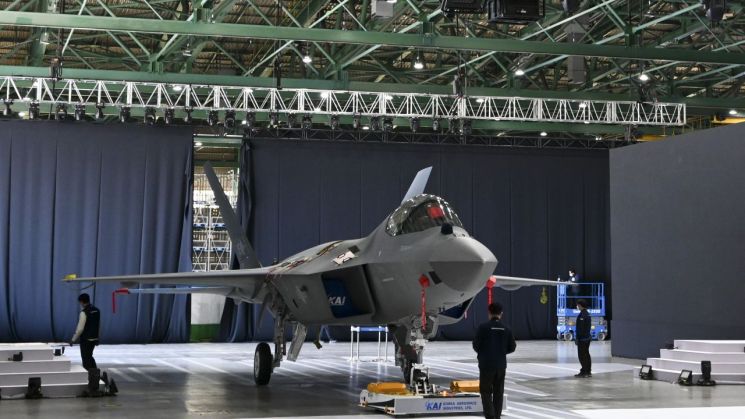
[Asia Economy Yang Nak-gyu, Military Specialist Reporter]The KF-21 (Boramae), the first domestically produced fighter jet, took 20 years from the announcement of its development to the first prototype being revealed to the public on the 9th.
The Korean Fighter eXperimental (KF-X) project effectively began in March 2001 when then-President Kim Dae-jung declared at the Air Force Academy graduation ceremony, "We will develop a domestically produced fighter jet by 2015."
In November 2002, the Joint Chiefs of Staff decided on a long-term new requirement to develop about 120 fighter jets slightly superior to the then-main Air Force fighter, the KF-16. This marked the official start of the KF-X project procedures.
In December 2015, the Defense Acquisition Program Administration (DAPA) signed the main system development contract with Korea Aerospace Industries (KAI) and began system development in January the following year. The system development (Block 1) from 2015 to 2026, jointly pursued with Indonesia, involves a budget of 8.1 trillion KRW, and the additional weapons testing (Block 2) conducted solely by Korea from 2026 to 2028 requires 700 billion KRW, bringing the total project scale to 8.8 trillion KRW. This makes the KF-X project the largest defense capability enhancement project since the founding of Korea.
By June 2018, requirements analysis and basic design were completed, followed by detailed design, and prototype production began in September 2019. Simultaneously, domestic development proceeded for the system integration technology related to four core components for which the U.S. refused technology transfer. The AESA radar and IRST, which correspond to the "eyes" of the KF-21, were developed domestically and prototypes were installed on the first prototype. The integrated electronic warfare suite (EW Suite), including the RF jammer, was also installed on the first prototype and underwent ground and flight testing. The EO TGP, which detects targets using optical imaging and radar and is an air-to-ground device, will be included in the Block 2 additional weapons testing for air-to-ground combat capability scheduled from July 2026 to 2028.
The KF-X’s exterior is a 4.5-generation fighter jet similar to the U.S. F-35A stealth fighter, which is considered 5th generation. It can be equipped with European Meteor air-to-air missiles, German Diehl’s air-to-air missiles (AIM-2000), and currently domestically developed long-range air-to-ground guided missiles.
With partial domestic production of the four core components?AESA radar, IRST, EW Suite, and EO TGP?and with Korean engineers leading the entire process from design to production, the completed KF-21 was unveiled for the first time on this day. However, the KF-21 is not yet ready to fly. After about a year of ground testing, its first flight is scheduled for around July next year.
The prototypes 1 through 6, which will be produced sequentially by the first half of next year, must complete a total of about 2,200 sorties (flight missions) over four years of flight testing. By June 2026, the system development of Block 1, which includes basic flight performance and air-to-air combat capability, will be completed. Subsequently, the initial Block 1 production will be completed and deployed by 2028. Unless another country beats Korea to it, Korea will become the 13th country in the world to develop a domestically produced fighter jet, but it will take at least another five years to reach that milestone.
© The Asia Business Daily(www.asiae.co.kr). All rights reserved.

















