Ministry of Environment to Cover 70% of Deficit from Fuel Purchase Costs
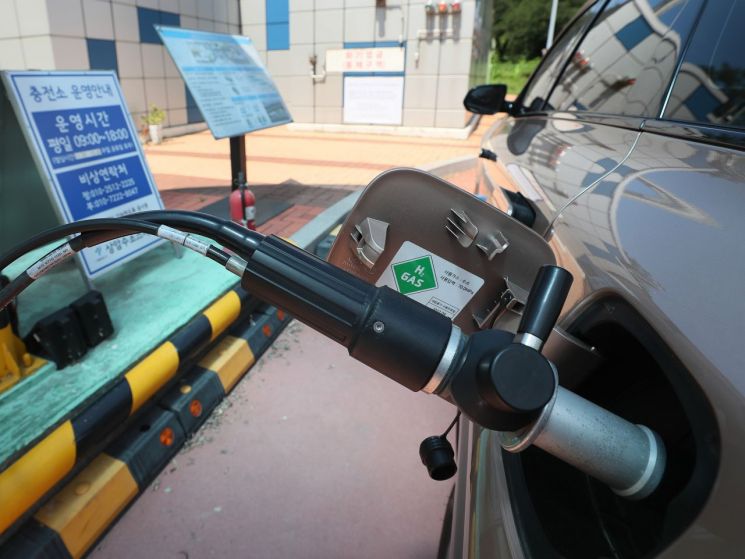
[Sejong=Asia Economy Reporter Joo Sang-don] Last year, 12 out of 19 hydrogen charging stations operated by small and medium-sized private companies failed to avoid deficits. The Ministry of Environment decided to compensate these underperforming stations with 1.4 billion KRW.
On the 9th, the Ministry of Environment announced that it will support 1.37 billion KRW for hydrogen fuel purchase costs to improve the operating conditions of the 12 deficit stations. This means that each station will receive an average of about 110 million KRW for hydrogen fuel purchase costs, marking the first time the government budget has been used to support fuel purchase costs.
The support targets are 19 hydrogen charging stations out of 34 that received completion inspection certificates by the end of 2019 and had operational performance in 2020, excluding 15 stations operated by large corporations, some public institutions, and research hydrogen charging stations. Among these, 3 stations that made a profit, 1 station with a small deficit that did not apply for support, and 3 stations where the hydrogen supplier also handles sales making it difficult to assess the operator’s profit and loss were excluded. The remaining 12 stations will receive fuel purchase cost support. These 12 stations are located in Gyeonggi, Busan, Daejeon, Gyeongnam, and Ulsan. Most stations operating in cities and provinces other than Seoul suffered deficits.
The 12 hydrogen charging stations receiving fuel purchase cost support recorded an average deficit of 183 million KRW last year. Their income was 307 million KRW, but expenses were higher at 490 million KRW. Hydrogen purchase costs and labor costs accounted for 87% of the expenses. Accordingly, the Ministry of Environment decided to support 3,443 KRW/kg, which is 70% of the amount excluding the break-even price of 1,859 KRW/kg from the average hydrogen purchase price of 6,777 KRW/kg. The Ministry of Environment, in consultation with the Ministry of Economy and Finance, has agreed to compensate 70% of the deficits of hydrogen charging stations for five years until 2025, including last year’s deficit.
With the Ministry of Environment’s decision to compensate hydrogen charging station deficits, the scale of support is expected to increase further. Previously, the number of hydrogen charging stations nationwide increased from 34 in 2019 to 60 in 2020, and to 69 as of March this year. The government plans to expand hydrogen charging stations to 310 by 2022 and over 1,200 by 2040. If the supply of hydrogen vehicles does not keep pace with the increase in hydrogen charging stations and regional imbalances continue, the number of deficit stations and related support are likely to continue growing.
© The Asia Business Daily(www.asiae.co.kr). All rights reserved.

















