AZ Vaccine Administration Restricted in Nearly 20 Countries
Suspended in 17 Countries Worldwide... Most in Europe
South Korea "Reviewing EMA Results for Announcement"
Possible Schedule Adjustments for Young Women
Considering Cross-Vaccination with Different Vaccines for 1st and 2nd Doses
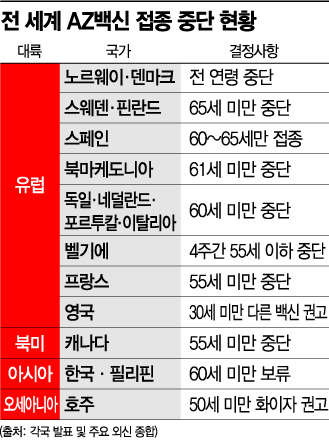
[Asia Economy reporters Hyun-ui Cho and Ji-hee Kim] Nearly 20 countries overseas have suspended AstraZeneca (AZ) vaccine inoculations. As controversies continue over blood clots occurring in younger age groups, countries are imposing age restrictions. The anxiety that emerged in Europe has spread to all continents including North America, Asia, Oceania, and Africa. South Korean health authorities are scheduled to decide on whether to resume AZ vaccine inoculations on the 11th.
On the 8th (local time), Portugal temporarily suspended AZ vaccine inoculations for those under 60. Gra?a Freitas, head of the health authority, said at a press conference, "The goal of vaccination is to save lives and prevent serious illness," adding, "This can also be achieved with other vaccines."
After the European Medicines Agency (EMA) announced the day before that there is a link between the AZ vaccine and blood clot occurrences, major countries including Portugal have successively restricted the vaccination age. The Philippines and Australia also announced on the same day a suspension of inoculations for those under 60 and a recommendation to stop for those under 50, respectively.
The number of countries suspending AZ vaccine inoculations has thus approached 20. By continent, Europe leads with 13 countries including Germany, the Netherlands, Portugal, Italy, Norway, Denmark, Sweden, Finland, Spain, North Macedonia, Belgium, France, and the United Kingdom. Asia has two countries, South Korea and the Philippines, while North America (Canada) and Oceania (Australia) each have one country.
Globally, there is a clear trend of avoiding the AZ vaccine, even leading to revisions in vaccination plans. Even countries struggling with vaccine supply are refusing the AZ vaccine. In Europe, where vaccine supplies are scarce, Sweden and Finland have suspended inoculations for all age groups.
Africa, often considered a 'vaccine blind spot,' urgently needs vaccines due to the spread of variant viruses originating from South Africa, but on this day, it withdrew plans to purchase the AZ vaccine. The AZ vaccine accounts for the majority of vaccines African countries receive through the international vaccine supply organization 'COVAX Facility,' led by the World Health Organization (WHO) and others.
The African Union (AU) health agency announced on this day, "We have changed the vaccine purchase plan to Johnson & Johnson (J&J) products." John Nkengasong, director of the Africa Centers for Disease Control and Prevention (CDC), explained, "The change was not due to the possible association of blood clots with the AZ vaccine. It was to avoid overlap with the COVAX program's purchase plans," but this still dealt another blow to AZ.
The South Korean government is deeply considering the AZ vaccine inoculation. While most experts argue for restricting or stopping vaccinations, authorities are rather leaning toward the possibility of resuming inoculations.
On the 8th, Kwon Deok-cheol, Minister of Health and Welfare, said, "EMA announced that the benefits of receiving the AZ vaccine outweigh not receiving it," adding, "This announcement is based on science." Minister Kwon added, "The Ministry of Food and Drug Safety and the Korea Disease Control and Prevention Agency are consulting various experts and reviewing EMA results, so I think inoculations will resume."
This statement appears to be largely influenced by the high domestic dependence on the AZ vaccine. If AZ vaccine inoculations are immediately suspended or reduced, there is a significant shortage of alternative vaccines. The government plans to announce the decision on whether to resume inoculations on the 11th after expert reviews.
Even if inoculations resume, it may not be easy to proceed as planned. Depending on decisions by major European countries, vaccination schedules for younger women, who account for most overseas blood clot cases, may be adjusted.
The government has also indicated an intention to consider 'heterologous vaccination.' Kim Ki-nam, head of the COVID-19 Vaccination Management Team, said regarding possible restrictions on the second dose of the AZ vaccine, "It is necessary to review second dose options including heterologous vaccination through domestic and international research literature."
Heterologous vaccination refers to receiving vaccines developed by different methods for the first and second doses. However, if trust is not restored amid safety concerns expressed even by some experts, vaccination rates may fall short of expectations.
Considering the risk of rare blood clot occurrences after AZ vaccination, the government decided to postpone inoculations for special education, childcare, and health teachers, and to suspend vaccinations for those under 60. As a result, vaccinations for about 180,000 people (142,202 postponed, 38,771 suspended) have been delayed.
Professor Chun Eun-mi of the Respiratory Medicine Department at Ewha Mokdong Hospital said, "Because the risk of blood clots is high for those under 60, forcing them to receive the AZ vaccine is not reasonable," adding, "If they do not want to receive the AZ vaccine, options such as receiving other vaccines when supply stabilizes in the second half of the year should be prepared."
© The Asia Business Daily(www.asiae.co.kr). All rights reserved.
![From Bar Hostess to Organ Seller to High Society... The Grotesque Con of a "Human Counterfeit" [Slate]](https://cwcontent.asiae.co.kr/asiaresize/183/2026021902243444107_1771435474.jpg)
















