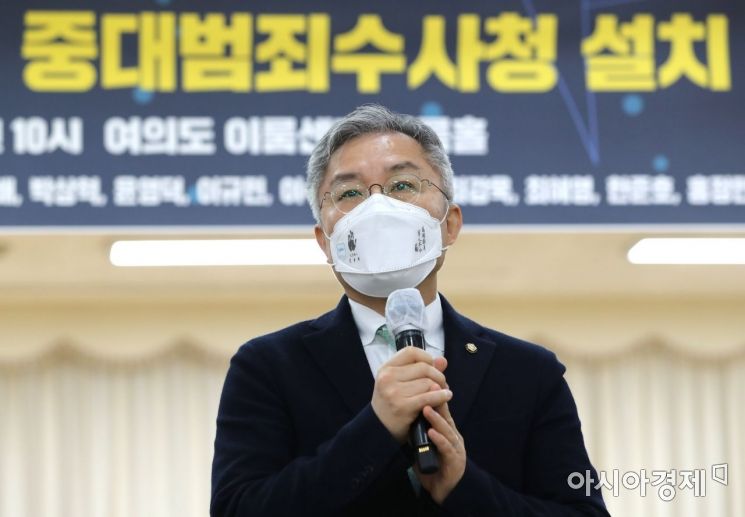
 Choi Kang-wook, leader of the Open Democratic Party, is speaking at the legislative public hearing for the establishment of the Serious Crime Investigation Agency to completely separate investigation and prosecution, held on the 23rd at the Irum Center in Yeouido, Seoul. Photo by Yoon Dong-joo doso7@
[Asia Economy Reporter Park Cheol-eung] A bill to abolish the crime of insult under the Criminal Act has been proposed. The bill is based on the premise that the law is being abused as a means to attack others and that the state should not judge the permissibility of expression.
On the 9th, according to the National Assembly, Choi Kang-wook, a member of the Open Democratic Party, introduced a bill the day before to delete Article 311 of the Criminal Act (Anyone who publicly insults another person shall be punished by imprisonment or detention for not more than one year or by a fine not exceeding 2 million won). Kang Min-jung and Kim Ui-gyeom of the same party, along with Kim Nam-guk, Kim Seung-won, Moon Jeong-bok, Moon Jin-seok, Yoon Young-duk, Lee Gyu-min, and Hwang Un-ha of the Democratic Party, were listed as co-sponsors.
Choi explained the reason for the proposal, saying, "The scope of ‘insult’ as defined in the Criminal Act is so broad that it can regulate freedom of expression that should be protected under the Constitution. Expressions that may lower a person's social evaluation, including not only abusive language but also criticism, satire, humor directed at others, and somewhat coarse neologisms widely used on the internet, can fall under this, making it difficult to predict in advance which expressions are subject to punishment."
He continued, "There have been many cases where the crime of insult is abused as a means to attack the other party in actual private disputes, causing a waste of investigative resources." He also noted that simple insults should be left to the self-correcting function of civil society or be subject to civil liability, and that hate speech against minorities can be regulated through separate laws.
Choi stated, "The purpose is to delete the crime of insult so that the state cannot judge the permissibility of expression based on the broad concept of insult, thereby preventing criminal punishment."
Choi also introduced a bill to limit the application of defamation under the Act on Promotion of Information and Communications Network Utilization and Information Protection.
The provision stating, "Anyone who publicly reveals facts through an information and communications network with the intent to defame another person shall be punished by imprisonment for not more than three years or a fine not exceeding 30 million won," is to be applied only when the stated facts infringe on "serious secrets concerning private life." Choi explained, "This aims to harmonize the freedom of the press and expression guaranteed by the Constitution with the protection of privacy."
Additionally, the bill includes a revision to make all defamation offenses under the information and communications network subject to a complaint requirement, meaning prosecution can only be initiated upon a complaint. This is intended to minimize cases where investigative agencies arbitrarily start investigations or where ‘strategic lawsuits against public participation’ by third-party accusations are abused.
Choi said, "In 2020, there were 18,348 cases of defamation under the Act on Promotion of Information and Communications Network Utilization and Information Protection received by the prosecution, which is more than the number of defamation cases under the Criminal Act received during the same period. The current law criminalizes not only false facts but also true facts stated on the internet and other information and communications networks, excessively restricting the freedom of expression and freedom of the press guaranteed by the Constitution. There are also cases of abuse of defamation laws through excessive complaints and accusations."
© The Asia Business Daily(www.asiae.co.kr). All rights reserved.

















