Park Young-sun Visits 'Youth' in First and Last Campaign... 2030 Turns Their Backs Coldly
Expert: "Youth Cannot Be Persuaded by Progressive or Conservative Ideologies"
 On the 7th, Park Young-sun, the Democratic Party of Korea candidate for Seoul mayor, leaves the election campaign camp. Photo by Yonhap News
[Asia Economy Reporter Kang Juhee] The April 7 by-elections ended in a crushing defeat for the Democratic Party of Korea, drawing attention to the dramatic shift in the voting sentiment of those in their 20s within just one year. The youth, who overwhelmingly supported the Democratic Party in last year's April 15 general election, turned their backs coldly this time by casting their votes for the People Power Party.
Experts analyzed that the 20s generation is an ideologically detached group without clear progressive or conservative leanings, and accumulated dissatisfaction with the current government led to this outcome.
According to exit polls released by the three major terrestrial broadcasters after voting ended on the 7th, Oh Se-hoon, the elected mayor of Seoul, secured 59% of the vote, significantly ahead of Democratic Party candidate Park Young-sun, who received 37.7%, by a margin of 21.3 percentage points. Oh also led Park in all age groups except those in their 40s.
Oh received 55.3% of the vote among those aged 20 and under (Park 34.1%) and 56.5% among those in their 30s (Park 38.7%). Notably, support for Oh among males aged 20 and under was a remarkable 72.5%, the second highest after women aged 60 and over (73.3%), and even higher than men aged 60 and over (70.2%).
The voting sentiment of those in their 20s has reversed completely compared to last year's general election. According to exit polls from the April 15 general election, the People Power Party's support rate among 20s nationwide was only 32%. In contrast, the Democratic Party secured 56.4% among 20s, leading by 24.4 percentage points.
The People Power Party also garnered only 29.7% of the vote among those in their 30s, trailing the Democratic Party (61.1%) by 31.4 percentage points. Although the general election was nationwide and direct comparison with this by-election is difficult, the two parties have effectively swapped their standings within a year. This reversal was most dramatic among the 2030 generation.
 Around midnight on the 25th of last month, Park Young-sun, the Democratic Party of Korea candidate for Seoul mayor, started her first election campaign by working a night shift at a convenience store. She is listening to the difficulties of a night shift worker at a convenience store in front of Hongdae, Mapo-gu, Seoul. / Photo by Yonhap News
The shift in sentiment among the 2030 generation is largely attributed to extreme distrust in the current government due to issues such as rising real estate prices and the Korea Land and Housing Corporation (LH) scandal. Additionally, controversies over fairness, such as the direct employment of security staff at Incheon International Airport last year and repeated 'double standards' on real estate issues by ruling party figures, also contributed to the youth, who value 'equality,' turning away from the Democratic Party.
Candidate Park and the Democratic Party recognized these issues and emphasized key youth policies such as youth housing and public transportation subsidies, making every effort to regain the support of the 2030 generation. On the first day of campaigning, the 25th, Park visited a convenience store night shift to listen to youth grievances, and on the last day of the campaign, the 6th, she held a focused rally at Sangsangmadang in front of Hongik University, a space densely populated by young people.
However, Park faced repeated criticism during the campaign for remarks that seemed to lack sincerity in understanding the youth's concerns. After hearing youth grievances at the convenience store, she recommended 'unmanned stores' or suggested 'AI startups' as job opportunities to students majoring in translation and interpretation, which was criticized as failing to empathize with students struggling to find jobs due to technological advancements.
Park also sparked controversy during the campaign by responding to low 20s support in polls with, "Those in their 20s have less experience with past history compared to those in their 40s and 50s," which was seen as disparaging the 20s.
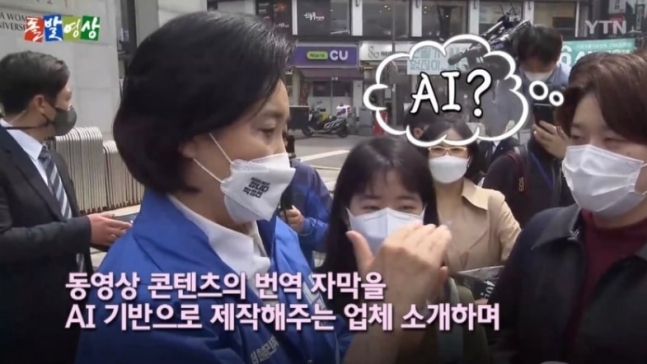 Park Young-sun, the Democratic Party of Korea's candidate for Seoul mayor, recommending an artificial intelligence (AI) translation startup to a student majoring in interpretation and translation during a campaign rally. Photo by YTN, captured from 'Dolbal Video'.
Office worker Kim (28) said about Park's remarks, "Although the Democratic Party showed efforts by holding focused rallies for the youth, it did not feel very sincere. Outwardly, they say they care about young people, but inwardly, they seemed to look down on or try to lecture those in their 20s, showing a 'bossy' attitude."
Experts analyzed that the 20s generation is an ideologically detached group without clear progressive or conservative leanings, and this election result reflects accumulated dissatisfaction with the current government.
Political commentator Lee Jong-hoon explained, "The 20s generation does not have a clear ideological identity. People think they are progressive because they have supported progressive parties, but they can be seen as an 'ideologically detached generation' that cannot be defined by the progressive-conservative divide. The youth supported the Moon Jae-in administration not because of ideology but because it aligned with their interests."
He continued, "Currently, dissatisfaction with the government has accumulated. Jobs have decreased, employment is at a cliff edge, and real estate prices have soared, making home ownership a distant dream. However, the Democratic Party's policies were peripheral and did not seem to address fundamental issues like jobs and real estate, which led to this result."
© The Asia Business Daily(www.asiae.co.kr). All rights reserved.



















