Seemingly Starting with Easing Floor Height Regulations Along the Han River
Expectations for Faster Permits and Relaxed Safety Inspection Evaluations
Cooperation with City Council Crucial if Ruling Party Takes Control
Concerns Over Backlash from Housing Price Stimulus
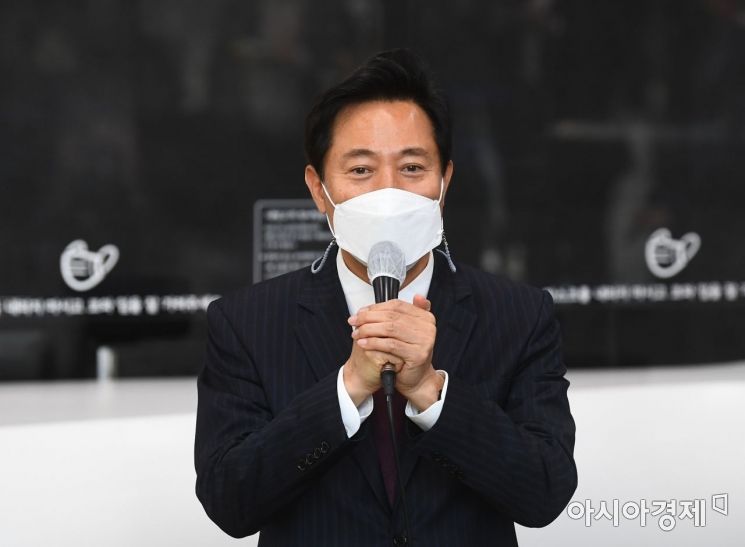 Mayor Oh Se-hoon, elected as the 38th Mayor of Seoul, is arriving at Seoul City Hall for his first day of work on the 8th. Photo by Moon Ho-nam munonam@
[Asia Economy Reporters Kim Hyemin and Lim Onyu] With Oh Se-hoon, the newly elected mayor of Seoul, returning to the city after 10 years, significant changes are expected in real estate policies. The policy focus is anticipated to shift from urban regeneration to Oh Se-hoon-style revitalization of redevelopment and reconstruction. Various regulations that have hindered reconstruction projects so far are likely to be eased, potentially accelerating large-scale reconstruction projects that had been stalled.
However, if excessive deregulation stimulates housing prices, there could be a backlash in next year’s local elections. The short term of only 1 year and 3 months, combined with the difficulty of coordinating real estate policies with the government and the city council, also poses challenges.
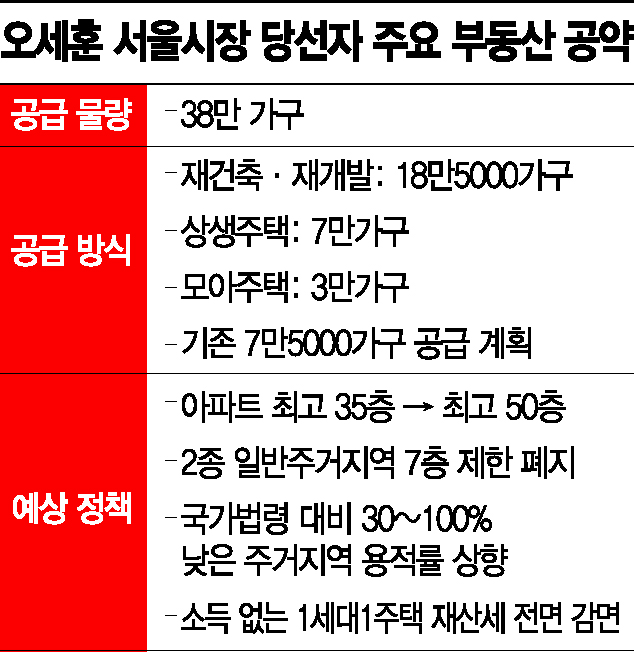
◇ Easing the Stalled Reconstruction = Starting his official schedule on the 8th, Mayor-elect Oh is expected to begin lifting regulations one by one within his authority. The consensus is that the first target will be the ‘35-floor height restriction along the Han River.’ Currently, residential buildings in Seoul (excluding mixed-use complexes) are limited to 35 floors under the ‘2030 Seoul Plan,’ an urban master plan established by former Mayor Park Won-soon. Yoon Ji-hae, chief researcher at Real Estate 114, said, “Lifting the height restriction is within his authority and carries symbolic significance,” adding, “There is no disagreement with the government on this matter.”
If the height restriction along the Han River is lifted, development plans for the Seongsu Strategic Maintenance Zone could accelerate. Expectations are also high for large-scale apartment complexes in Gangnam, such as the Eonma Apartment in Gangnam-gu and Jamsil Jugong Complex 5 in Songpa-gu, where reconstruction progress had been slow due to conflicts with the city over floor limits.
Approval procedures for major reconstruction projects stuck at the Urban Planning Committee are also expected to speed up. During his candidacy, Oh mentioned specific project sites including Eonma, Mido, Woosung 4th, Jamsil Complex 5, Jayang Hanyang, Bangbae District 15, Sadang District 5, Yeouido Gongjak, and Sinbanpo 7th. He also expressed his intention to expedite the designation and announcement of maintenance zones in Apgujeong and Yeouido areas.
Safety inspection evaluations are also expected to be less stringent than in the past. Chief researcher Yoon said, “The actual approval authority lies with local governments,” adding, “While the overall framework of the two-stage safety inspection cannot be changed, detailed evaluations can be relaxed within the scope of authority.”
◇ Cautious Approach Expected Amid Concerns Over Housing Price Stimulation = However, there are simultaneous concerns that aggressively easing redevelopment and reconstruction regulations could stimulate Seoul’s housing prices. In fact, just the prospect of Mayor Oh’s election caused fluctuations in the redevelopment markets of Apgujeong, Yeouido, and Mok-dong. On the 3rd, a unit in Apgujeong-dong Hyundai Apartment Complex 7 (245㎡ exclusive area) changed hands for 8 billion KRW, setting a new record price. Prices of old villas in the northern part of the city, which had cooled sharply due to concerns over cash settlements following the 2·4 measures, also rose by tens of millions of KRW within a month after the ‘Fourth New Town’ pledge raised redevelopment expectations.
Rapid housing price increases could negatively impact not only the mayor’s re-election but also his 2022 presidential bid. This creates a policy dilemma between the demand for deregulation and housing price stability.
It is also uncertain whether smooth policy coordination will be possible with the city council, which is effectively controlled by the ruling party, as well as with the government. Relaxing floor area ratio regulations and abolishing the 7-floor limit in second-class general residential areas require amendments to ordinances, which are difficult without the city council’s cooperation. If there is conflict with the government, which supports public-led redevelopment and reconstruction, housing supply could be disrupted whether by private or public sectors.
However, since both Mayor Oh and the government prefer to avoid confrontation, it is expected that they will seek compromises rather than outright exclusion.
During his candidacy, Mayor Oh expressed willingness to communicate, saying, “I understand that city and district council members also need to supply housing,” and “I will engage in frequent dialogue to narrow differences.” On the same day, Deputy Prime Minister and Minister of Strategy and Finance Hong Nam-ki stated at a related ministers’ meeting on the real estate market, “The goal of stabilizing housing for ordinary citizens through expanded supply is certainly shared,” adding, “Housing supply cannot be done independently by the central government, metropolitan governments, or local governments in administrative procedures. Mutual cooperation is essential.”
© The Asia Business Daily(www.asiae.co.kr). All rights reserved.


















