Korea Real Estate Board April First Week Apartment Price Trends
Seoul 0.05%↑... Seller-Buyer Tug of War
Government Increases Housing Supply but Regulatory Relaxation Uncertain
Seoul Mayor Election Defeat... Policy Effects Stall
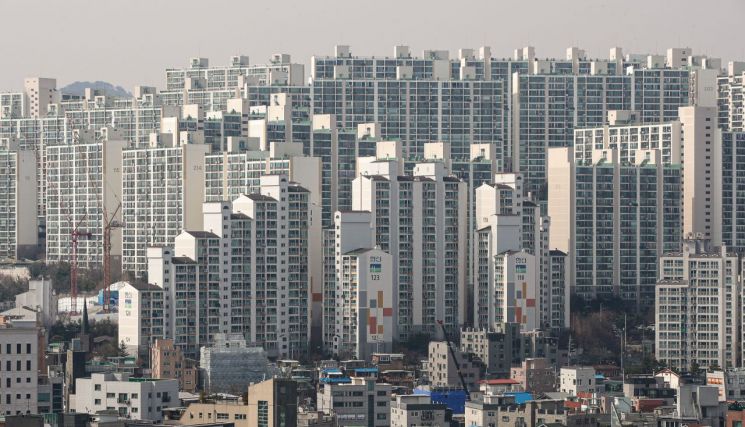
[Asia Economy Reporter Moon Jiwon] Apartment prices in Seoul recorded a 0.05% increase, the same rate as last week, due to a tug-of-war between buying and selling pressures. Although apartment buying demand has somewhat weakened following the government's 2·4 housing supply plan, expectations for deregulation of private reconstruction and redevelopment during the Seoul mayoral election process have led to a situation where apartment prices neither fall significantly nor rise sharply.
According to the weekly apartment price trend for the first week of April announced by the Korea Real Estate Board on the 8th, apartment prices in Seoul rose by 0.05%, the same as the previous week. The Korea Real Estate Board explained, "The rise was maintained due to continued weakening of buying demand and cautious sentiment amid rising market interest rates, increased tax burdens, and concretization of the 2·4 supply plan."
In Seoul, apartment price increases expanded in areas with reconstruction expectations such as Nowon-gu (0.09%) and Songpa-gu (0.10%) compared to the previous week. Gangnam-gu (0.08%) also saw price increases mainly in reconstruction complexes like Apgujeong and Gaepo-dong, while Seocho-gu (0.08%) and Gangdong-gu (0.04%) showed similar or even stronger buying demand than the previous week.
Compared to last year's rapid rise in housing prices, the market appears stable, but in some Gangnam areas, prices rose as buying demand concentrated due to expectations of deregulation that emerged during the Seoul mayoral by-election. This survey reflects changes up to the 5th and does not include the results of the Seoul mayoral by-election, where the opposition party won the previous day.
However, Yangcheon-gu (0.07%), which recently faced issues such as the final rejection of the Mokdong 11th complex reconstruction safety diagnosis, saw a reduced rate of increase compared to the previous week (0.09%), and Seongdong-gu (0.02%), Jongno-gu (0.02%), and Yeongdeungpo-gu (0.04%) also showed stability.
In Incheon, where apartment prices have been rising sharply recently, prices increased by 0.49% this week, expanding from 0.48% the previous week. Yeonsu-gu (0.95%) saw significant increases mainly in Cheonghak and Yeonsu-dong, where transportation improvements are expected, and Michuhol-gu (0.58%), Seo-gu (0.42%), and Bupyeong-gu (0.41%) also experienced strong buying demand. In Gyeonggi-do, the apartment price increase rate fell from 0.36% to 0.34%, showing stability for two consecutive weeks. Ansan-si (0.85%), Siheung-si (0.86%), and Uiwang-si (0.83%) saw significant price increases due to expectations of development benefits.
The jeonse (long-term lease) market generally showed a similar pattern to the previous week. Seoul apartment jeonse prices rose by 0.03%, the same as the previous week, halting the narrowing of the increase after four weeks. The Korea Real Estate Board explained, "Due to fatigue from rapid price rises, seasonal off-season, and the impact of new housing supply, jeonse listings have increased, leading to supply-demand stabilization."
North of the Han River, Mapo-gu (-0.01%) maintained a decline due to the impact of new housing supply, and Seongbuk-gu (0.06%) and Dobong-gu (0.01%) saw a reduced rate of increase as jeonse demand decreased. South of the Han River, Seocho-gu (0.03%) rose mainly in some complexes such as Bangbae-dong, but Gangnam-gu (-0.02%) and Gangdong-gu (-0.01%) continued to decline as listings accumulated in most complexes. Songpa-gu (0.00%) remained flat.
Incheon (0.27%) and Gyeonggi-do (0.12%) recorded the same increase rates as the previous week. In Incheon, Seo-gu (0.40%) saw jeonse price increases mainly in Cheongna International City and areas near stations with good transportation. In Gyeonggi-do, jeonse prices rose significantly in Siheung-si (0.41%), Suwon Gwonseon-gu (0.40%), and Dongducheon-si (0.37%), while Gwacheon-si (-0.16%) continued to decline due to the impact of new housing supply.
Sejong City’s jeonse prices rose by 0.15% this week, significantly expanding from 0.06% the previous week. This contrasts with the trend since the second week of March, which had been stabilizing at 0.24% → 0.12% → 0.11% → 0.06%. The Korea Real Estate Board explained, "A shortage of jeonse listings, especially in mid-to-low price ranges in Saerom-dong and Jochiwon-eup within the Happy City, has led to jeonse price increases in some complexes."
© The Asia Business Daily(www.asiae.co.kr). All rights reserved.
![Clutching a Stolen Dior Bag, Saying "I Hate Being Poor but Real"... The Grotesque Con of a "Human Knockoff" [Slate]](https://cwcontent.asiae.co.kr/asiaresize/183/2026021902243444107_1771435474.jpg)

















