Half of Companies Approved for Business Restructuring Exceed Productivity Targets
Only One Tax Reduction Support Case in 5 Years... Need to Expand Eligible Targets and Incentives
[Sejong=Asia Economy Reporter Kwon Haeyoung] #Unid, a manufacturer of potassium hydroxide (caustic potash) used as a pharmaceutical additive, acquired Hanwha Solutions' (formerly Hanwha Chemical) Ulsan caustic soda plant in 2016. This was right after the enactment of the "Special Act on the Promotion of Corporate Vitality (One-Shot Act)," which simplifies procedures and regulations such as the Commercial Act, Tax Law, and Fair Trade Act to assist companies in preemptive restructuring. Unid converted the acquired plant into a potassium hydroxide plant, reducing relocation costs while expanding production capacity. Meanwhile, Hanwha Solutions achieved a twofold benefit by reducing the oversupply of caustic soda production by 200,000 tons through the plant sale and using the proceeds to improve its financial structure.
The Corporate Vitality Act (One-Shot Act), enacted to promote preemptive corporate restructuring, is receiving renewed attention as it marks its 5th anniversary in August. This is because it clearly demonstrates the impact of legislation on corporate activities amid the deepening 'K-shaped' polarization between companies due to COVID-19 and the flood of anti-corporate bills such as the three corporate regulation laws (Fair Trade Act, Commercial Act, Financial Group Supervision Act) and the Serious Accident Punishment Act.
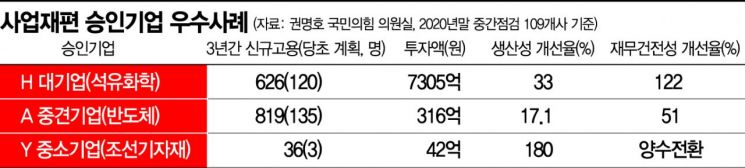
According to data submitted by the Ministry of Trade, Industry and Energy to Rep. Kwon Myungho of the People Power Party on the 8th, among 17 companies that passed the three-year business restructuring period after the Corporate Vitality Act was implemented in 2016, more than half?9 companies?exceeded their initial production targets. Considering that 166 companies have been approved for business restructuring under the law so far, the number of companies showing improved performance after the restructuring period is expected to increase further.
The government evaluates the productivity of companies or their respective businesses during the three-year restructuring period by comparing the increase in return on total assets, fixed asset turnover, and value-added ratio against the starting year of restructuring, with 53% of companies achieving their management goals.
An official from the Ministry of Trade, Industry and Energy explained, "Since the One-Shot Act is mainly applied to companies or industries requiring urgent intervention, there are limitations in improving productivity and financial soundness in a short period. However, half of the companies that passed the three-year restructuring period showed achievements in meeting management goals despite COVID-19."
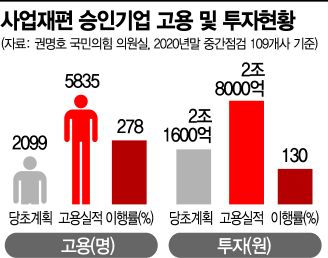
The employment and investment status of companies approved for business restructuring also exceeded the initial targets set at the time of planning. Among 109 companies approved for restructuring from 2016 to 2019, mid-term inspections showed that by the end of last year, they employed 5,835 people and invested 2.8 trillion KRW, achieving 2.7 times and 1.3 times the original targets of 2,099 employees and 2.16 trillion KRW, respectively.
Companies evaluate that the Corporate Vitality Act holds significant implications amid widespread anti-corporate sentiment in society and the flood of 'corporate tightening' bills under the current administration. However, they also express that it is difficult to evaluate the Act positively alone given the intensity of anti-corporate laws. A representative from the Federation of Korean Industries said, "It is true that companies have benefited from the law," but added, "Considering the broad scope of application of the Serious Accident Punishment Act, the benefits from the Corporate Vitality Act are minimal."
Challenges remain. Although the scope of application has expanded beyond oversupplied industries to include new industries and companies in industrial crisis areas through legal amendments, the industry points out that there are almost no tax or procedural benefits.
Since the enactment of the Corporate Vitality Act, the government has supported a total of 67 cases through procedural, tax, research and development (R&D), and funding benefits until February this year, but only one case involved tax reduction. Regulatory relaxations, including two cases of simplified merger review procedures, amounted to only six cases. Most supports, such as 15 cases of R&D support and 29 cases of SME policy fund support, were financial aids targeting small and medium-sized enterprises, resulting in limited perceived effects for companies.
A Federation of Korean Industries official said, "The Japanese Industrial Competitiveness Enhancement Act, which we benchmarked, provides significant procedural benefits such as allowing mergers and acquisitions (M&A) using treasury stock and frequently amends the law to support changes in the corporate management environment," adding, "The government should also provide clear incentives through corporate tax reductions and substantial procedural simplifications and activate the system so that it can be used regardless of company size."
© The Asia Business Daily(www.asiae.co.kr). All rights reserved.


















