Analysis of Historical Long-Term Stock Price Uptrend Cycles
Fourth Bull Market Since COVID-19... Second Uptrend Phase
Potential for Further Gains, Semiconductors as Key Variable
[Asia Economy Reporter Ji Yeon-jin] The domestic stock market, which had been stagnant for over two months, has recently rebounded, pushing the KOSPI target index higher. As the KOSPI has entered its fourth bull market, surpassing its historical high and reaching a new peak, there are forecasts that the index will exceed the 3600 level.
On the 8th, Daishin Securities presented a KOSPI target index of 3630 for this year based on a model analyzing historical stock price rise cycles. At the beginning of the year, securities firms set the KOSPI target band between 2500 and 3500. This was adjusted upward after the KOSPI surpassed 3000 for the first time in history early this year. Recently, Meritz Securities proposed 3500, and NH Investment & Securities suggested 3400.
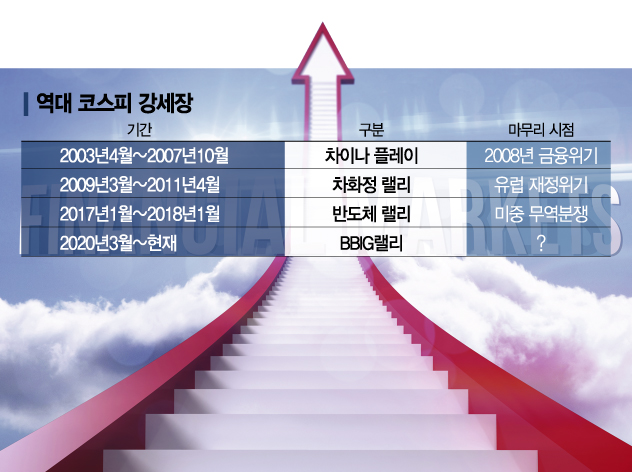
Since 2000, there have been a total of four stock price rise cycles in the KOSPI. Representative cycles include the 'China Play' (April 2003 - October 2007), which benefited from China's economic growth boom; the 'Chahwajeong Rally' (March 2009 - April 2011), a major bull market led by the automobile, chemical, and refining sectors; and the 'Semiconductor Rally' (January 2017 - January 2018), driven by rising semiconductor prices. The current cycle, starting after the massive crash in March last year due to the COVID-19 crisis, is considered the fourth bull market.
Historical long-term stock price rise cycles share common characteristics: stock prices rise first despite poor corporate earnings during economic recessions (Stage 1), followed by a primary rise phase where improving corporate earnings accompany rising stock prices (Stage 2). Then, as the real economy improves, a secondary rise phase based on the 'wealth effect' occurs (Stage 3), followed by an expansion of the gap between expected and realized earnings (Stage 4), after which the stock price rise phase ends (Stage 5). According to this model, the current bull market is in the secondary rise phase, Stage 3. It is expected that the transition to Stage 4 can be confirmed through the Q1 earnings season starting on the 7th of this year. Kim Ji-yoon, a researcher at Daishin Securities, stated, "Last year, KOSPI earnings consistently met expectations," adding, "Considering the ongoing upward revisions in earnings forecasts despite recent stock price weakness, Q1 earnings this year are also likely to meet expectations."
In particular, the fact that short correction periods repeatedly occurred within long-term stock price rise phases in past bull markets is also cited as a factor supporting further KOSPI gains. During those correction periods, the duration ranged from a minimum of 21 days to a maximum of 109 days, with an average of 48 days. The stock price decline during these periods ranged from a minimum of -5.1% to a maximum of -20.0%, averaging -10.9%. Over the four historical stock price rise cycles, the KOSPI's industrial structure has shifted towards a greater proportion of high-tech companies such as software and pharmaceuticals/biotech, with an increased dependence on the semiconductor industry.
Therefore, the key variable determining the future direction of the index is expected to be the movement of semiconductor stock prices. Researcher Kim said, "According to inventory cycle indicators, the semiconductor industry is currently in a boom phase. The strong manufacturing sectors in China and the U.S., along with policy-driven expansion of U.S. consumption, support the continuation of strong semiconductor exports." He added, "The sustained rise in expected inflation is a risk factor. While the possibility of a sharp price surge leading to early Federal Reserve intervention is considered low, it is necessary to continuously monitor the potential for a trend deviation from the Fed's target."
© The Asia Business Daily(www.asiae.co.kr). All rights reserved.

















