Personnel Reform, Major Policy Changes Expected... Possible Large-Scale Overhaul of Grade 3 and Above Positions
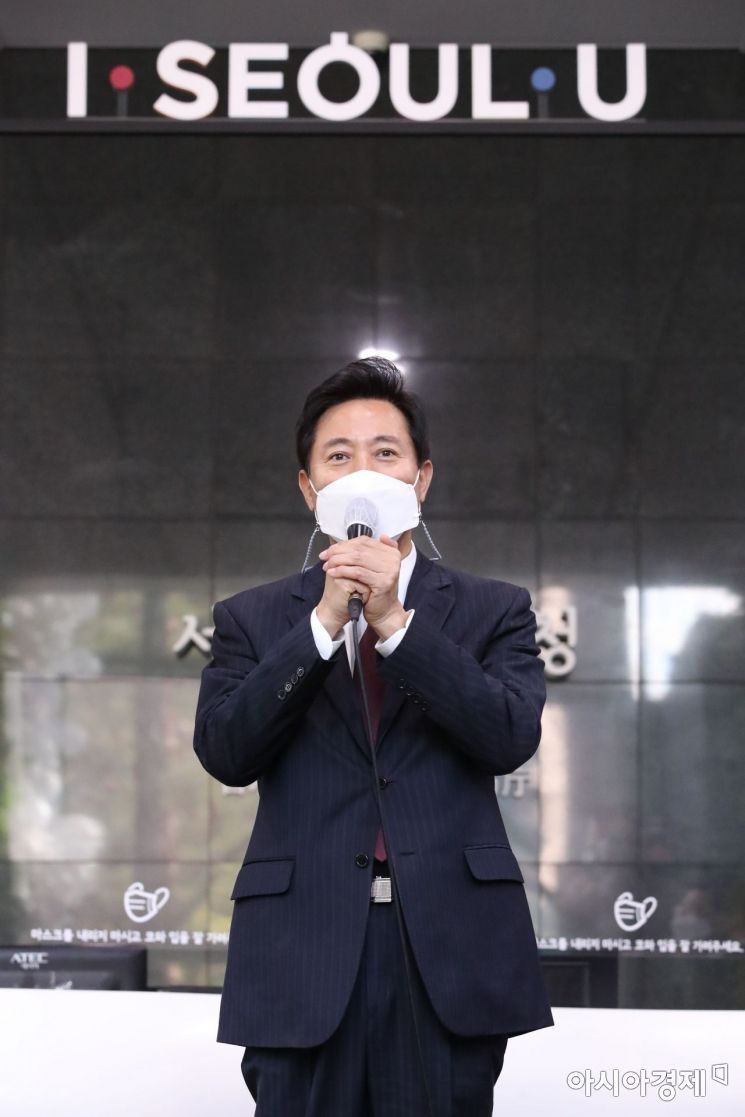 Mayor Oh Se-hoon, elected as the 38th Mayor of Seoul, is arriving at Seoul City Hall for his first day of work on the 8th. Photo by Moon Ho-nam munonam@
[Asia Economy Reporters Lim Cheol-young and Park Jong-il] Seoul Mayor Oh Se-hoon began his first day in office on the 8th, marking the start of significant changes in Seoul's city administration after 10 years. After paying respects at the National Cemetery, Mayor Oh arrived at City Hall and received the handover documents from Seo Jeong-hyeop, the Acting Mayor who had held the position for nine months, signing them. Following a visit to the City Council and other scheduled events, he returned to City Hall in the afternoon to receive briefings on key city issues, officially commencing his duties. From this day forward, Mayor Oh is expected to initiate a major overhaul of Seoul’s administration through personnel changes, organizational restructuring, and the removal of policies from the previous mayor’s tenure.
Mayor Oh announced plans to change 171 out of 229 major policies?approximately 75%?that were implemented by former Mayor Park Won-soon over the past decade. The most significant focus is on personnel renewal. There is a high likelihood of substantial changes among senior officials, including first and second-tier executives, as well as those at grade 3 and above. In 2011, for example, five out of six grade 1 officials and many grade 2 officials left Seoul City Hall.
While the appointments of the Administrative First and Second Deputy Mayors require presidential approval and remaining procedures, the Political Deputy Mayor can be appointed directly by the mayor. Candidates mentioned for Administrative First Deputy Mayor include Jo In-dong, Chief of the Planning Office, and Kim Ui-seung, Director of Economic Policy. For Administrative Second Deputy Mayor, Kim Hyo-soo, former Head of the Housing Headquarters, and Ryu Hoon, Director of Urban Regeneration (grade 1), are being considered. The Political Deputy Mayor position is rumored to be offered to Kang Cheol-won, a close aide of Mayor Oh and former Director of Political Coordination at Seoul City Hall. However, since Mayor Oh announced a joint administration with the People’s Party and hinted at appointing a female deputy mayor, there are many variables.
The so-called “6th floor people” from the previous mayor’s administration will also face significant replacement. These are secretarial and political staff who assist the mayor on the 6th floor, where the mayor’s office is located. The mayor can appoint up to 28 special-position public officials. Among affiliated organizations, the positions of President of the Seoul Housing and Communities Corporation (SH Corporation), previously held by Land, Infrastructure and Transport Minister Byun Chang-heum, and President of the Seoul Institute are currently vacant. Kim Hyun-ah, a member of the People Power Party’s Emergency Committee, is a potential candidate for SH Corporation President. Additionally, appointments for heads of the Seoul Philharmonic Orchestra, Seoul Welfare Foundation, Seoul Design Foundation, and Seoul Tourism Foundation are expected.
Organizational restructuring is also anticipated to realize Mayor Oh’s key pledges such as speed housing supply, speed transportation, and balanced regional development. Beyond existing housing supply plans, projects currently underway like the Gwanghwamun restructuring and urban regeneration may be halted. The controversial Gwanghwamun Square restructuring could also be subject to change.
Earlier, in November last year, Mayor Oh criticized on social media, saying, "I want to ask who this construction is really for, especially when life has become so difficult due to COVID-19," and added, "The insistence that the square should be off-center is just the architect’s stubbornness." The restructuring of TBS Traffic Broadcasting is also a point of interest. During the election campaign, Mayor Oh did not appear on “Kim Eo-jun’s News Factory,” hosted by Kim Eo-jun, citing bias. Although Seoul City cannot intervene in TBS’s programming or production under broadcasting law, it holds budgetary authority and appoints the chairman, CEO, and auditors. The People Power Party has consistently labeled TBS, especially Kim’s broadcasts, as pro-government biased media.
A Seoul City official stated, "Since there is no transition committee, we are reviewing policies that can be implemented within the 1 year and 3 months term," adding, "Significant changes to projects and the organization seem inevitable."
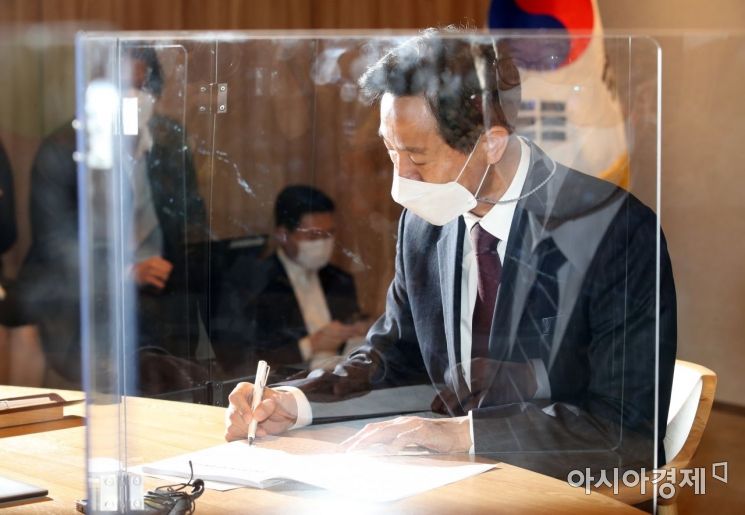 Seoul Mayor Oh Se-hoon is arriving at Seoul City Hall on the morning of the 8th and signing the office handover document. / Photo by Joint Press Corps
© The Asia Business Daily(www.asiae.co.kr). All rights reserved.


















