"Regularly Analyze and Diagnose Quarantine, Real Economy, and Financial Indicators"
"Small Business Difficulties Persist... Maintain Current Financial Support Policy"
"Thoroughly Manage Localized Risks Such as Household Loan Growth and Corporate Credit Rating Declines"
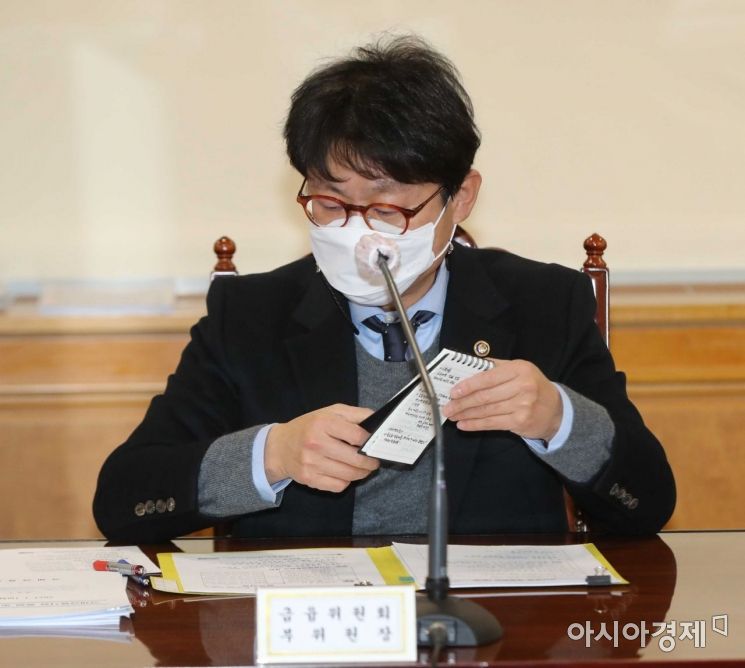
[Asia Economy Reporter Kwangho Lee] Do Kyusang, Vice Chairman of the Financial Services Commission, stated on the 8th, "We plan to form a COVID-19 financial situation monitoring working group with policy financial institutions and private experts to periodically analyze and diagnose quarantine, real economy, and financial indicators."
Vice Chairman Do made this remark during the 'Financial Risk Response Team Meeting' held via video conference on the same day, saying, "We will operate COVID-19 financial response measures with a mid- to long-term perspective."
He added, "We will diagnose which stage the current situation is in among the crisis continuation stage, recovery stage, and normal stage. Based on this, during the crisis continuation stage, financial support will continue, and when our economy and financial markets enter the recovery stage, the level of financial response measures will be gradually and stepwise lowered over a sufficient period."
He further stated, "In this process, we will also coordinate with major countries' policy shifts and discussions on normalization by international financial organizations," and evaluated, "According to this 'diagnosis and response policy system,' assessing the situation at the end of March shows that the COVID-19 crisis phase is still ongoing."
Vice Chairman Do emphasized, "The difficulties felt by vulnerable sectors such as small business owners remain," and said, "We will maintain the current financial support stance."
In particular, he mentioned, "The government will make every effort to manage localized risks such as the increase in household loans and the downgrade of corporate credit ratings," and added, "Funding support for small business owners and SMEs will be further strengthened, and for market stabilization programs, the Stock Market Stabilization Fund and Bond Market Stabilization Fund will maintain their support frameworks but respond flexibly according to market conditions."
Vice Chairman Do explained, "The Stock Market Stabilization Fund's purchase commitment period ends today. After gathering opinions from the financial sector and experts, the majority view was that the market functions sufficiently on its own," and said, "The purchase commitment period will not be extended, and the raised funds will be distributed to the contributing institutions."
He also stated, "The Stock Market Stabilization Fund itself will continue to exist, and in case of market instability, the purchase commitment period will be immediately reset with the contributing institutions, and support will be resumed."
Additionally, he added, "The Bond Market Stabilization Fund, which has been responsible for supporting high-quality bonds, holds available resources of 1.4 trillion won and will maintain its current support capacity for the time being."
The meeting also discussed market risk assessment and measures to strengthen responses.
Vice Chairman Do said, "The recent Archegos fund incident in the United States clearly shows that although the financial market appears stable on the surface, it is actually a vulnerable situation with various risk factors scattered beneath the surface," and expressed, "The government will thoroughly examine potential risk factors that were hidden amid the previous financial easing stance and excess liquidity situation, and proactively prepare response measures in case of emergencies."
© The Asia Business Daily(www.asiae.co.kr). All rights reserved.

















