Basic Science Institute Participates in Muon Research Led by US Fermi National Accelerator Laboratory
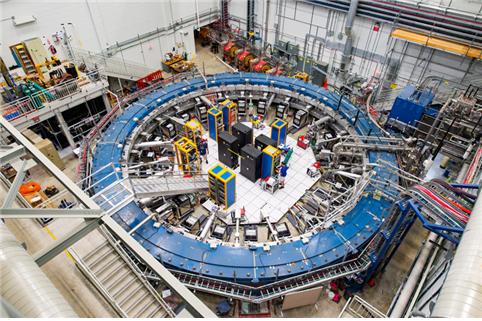 The muon storage ring, a key device in the Muon g-2 experiment.
 The muon storage ring is surrounded by detectors, the muon beamline, and other equipment. The interior of the storage ring is maintained at approximately -267 degrees Celsius, and the magnetic field inside the ring is kept extremely uniform. Muons are stored inside the muon storage ring at speeds close to the speed of light.
[Asia Economy Reporter Kim Bong-su] The possibility of additional particles or forces beyond the currently confirmed fundamental particles has increased.
According to the Institute for Basic Science (IBS), on the 8th, the Fermi National Accelerator Laboratory in the United States announced that through the international collaborative research project "Muon g-2," which included Korean researchers, it was proven with a confidence level of 4.2 sigma that muons behave differently from the predictions of modern physics. Muons are heavier cousins of electrons and are produced when high-energy particles collide. They have a lifespan of about 2 microseconds. Generally, a confidence level of 3 sigma (99.7%) in an experiment is considered a "hint," while 5 sigma (99.99994%) or higher is recognized as a "discovery."
Eight researchers, including Yanis Semertzidis, head of the Axion and Extreme Interaction Research Group at IBS, collaborated with the Fermi Laboratory and other joint researchers to measure and announce the muon oscillation. This confirmed the long-standing discrepancy between theory and experiment that has remained unsolved for decades, and it is expected to provide clues to pioneering new physics.
The Standard Model, the essence of modern physics, is the theory that best explains the subatomic world (particles smaller than atoms, such as neutrons, protons, and electrons). It describes fundamental particles such as quarks, electrons, muons, and neutrinos that make up the universe, the three forces excluding gravity (electromagnetic force, strong force, weak force), and the interactions among them.
Muons act like mirrors reflecting this subatomic world. Under a strong magnetic field, the magnetic axis of a muon wobbles like a spinning top, and this wobble is expressed by the g value. Since muons interact with countless virtual particles that appear and disappear in a vacuum, the g value is also influenced by them. Scientists can calculate this g value very precisely using the Standard Model. If there are particles or forces in the vacuum that we do not know about, the g value will differ from the prediction. Here, vacuum does not mean empty space but is filled with countless virtual particles that appear and disappear. This is called quantum vacuum or quantum foam.
This result is based on the analysis of data collected during the first year of the Muon g-2 experiment, newly presenting the muon g value as 2.00233184122. The theoretical value calculated by the Standard Model was 2.00233183620.
The confidence level of 4.2 sigma in this experiment does not reach the scientific discovery threshold of 5 sigma but still represents strong evidence. The probability that this result arose from statistical error is 1 in 40,000. This confirms with higher confidence the hint provided by the previous experiment at Brookhaven National Laboratory (1997?2001), which had a confidence level of 3.7 sigma, within just one year. Currently, the second and third data sets of the Muon g-2 experiment are being analyzed, and the fourth experiment is underway.
The IBS research team contributed to maintaining a uniform magnetic field within the muon storage ring and reducing the muon orbital oscillation effect in this experiment. Yanis Semertzidis, head of the Institutional Board, the decision-making body of the experiment, said, "This result is strong evidence that muons interact sensitively with particles or forces not included in the Standard Model. The data analyzed so far represent only 6% of the total data the Muon g-2 experiment will ultimately collect. From the first experimental results, we have seen interesting differences from the Standard Model, and we expect to learn much more in the coming years."
This research result was published on the 8th in the international academic journal Physical Review Letters (IF=8.385).
© The Asia Business Daily(www.asiae.co.kr). All rights reserved.
![Clutching a Stolen Dior Bag, Saying "I Hate Being Poor but Real"... The Grotesque Con of a "Human Knockoff" [Slate]](https://cwcontent.asiae.co.kr/asiaresize/183/2026021902243444107_1771435474.jpg)
















