[Asia Economy Reporter Su-yeon Woo] As attention focuses on the policy direction following the election of the new Seoul mayor, on the 8th, the Korea Economic Research Institute (KERI) identified the three major challenges Seoul must address as "job stagnation, housing shortage, and chronic low growth."
Seoul's Employment Rate Ranks 13th Nationwide... Unemployment Rate Last for 3 Consecutive Years
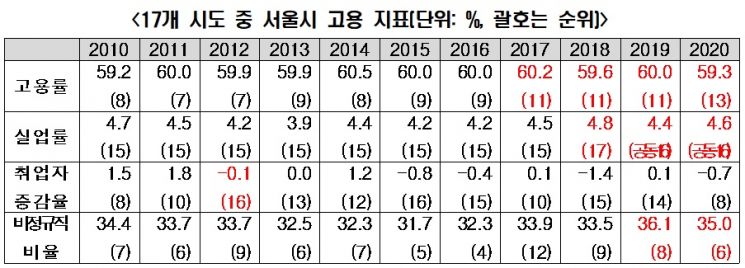
First, KERI analyzed job indicators such as employment rates from 2010 to 2020 and evaluated that Seoul's job performance had been sluggish even before COVID-19. Seoul's employment rate dropped to 60.2% in 2017, ranking 11th among 17 cities, and fell further to 13th last year amid the COVID-19 impact.
 (Source=Statistics Korea)
 ※The better the indicator, the higher the rank (Employment rate and employment growth rate are in descending order, unemployment rate and irregular worker ratio are in ascending order)
The unemployment rate has also been the lowest for three consecutive years since rising to 4.8% in 2018. The employment growth rate was persistently poor from its lowest point in 2012 until 2019. Although the proportion of non-regular workers is relatively favorable, its fluctuation rate is high, worsening in 2017 but showing some improvement afterward.
In the year severely affected by COVID-19, the quality of jobs was also below the national average. The number of employed persons working 36 hours or more per week decreased by 237,000 (-5.9%) to 3.8 million within one year. During the same period, the nationwide decrease was 5.6%, making Seoul's decline 0.3 percentage points larger. Conversely, the number of employed persons working less than 36 hours increased by 112,000 (11.5%) to 1.083 million, with Seoul's increase 1.2 percentage points higher than the national rate (10.3%).
The number of large-scale self-employed decreased, while the increase in 'solo entrepreneurs' was significant. The number of self-employed with employees fell by 14.5%, from 276,000 in 2019 to 236,000 last year. Solo entrepreneurs rose by 5.2%, from 542,000 to 570,000.
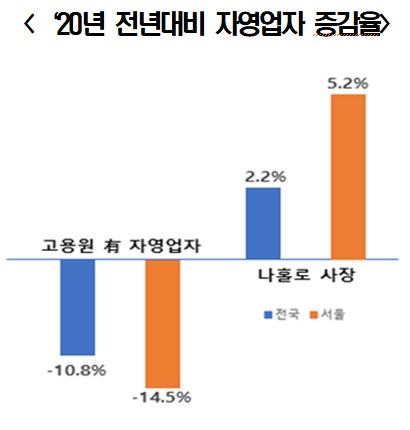 Self-Employed Growth Rate by Employment Status Compared to the Previous Year in 2020 / Data = Korea Economic Research Institute
As of 2020, over 90% of Seoul's total 5.051 million employed persons work in service sectors, including wholesale and retail trade, accommodation, and food services. Meanwhile, the number of manufacturing workers has steadily declined since 2015. KERI advised, "Since manufacturing and high value-added service industries offer many quality jobs, efforts should be made to attract companies and revitalize the private economy."
To recover jobs affected by COVID-19 this year, Seoul allocated 2.1576 trillion KRW, assigning 1.797 trillion KRW to direct job creation and 360.6 billion KRW to indirect job creation. The budget for direct job creation is five times larger than that for indirect job creation. KERI emphasized, "Direct job projects have low effectiveness in terms of employment sustainability," and urged, "Seoul should expand the budget for indirect job creation to lead to stable private sector job growth in the long term."
Soaring Housing Prices Increase Residential Instability in Seoul
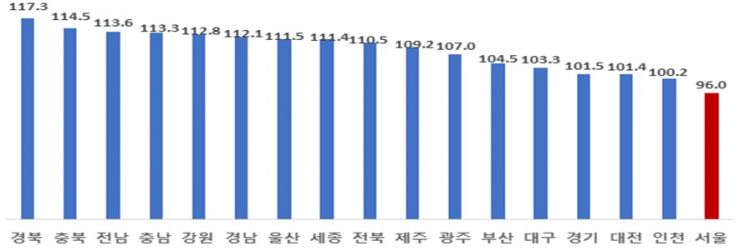
KERI pointed to housing issues as the second challenge. In 2019, Seoul was the only region with a housing supply rate below 100%, at 96%. The homeownership rate among Seoul citizens had been rising since 2014 but decreased to 42.7% in 2019. Since 2016, monthly rent (28.5%) surpassed jeonse (long-term deposit lease) (26.3%).
The sharp rise in Seoul apartment prices is also criticized for expanding housing instability. The average apartment price in Seoul showed little change until 2015 but began rising from 2017, reaching 1.09993 billion KRW in March this year, surpassing the 1 billion KRW mark.
KERI argued that deregulation and expansion of private redevelopment and reconstruction are necessary to increase real estate supply. Housing issues can undermine the work motivation of diligent workers and may become a major cause of recent social conflicts.
Lost Growth Engine, Chronic Low Growth
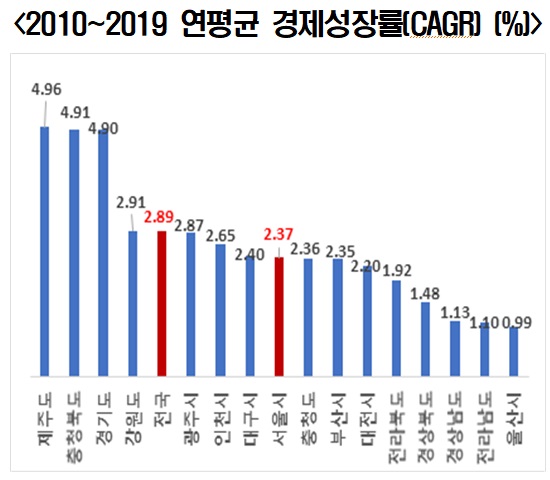
Lastly, KERI analyzed that Seoul needs to prepare long-term measures in response to the domestic economy's low growth trend. From 2010 to 2019, Seoul's economic growth rate (real GDP) was 2.37%, below the national average. Seoul's share of nominal GDP was 25.2% in 2000 but steadily declined to 22.5% in 2019.
Population decline and aging are accelerating low growth. As of the end of 2020, Seoul's total population (including foreigners) was 9.91 million, down 100,000 from the previous year, falling below 10 million for the first time in 32 years. In 2018, the proportion of people aged 65 and over reached 14.1%, entering an aged society. Additionally, Seoul's population decline rate averaged -0.6% annually from 2010 to 2020, the highest nationwide.
KERI expressed concern that sectors with many self-employed workers, such as wholesale and retail trade, accommodation, and food services, have been severely affected by COVID-19 amid Seoul's slowing economic growth. It pointed out the need to actively support small-scale self-employed individuals while preparing various vocational training programs to transition to industries with future growth potential and consumer demand.
Choo Kwang-ho, Director of Economic Policy at KERI, said, "In a situation where national growth engines are weakening, if the capital city Seoul focuses on the three major policy areas of reducing unemployment, improving housing conditions, and revitalizing the private economy to expand growth engines, it will not only develop vibrant urban competitiveness in the long term but also positively impact the entire national economy."
© The Asia Business Daily(www.asiae.co.kr). All rights reserved.



















