Five Candidate Complexes for Public Reconstruction Leading Projects Introduced in Last Year's August 4th Measures Finalized
Floor Area Ratio Increased by 178%p, Supply Units Increased 1.5 Times
Securing Project Feasibility... Maintenance Plan to Be Established Next Month
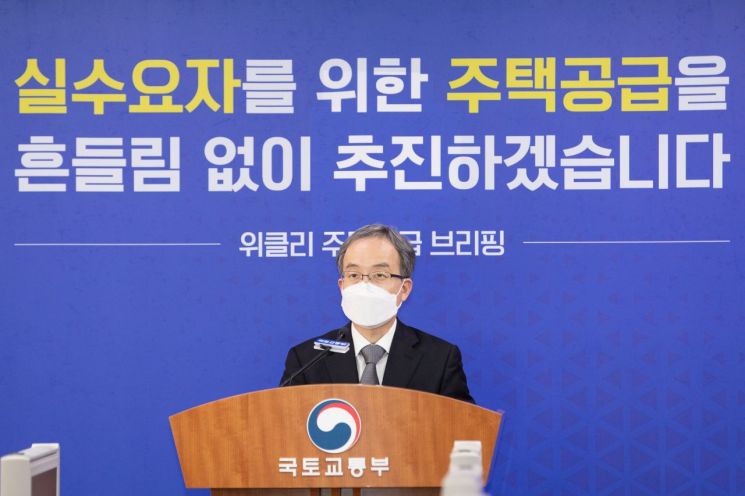 Kim Soo-sang, Director of the Housing and Land Office at the Ministry of Land, Infrastructure and Transport, is announcing candidate sites for the public reconstruction project during the Weekly Housing Supply Briefing on the 7th. (Photo by Ministry of Land, Infrastructure and Transport)
[Asia Economy Reporter Moon Jiwon] Five complexes including Shingil 13 District in Yeongdeungpo-gu, Mangwoo 1 District in Jungnang-gu, Miseong Geonyeong Apartment in Gwanak-gu, Gangbyeon Gangseo in Yongsan-gu, and Junggok Apartment in Gwangjin-gu were selected on the 7th as candidate sites for the 'Public Reconstruction' pilot project introduced through the August 4th measures last year.
According to the Ministry of Land, Infrastructure and Transport (MOLIT) on the day, the candidate sites for this pilot project were selected from seven complexes that participated in the public reconstruction preliminary consulting contest last year and submitted preliminary consulting results, based on having improved business feasibility and securing at least 10% resident consent.
Public reconstruction is a project that promotes housing supply by easing regulations such as floor area ratio and supporting procedures when public entities like Korea Land and Housing Corporation (LH) participate.
For the pilot project candidate sites, a special exception is granted by applying the lowest level (50%) of the donation rate range (50~70%) presented at the time of the measure announcement, and the highest level (50%) of the public sale ratio among the donated houses.
Analysis of the business effects for the five pilot project candidate sites showed that all five complexes will have an average increase of 178 percentage points in floor area ratio (from 162% to 340%) through urban planning incentives such as applying a one-step zoning upgrade.
The number of supply units will increase by 1.5 times compared to the current number of units (total 1,503 → 2,232 units), and the burden on association members is analyzed to decrease by an average of 52% compared to private reconstruction plans.
The Ministry of Land explained, "The candidate sites are mostly places where business feasibility is insufficient with private redevelopment projects or where projects have been stalled for a long time due to conflicts among residents. If business feasibility is improved with public participation and support, it is expected that housing can be supplied rapidly within urban areas."
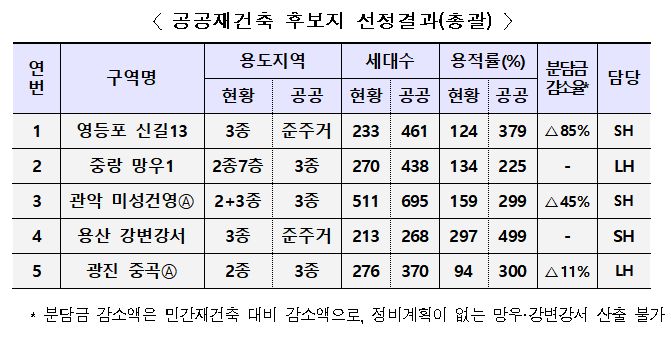
Shingil 13 District is located within the Shingil Redevelopment Promotion Zone, and despite being in a station area, the project has been delayed for a long time since the designation of the redevelopment zone in 2007 due to complex interests. Considering the station area location, the zoning will be upgraded from the current Type 3 General Residential Area to Semi-Residential Area, increasing the floor area ratio by 258 percentage points compared to the current level and by 130 percentage points compared to the private reconstruction plan, and the number of floors will be raised up to 35 floors to secure double the number of units.
Mangwoo 1 District established an association in 2012, but the project stalled due to various disputes such as lawsuits for dismissal of the association head and resident votes for zone cancellation, as well as difficulties in securing business feasibility. The government will upgrade the zoning to Type 3 General Residential Area, increasing the floor area ratio by 91 percentage points compared to the current level, and secure up to 23 floors to increase the number of units by 1.62 times.
Miseong Geonyeong Apartment has irregularly shaped land in the redevelopment zone and height restrictions due to nearby educational facilities, making it difficult to secure business feasibility through self-redevelopment. Therefore, the entire complex will be upgraded to Type 3 General Residential Area, increasing the floor area ratio by 140 percentage points compared to the current level, securing up to 27 floors, and increasing the number of units by 1.36 times. To regularize the site, some parcels will be incorporated, and infrastructure such as parks will be improved.
Gangbyeon Gangseo, completed in 1971, has a current floor area ratio of 297%, making it difficult to secure business feasibility without changing the zoning, and has been stalled for a long time since the association was established in 1993. MOLIT will upgrade the zoning from Type 3 General Residential Area to Semi-Residential Area, increasing the floor area ratio by 202 percentage points compared to the current level. The number of floors will be secured up to 35 floors, increasing the number of units by 1.26 times despite being a small area.
Lastly, Junggok Apartment had difficulty in efficient building layout and securing business feasibility due to an urban planning road passing through the complex, and had expressed to the district office the intention to abandon the project. MOLIT will upgrade the zoning to Type 3 General Residential Area, designing up to 18 floors considering the surrounding area, and increase the floor area ratio by 206 percentage points compared to the current level. Through this, 36 units of general sale, which did not exist before, will be supplied to secure business feasibility.
For the selected candidate sites, a detailed redevelopment plan (draft) will be established by next month reflecting resident demands and revised laws based on the preliminary consulting results prepared under public leadership. Based on the prepared redevelopment plan (draft), resident briefings and association general meetings will be held, and candidate sites that secure the consent rate necessary for designation as a public implementer will be designated as public implementers and the redevelopment plan will be promptly finalized. The required consent rate is two-thirds of landowners if LH and SH implement alone, and half of association members if the association and LH·SH jointly implement.
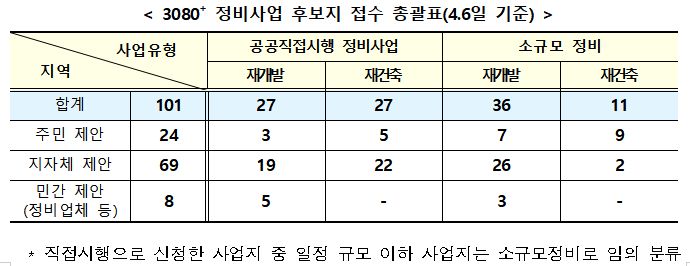
Meanwhile, a total of 101 sites have been submitted for the public direct implementation redevelopment projects and small-scale redevelopment/reconstruction projects announced in the February 4th measures.
For public-led redevelopment projects, 27 redevelopment sites and 27 reconstruction sites were proposed. Redevelopment includes 3 resident proposals, 19 local government proposals, and 5 private proposals, while reconstruction includes 5 resident proposals and 22 local government proposals.
For small-scale redevelopment projects, 36 redevelopment sites (7 resident proposals, 26 local government proposals, 3 private proposals), and 11 reconstruction sites (9 resident proposals, 2 local government proposals) were submitted.
Analysis of the submitted candidate sites showed high participation in areas with good conditions but difficult self-development due to regulations, and areas with poor location where private participation is difficult to induce. MOLIT plans to provide consulting services after identifying the willingness of associations to participate in project zones proposed by local governments and private sectors, and announce candidate sites in July after securing 10% resident consent for resident-proposed zones.
© The Asia Business Daily(www.asiae.co.kr). All rights reserved.
![Clutching a Stolen Dior Bag, Saying "I Hate Being Poor but Real"... The Grotesque Con of a "Human Knockoff" [Slate]](https://cwcontent.asiae.co.kr/asiaresize/183/2026021902243444107_1771435474.jpg)


















