UNIST Professor Jin-Young Kim's Team Achieves 25.6% Efficiency... Surpassing Previous 25.2% Record by Korea Institute of Science and Technology
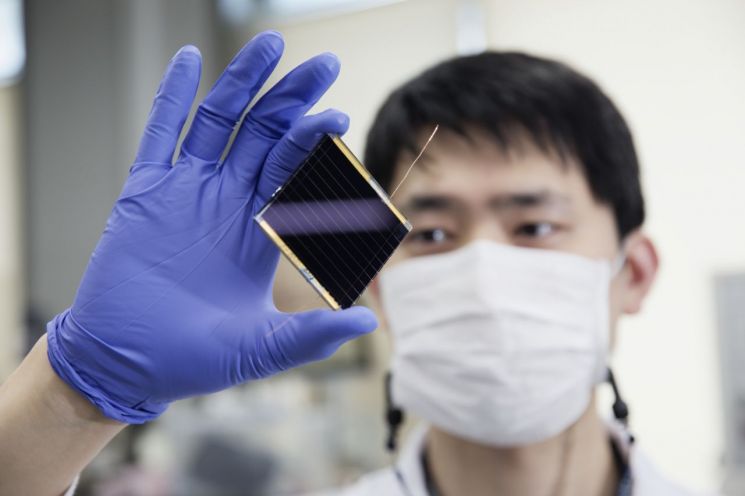
[Asia Economy Reporter Kim Bong-su] A Korean research team has set a new world record for the highest efficiency of perovskite solar cells, a next-generation solar cell material attracting attention.
The Ulsan National Institute of Science and Technology (UNIST) announced on the 6th that Professor Jin-Young Kim's team from the Department of Energy and Chemical Engineering, together with Dr. Dong-Seok Kim's research team from the Korea Institute of Energy Research and researchers from the Swiss Federal Institute of Technology Lausanne (EPFL), developed a perovskite solar cell with a solar-to-electric conversion efficiency of 25.6%.
This is the highest efficiency reported in a formal paper for perovskite solar cells. The previous highest record was 25.2%, jointly achieved by the Korea Research Institute of Chemical Technology (KRICT) and the MIT research team in the United States in 2019.
Perovskite solar cells are gaining attention as next-generation solar cells because they are easier to manufacture and have lower production costs compared to conventional silicon solar cells. In particular, they can be processed to be flexible, making them suitable for wearable materials. Consequently, there is intense international research competition to improve photoelectric conversion efficiency for practical use. In Korea, KRICT reclaimed the world’s top spot in April 2019 by surpassing the Chinese Academy of Sciences’ perovskite efficiency record of 23.7% with 24.2%, and then further improved the record to 25.2% in August of the same year, widening the gap with China by more than 1.5%, maintaining a leading position.
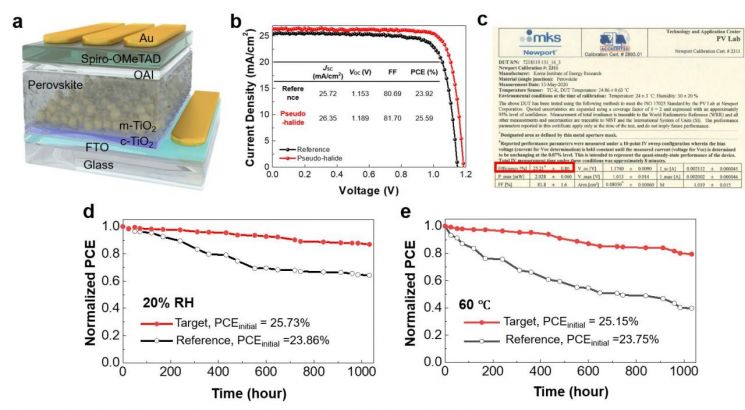
The research team improved efficiency by changing the combination of constituent elements in the core perovskite material using a new approach. This research is also expected to aid the development of optoelectronic devices such as next-generation displays based on perovskite materials.
Perovskite is a material composed of one anion and two cations forming a regular three-dimensional structure (crystal). It is easy and inexpensive to synthesize. This is why perovskite solar cells are expected to reduce the cost of solar power generation.
However, the efficiency of solar cells using this material still falls short of commercial (silicon) solar cells, and their durability is also inferior. To improve this, active research has been conducted to enhance efficiency and material stability by altering the combination of cations and other factors.
The joint research team enhanced the efficiency and durability of the solar cells by replacing a portion (2% solution content) of the anions in the perovskite with a substance called formate (HCOO-). Formate helps the regular three-dimensional structure inside the perovskite material to grow firmly. This is because formate interacts with metal cations to strengthen the bonding force. Using materials with well-grown regular crystal structures (high crystallinity) results in higher cell efficiency. In fact, the efficiency improved by more than 10% compared to perovskite cells without formate added.
Professor Jin-Young Kim explained, “We broke the fixed idea that only iodide (I-) or bromide (Br-) ions can be used as anions,” adding, “We focused on the fact that the size of formate is similar to that of the existing anions.”
Dr. Dong-Seok Kim, who was in charge of cell fabrication, said, “We designed and fabricated solar cell cells with structures that maximize efficiency using the developed material and secured a high certified record of 25.2%. It will be advantageous for commercialization as it is possible to produce cells of the same quality.”
The research results were published on the 5th in the international scientific journal 'Nature.'
© The Asia Business Daily(www.asiae.co.kr). All rights reserved.
![Clutching a Stolen Dior Bag, Saying "I Hate Being Poor but Real"... The Grotesque Con of a "Human Knockoff" [Slate]](https://cwcontent.asiae.co.kr/asiaresize/183/2026021902243444107_1771435474.jpg)

















