Overall examinees prefer 'Speech and Composition' and 'Probability and Statistics'
Top-tier students favor 'Language' corresponding to the 'Grammar' section
Math score gap between humanities and sciences 14.9 points... "Grade prediction becomes difficult"
Evaluation Institute: "Common subject weighting is higher when converting to standard scores"
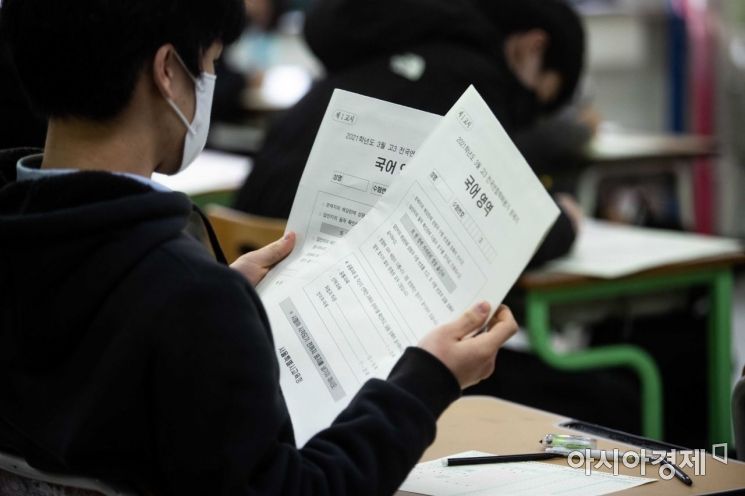 On the 25th, when the national joint academic achievement test for high school seniors was conducted, examinees at Gyeongbok High School in Jongno-gu, Seoul, are checking their test papers. Photo by Jinhyung Kang aymsdream@
[Asia Economy Reporter Han Jinju] In the March nationwide joint academic assessment conducted according to the 2022 academic year College Scholastic Ability Test (CSAT) system, the preference for elective subjects differed between top-ranking students and the overall student population.
According to the analysis of the March academic assessment by Etoos Education Evaluation Research Institute, more than half of the students in the top 1st and 2nd grades chose Language and Media and Calculus as their elective subjects. Among 1st-grade students, 64.4% selected Language and Media, while 52.3% of 2nd-grade students chose the same subject. In mathematics, 82.7% of 1st-grade students took Calculus, and 64.4% of 2nd-grade students took Calculus as well.
More Students Take 'Speech and Writing' in Korean, but Top Students Prefer 'Language and Media'
When expanded to include all students entered in Etoos's 'Academic Assessment Full Service' database, the results differed. For Korean, 67.2% took Speech and Writing, while 32.8% took Language and Media, showing the opposite trend. For mathematics elective subjects, the participation rates were 59% for Probability and Statistics, 35% for Calculus, and 6% for Geometry.
Based on the mathematics domain, the group that took Probability and Statistics, mainly chosen by humanities students, had a higher rate of selecting Speech and Writing. Conversely, the group that took Calculus and Geometry, mainly chosen by science students, had a higher rate of selecting Language and Media.
Kim Byungjin, director of Etoos Education Evaluation Research Institute, explained, "It can be interpreted that the tendency of top-performing students in grades 1 and 2 to prioritize science subjects influenced this outcome. Due to the nature of the subjects, the process of deriving answers in Language and Media, especially in the language section, is clearer than in Speech and Writing, which seems to have influenced students aiming for science tracks."
The clearer scope of study in Language and Media compared to Speech and Writing, and the fact that 'language' corresponds to the grammar section in the existing CSAT, means that if learning is completed well, the likelihood of variables occurring is low, which is believed to have increased the participation rate among top students.
Director Kim added, "Since the attribute of elective subject groups is important in the 2022 CSAT score calculation structure, the fact that many top students chose Language and Media suggests that this group may have a relative advantage. However, this can change depending on the difficulty of common subjects and elective subjects, so it is difficult to make a definitive statement."
 On the 25th, when the 2021 academic year nationwide joint academic achievement test for third-year high school students was conducted, examinees were taking the exam at Seoul Girls' High School in Mapo-gu, Seoul. Photo by Kim Hyun-min kimhyun81@
Mathematics Elective Subjects: Disadvantage for Humanities? Confusion Inevitable
In mathematics, there is a significant score gap between humanities and science tracks, raising concerns that humanities students may experience confusion. According to a survey conducted by Jongro Academy Haneul Education on 11,326 students immediately after last month's academic assessment, the average score for the common mathematics subject was 33.6 for humanities students, 48.6 for science students taking Calculus, and 44.2 for those taking Geometry, resulting in a 14.9-point difference between humanities and science tracks.
Notably, among students in the 1st grade for mathematics, only 14.9% of humanities students chose Probability and Statistics, and 21.1% were in the 2nd grade. Students who chose Calculus as their elective subject could enter the 1st grade if they scored 12 out of 26 points in the elective subject and 70 points in the common subject.
Lim Seongho, CEO of Jongro Academy Haneul Education, pointed out, "Students who chose Probability and Statistics are estimated to have received 2nd grade even with a score of 83, whereas students who chose Calculus or Geometry entered the 1st grade. This has caused a situation where grades drop depending on the elective subject. Humanities students find it very difficult to enter the top grade in mathematics, and science students can enter higher grades even if their elective subject scores are low, depending on how they perform in the common subject."
Lim explained, "It has become very difficult for 12th-grade students to predict CSAT grade scores. With repeat students joining the June mock exam and half of the repeat students expected to take the CSAT, score prediction and university applications are expected to be quite confusing."
Common Subjects Account for 75% of Scores... Ultimately, the Key is 'Common Subjects'
This year's CSAT eliminated the distinction between humanities and science tracks in line with the 2015 revised curriculum. Basic learning content is covered by common subjects, and other content is taken as elective subjects. With Korean and mathematics changing to a 'common subject + elective subject' structure, the scoring method also changed. For Korean, out of 45 questions, 34 are common subjects, and students must choose one elective subject (11 questions) between Speech and Writing and Language and Media. For mathematics, 22 out of 30 questions are common subjects, covering Mathematics I and II, and students choose one elective subject (8 questions) from Probability and Statistics, Calculus, or Geometry. The Korea Institute for Curriculum and Evaluation previously announced that "the weight of common subjects is about 75%, and the results of common subjects compensate for differences in elective subjects."
Both Korean and mathematics scores are reported as standard scores. Unlike raw scores, standard scores are calculated by summing weighted scores. Grades for each subject are also determined based on standard scores according to proportions: 1st grade is 4%, 2nd grade 7%, 3rd grade 12%, 4th grade 17%, etc. In other words, the results of common subjects have a significant impact on standard scores and grades. If the raw score in common subjects is high, the final standard score is calculated higher, as the weighting of common subjects is higher than that of elective subjects, according to the evaluation institute.
The institute explained, "Even if two students have the same raw scores in common and elective subjects, their final standard scores may differ if their elective subjects differ. This is because the composition of test takers by elective subject (distribution of common subject scores) is reflected in the final standard score."
© The Asia Business Daily(www.asiae.co.kr). All rights reserved.


















