First time in two months since the rapid spread of COVID-19, inflation rate stays in the 1% range
Agricultural, livestock, and fishery products up 13.7%... Green onions up 305.8%
Impact of rising international oil prices... Industrial product prices rise for the first time in 11 months
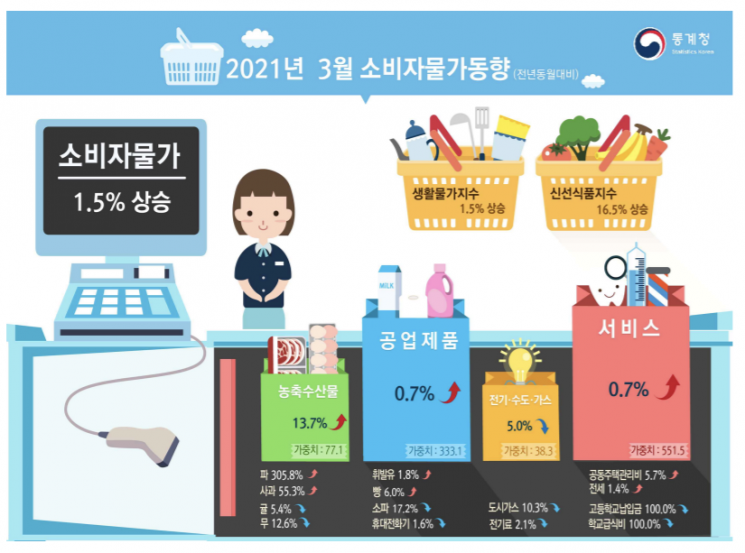
[Sejong=Asia Economy Reporter Kim Hyunjung] The consumer price index in March rose 1.5% compared to last year, marking the largest increase in one year and two months. This is the first time since the spread of COVID-19 that the inflation rate has remained in the 1% range for two consecutive months. Industrial product prices stopped declining after one year due to the impact of rising international oil prices, while prices of agricultural, livestock, and fishery products such as fruits and vegetables continued to show strong upward trends due to poor crop conditions.
According to the 'March Consumer Price Trends' announced by Statistics Korea on the 2nd, the consumer price index last month recorded 107.16 (2015=100), up 1.5% compared to the same month last year. This is the highest increase since January last year (1.5%). The consumer price inflation rate stayed in the 0% range from October (0.1%), November (0.6%), December (0.5%) last year to January (0.6%) this year, then showed 1.1% in February and 1.5% in March, maintaining the 1% range for two consecutive months. This is the first time since March last year, when COVID-19 rapidly spread, that consumer prices have risen in the 1% range for two consecutive months.
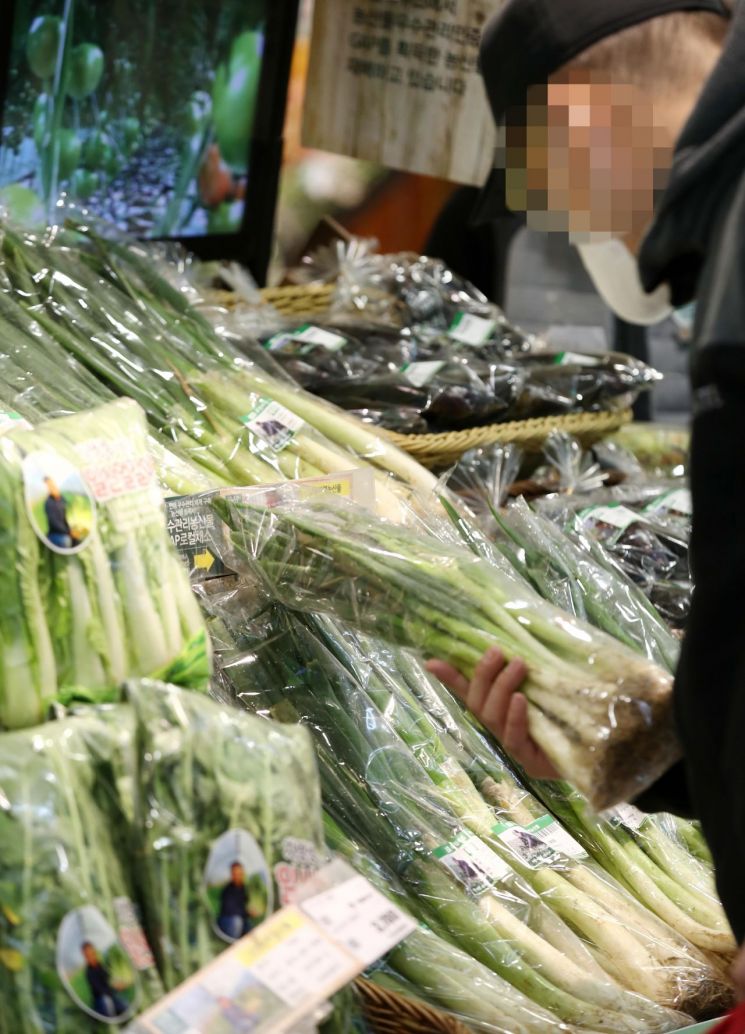
◆Continued burden on grocery prices= Prices of goods rose 2.5% compared to a year ago. Agricultural, livestock, and fishery products rose 13.7%, continuing double-digit growth, though the increase narrowed compared to the previous month (16.2%). Agricultural products rose 19.2%, livestock products 10.2%, and fishery products 1.8%. Due to poor crop conditions caused by typhoon weather deterioration, green onion prices soared 305.8%. This is the largest increase since April 1994 (821.4%). However, the price increase is expected to stabilize as early-harvested green onions are shipped this month. Apples (55.3%) and eggs (39.6%) also showed upward trends, and prices of rice (13.1%) and domestic beef (11.5%) rose, continuing to increase the burden on grocery prices.
Industrial product prices, which had been declining, rose 0.7% due to the impact of rising international oil prices and increased prices of processed foods, marking the first increase since April last year (0.7%). Electricity, water, and gas prices fell 5.0%.
Service prices rose 0.7% compared to a year ago. Personal services increased 1.8%, while public services fell 2.0%. Among personal services, dining-out prices rose 1.5%, recording the highest increase since September 2019 (1.4%). Statistics Korea analyzed that this was influenced more by price increases in cafeteria meals and sashimi rather than demand recovery. Rent rose 1.0% compared to a year ago. The increase rates for jeonse (long-term deposit lease) and monthly rent were 1.4% and 0.6%, respectively. Among these, monthly rent recorded the highest increase since November 2014 (0.6%).
The index excluding agricultural products and petroleum rose 1.0%, and the index excluding food and energy rose 0.6%. The living cost index rose 1.5% compared to a year ago, and the fresh food index jumped 16.5%.
◆Demand-driven factors still influencing price increases... Upward trend likely to continue next month= Although inflation is accelerating, Statistics Korea judges that it is not at a 'serious' level that would raise concerns about inflation. The cumulative consumer price inflation rate comparing the average price level from January to March this year with the same period last year is about 1.1%.
Oh Woonseon, Director of Economic Trend Statistics Review at Statistics Korea, said, "Looking at the cumulative inflation rate (1.1%), it is difficult to say it is at a serious level," and emphasized, "Although various factors are involved, it is not a situation where we can say the inflation rate will expand significantly."
Regarding future upward inflation factors, he explained, "Demand-side factors such as improved consumer sentiment and supply-side factors such as international oil prices may act," adding, "Also, the low inflation in April and May last year will have a base effect." He further added, "Stabilization of agricultural and livestock prices will be a downward factor, and the situation may change rapidly depending on the development of COVID-19."
© The Asia Business Daily(www.asiae.co.kr). All rights reserved.
![Clutching a Stolen Dior Bag, Saying "I Hate Being Poor but Real"... The Grotesque Con of a "Human Knockoff" [Slate]](https://cwcontent.asiae.co.kr/asiaresize/183/2026021902243444107_1771435474.jpg)












