Claiming 'Pangyo New Town Level' but Success Uncertain Due to Public-Led Distrust
Ruling Party Pushes for Mortgage LTV Relaxation Amid Growing Policy Confusion Between Party and Government
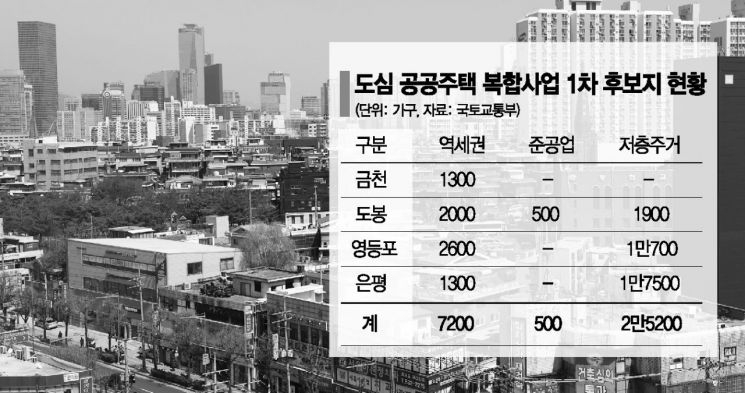
[Asia Economy reporters Kangwook Cho and Mone Won] Since the LH speculation scandal, the government’s real estate policy has fallen into a total crisis, losing not only trust but also justification and momentum. Although it announced 21 candidate sites for the urban public housing complex development project, self-praising the scale as equivalent to the “Pangyo New Town,” most of these sites have not even gauged residents’ willingness to participate.
Another factor causing doubts about the success of supply expansion measures is the continued emphasis on “public-led” initiatives by entities such as LH and Seoul Housing and Communities Corporation (SH).
Moreover, with the ruling party ahead of the Seoul mayoral election hinting at the possibility of easing existing mortgage loan-to-value (LTV) ratios, policy confusion between the party and government is growing. Controversies over rent increases, reflecting a typical “double standard” by key ruling party figures, have also emerged, raising concerns that the current government’s 25th real estate measure may fail to even get off the ground.
◇ From Announcement... Resident Consent Comes Later = On the 31st, the government announced 21 candidate sites for the urban public housing complex development project, including areas around Gasan Digital Station in Geumcheon-gu, Yeonsinnae Station in Eunpyeong-gu, and Yeongdeungpo Station in Yeongdeungpo-gu, Seoul. If the project proceeds smoothly, the supply volume alone would be on par with the Pangyo New Town.
The key issue is whether residents will consent. This project requires landowners’ consent of 10% to request district designation, and after the area is designated as a planned district, consent from two-thirds of landowners within one year to proceed. Notably, all the candidate sites disclosed this time were recommended by local governments and consist of privately owned land. There has been strong backlash against the government’s unilateral decision to announce without prior consent from landowners. In fact, 371 residents of the former Jeungsan 4 district in Eunpyeong-gu, Seoul, recently sent a statement opposing the government’s designation of urban project candidate sites to the Ministry of Land, Infrastructure and Transport and the Seoul Metropolitan Government.
On the 1st, Yoon Sung-won, First Vice Minister of Land, Infrastructure and Transport, stated on a radio broadcast, “Since the floor area ratio and number of floors will increase, supply will rise by 40%, and landowners’ expected profits will increase by 30%. Because they will receive much higher returns than in private projects while public supply also increases, there should be no major problem in obtaining residents’ consent.”
However, distrust toward “public-led” initiatives due to speculation inducement and poor construction quality is widespread, making the project’s success uncertain. The Shingil 2, 4, and 15 districts (a total of 4,945 households expected), which were formerly New Town districts but are now low-rise residential candidate sites, have already requested re-designation as redevelopment zones to the district office at the end of last year and are pursuing private redevelopment.
Kwon Il, head of the research team at Real Estate Info, criticized, “The government is still talking about pie-in-the-sky ideas. There is no alternative plan for what to do if the expected returns are not met.”
◇ Borrow More to Buy a House?… Late ‘Vote Catching’ Amid Mixed Signals = Another problem is the conflicting voices between the government and ruling party regarding recent real estate loan policies. Ahead of the Seoul and Busan mayoral by-elections, the late introduction of vote-catching measures is aggravating market confusion.
The Democratic Party is pushing to ease the loan-to-value ratio (LTV) and debt-to-income ratio (DTI) for the housing mortgage of non-homeowners. This means loosening the LTV, which is the ratio of loan amount to collateral value when borrowing from financial institutions using a house as collateral, to open more pathways for non-homeowners to buy homes. Currently, LTV and DTI are set at 40-50% in regulated real estate areas, with a 10 percentage point increase for non-homeowners and actual demanders. The party is reportedly considering raising this up to 70%. In this case, a non-homeowner buying a 500 million won apartment in a speculative or overheated speculation district could borrow up to 350 million won.
However, this is completely opposite to the initial stance of the current government, which has emphasized “housing price stabilization” through tightening loans since its inauguration. It also contradicts the government’s tough stance on real estate speculation, which introduced LTV regulations on non-mortgage loans such as land loans. This has led to ridicule that this is a belated desperate measure to win votes amid policy failures.
Furthermore, controversies over rent increases involving former Blue House Policy Chief Kim Sang-jo, who was dismissed, and Democratic Party lawmaker Park Ju-min, who proposed amendments to the Housing Lease Protection Act, are amplifying distrust in both the government and ruling party policies.
Lee Eun-hyung, senior researcher at the Korea Construction Policy Institute, pointed out, “At this point, restoring the credibility of the public sector seems to be the top priority. To do so, visible precedents, that is, successful pilot cases, must be shown to residents first.”
© The Asia Business Daily(www.asiae.co.kr). All rights reserved.

















