Increase in Safety Accidents Related to Hand Sanitizers
Children's 'Eye' Accidents Due to Sanitizer Placement and Eye Level
Experts "Follow Sanitizer Usage Precautions... Ensure Thorough Management"
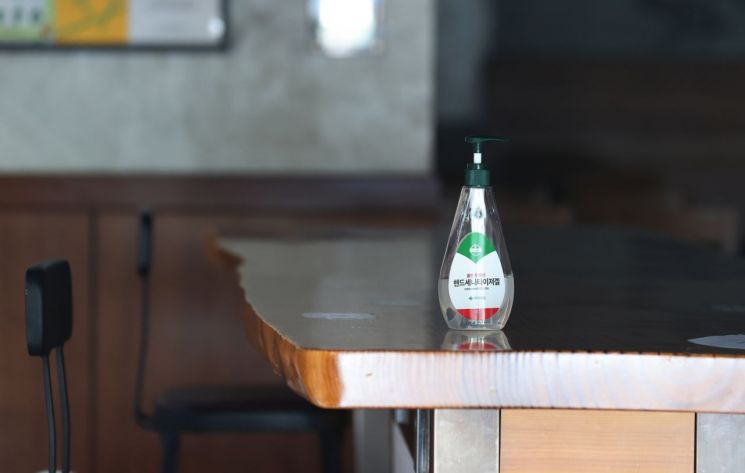
[Asia Economy Reporter Kim Soyoung] As the COVID-19 pandemic has prolonged, hand sanitizers that can prevent infection have become an essential item in daily life. However, safety accidents such as the sanitizer splashing into eyes or being mistaken for food and ingested have also increased significantly, requiring caution.
Last year, a total of 69 cases related to hand sanitizer hazards were reported to the Consumer Injury Surveillance System (CISS). This is about 17 times higher compared to 4 cases in 2019.
Analyzing 55 cases where the affected body part could be identified, 40 cases (72.8%) involved the 'eye.' Cases where swallowing hand sanitizer caused problems in the 'internal digestive system' accounted for 11 cases (20.0%).
Among the 40 eye safety accidents caused by sanitizer, 24 cases (60.0%) occurred in children aged 14 or younger. Eye injuries frequently happened to children whose height was the same as or lower than the sanitizer's placement, especially shorter young children, who used sanitizers installed in public places such as elevators or restaurants, resulting in sanitizer splashing into their eyes.
 A child who suffered a corneal burn after hand sanitizer got into their eye. Photo by YTN News Capture
In fact, one child who experienced such an accident tried to use a sanitizer placed higher than their height in an elevator, but the sanitizer sprayed suddenly and splashed into their eye. A hospital examination revealed a 'corneal burn,' causing the cornea to peel.
As in the above case, sanitizers contain alcohol concentrated at over 60%, so if it comes into direct contact with the eyes, it can cause severe injuries such as corneal damage, requiring caution.
Not only children but adults have also experienced related accidents. These incidents arise from situations where the sanitizer is sprayed like a mist due to pressure differences, regardless of the sanitizer's height or distance.
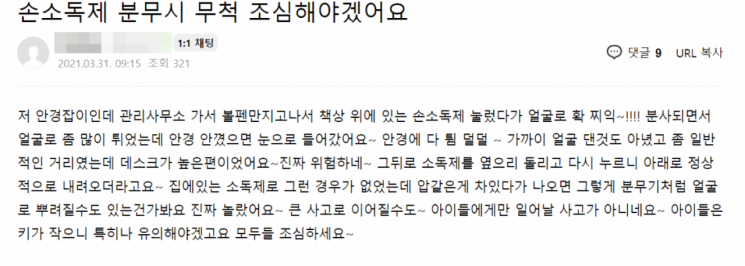
One netizen wrote on an online community, "I pressed the hand sanitizer on the desk, and it sprayed all over my face. If I hadn’t been wearing glasses, it would have gotten into my eyes," adding, "I wasn’t even that close to it; it was a fairly normal distance."
He continued, "It seems that when pressure builds up and is released, it can spray like a mist onto the face. This isn’t an accident that only happens to children," and added, "Since children are shorter, extra caution is needed."
Alongside various accident cases during sanitizer use, there have also been cases of digestive system hazards. Among 11 such cases, 6 (54.5%) involved users aged 15 or older who mistook hand sanitizer for syrup at a cafe and mixed it into drinks or confused pouch-type sanitizers with beverages or jelly and ingested them. The remaining 5 cases (45.5%) involved children under 5 years old at home who ate or swallowed sanitizer.


Such accident cases can also be easily found in online communities. One netizen shared, "I squeezed hand sanitizer onto my hand, and it felt sticky, so I realized I was rubbing syrup (on my hand). I almost put hand sanitizer into coffee thinking it was syrup before," recounting the situation.
Other cases include spraying sanitizer on a bus only to find out it was actually a car cleaner, or getting burned after lighting a candle immediately after applying sanitizer.
Moreover, with rising temperatures recently, there is a need for vigilance regarding summer fire accidents related to sanitizers. Storing hand sanitizer for long periods inside a vehicle with high indoor temperatures poses risks of fire or explosion. Smokers should allow sufficient time after using sanitizer before lighting a cigarette.
In the U.S., a woman suffered third-degree burns on her face and body when a small flame from lighting a candle touched a hand sanitizer container she had applied, causing an explosion.
Regarding this, the Fire Agency has released a 'Safe Hand Sanitizer Usage Manual' which includes: △ Do not store hand sanitizer inside vehicles. △ Allow hand sanitizer on hands to dry completely before using fire. △ Be careful to prevent sanitizer from getting into eyes. △ If it gets into eyes, rinse with running water and seek medical treatment. △ Keep the sanitizer cap tightly closed to prevent leakage.
Experts emphasize the importance of checking and adhering to precautions when using sanitizers. Professor Ra Kwanghyun of Dong-A University’s Department of Police and Fire Science said, "As hand sanitizers are used routinely, people have become accustomed to them and seem to have become insensitive to the risks that can occur during their use," adding, "Sanitizers should be stored and used according to precautions, such as not storing them in vehicles during summer."
He also stressed, "Stores or other institutions where sanitizers are provided should ensure that sanitizers are clearly distinguishable from other products, and especially provide thorough guidance and management to prevent accidents involving young children who come and go."
© The Asia Business Daily(www.asiae.co.kr). All rights reserved.
![Clutching a Stolen Dior Bag, Saying "I Hate Being Poor but Real"... The Grotesque Con of a "Human Knockoff" [Slate]](https://cwcontent.asiae.co.kr/asiaresize/183/2026021902243444107_1771435474.jpg)


















