"Monthly Earnings Drop from 45 Million to 10 Million Won... Never Seen Such a Bad Economy"
No Fatal Accidents in 21 Years... Criticism of Baseless Safety Concerns
Uljin County to Challenge Procedural Illegality of One-Sided Energy Policy Until the End
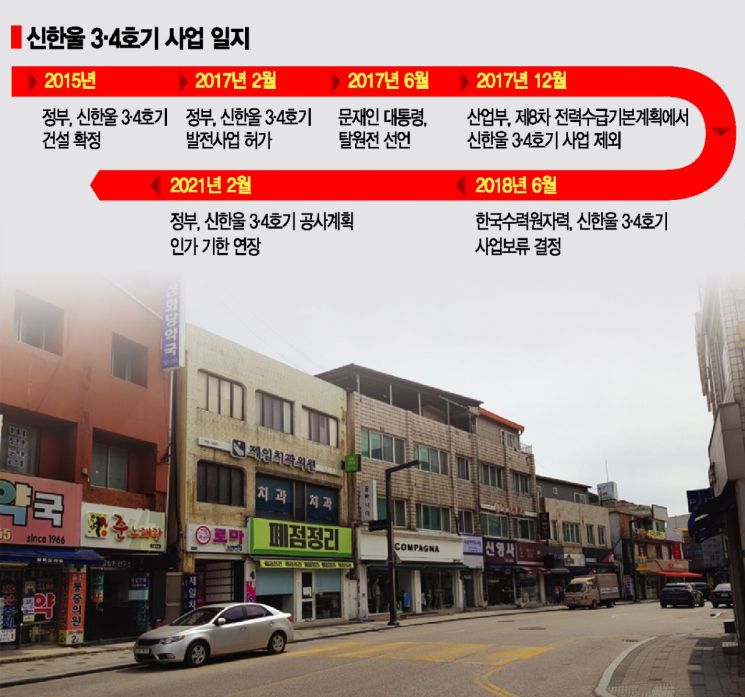 On the afternoon of the 24th, many stores located on Uljin Jungang-ro, the largest downtown area in Uljin, Gyeongbuk, were vacant, and the streets were so deserted that no people could be seen. As the construction of Shin Hanul Units 3 and 4 was halted, the hollowing out worsened, causing the local economy to collapse and the downtown commercial district to suffer a severe blow.
[Uljin=Asia Economy Reporter Kwon Haeyoung] The local sentiment is boiling over due to the government's successive nuclear phase-out measures. Following the suspension of the construction of Shin Hanul Units 3 and 4 in Uljin, Gyeongbuk, the official cancellation of the Yeongdeok Cheonji Nuclear Power Plant project on the 29th has sparked reactions that it will plunge not only into financial losses but also severe stagnation of the local economy. Contrary to the Moon Jae-in administration's nuclear phase-out policy, support for nuclear power is actually increasing in regions with nuclear plants.
"Sales have dropped to a quarter of what they were 3 to 4 years ago. The cancellation of Shin Hanul Units 3 and 4 construction caused outsiders to leave like a receding tide. After raising Uljin's dependence on nuclear power to this level, now not building Units 3 and 4 means the residents are on the brink of starvation."
On the afternoon of the 24th, at Uljin Jungang-ro, the largest downtown area of Uljin where the county office, Nonghyup, shops, and traditional markets are concentrated, Nam Sangjoong (67), who has operated a men's clothing store in front of Uljin County Office for 31 years, sighed, saying, "The Uljin economy has never been this bad." Sales, which were around 45 million won per month when the current government took office in 2017, rapidly declined from two years ago and fell to about 10 million won per month due to the overlapping impact of COVID-19 last year. Even during the 1997 financial crisis, this flagship store on Jungang-ro recorded monthly sales of 25 million won, but these days there are many days when they return home empty-handed. The suspension of Shin Hanul Units 3 and 4 construction led to the withdrawal of construction and civil engineering subcontractors, and outsiders leaving Uljin caused the commercial district to collapse. COVID-19 poured cold water on the already cooling local economy.
The Jungang-ro visited that day was so depopulated that it was hard to find people. In one block about 100 meters long and wide, there were nine vacant stores with "For Rent" signs posted. It was difficult to find customers in the open stores, and even pedestrians were rare. The traditional market, Uljin Bajige Market, was also desolate. Buk-myeon, where the Shin Hanul Units 3 and 4 site is located, and nearby Jukbyeon-myeon took a direct hit, and as nuclear-related work decreased, residents switched to farming or sought new jobs such as street cleaning.
Mr. Nam raised his voice, saying, "Is there any guarantee that the next government will not pursue de-solar or de-wind policies? Even if each administration has different goals, if energy policies that should be planned for 100 years are overturned in an instant, no citizen can trust the government."
A Mr. A, who runs an eyeglass store nearby, said, "In the 21 years since settling in Uljin, I have never heard of any casualties caused by nuclear power plants. We now live with nuclear power. It is more urgent to deal with daily livelihood issues than to stop nuclear projects based on unfounded safety concerns," he lamented.
The contraction of Uljin's local economy began after the current government took office and the nuclear phase-out policy was intensified. Shin Hanul Units 3 and 4 were confirmed for construction in 2015 and received power generation business permits in February 2017, but were stranded after President Moon Jae-in's nuclear phase-out declaration in May of the same year. The government excluded Shin Hanul Units 3 and 4 from the 8th Basic Plan for Electricity Supply and Demand in December 2017, and Korea Hydro & Nuclear Power decided to suspend the project in June 2018. This caused social and economic losses such as population decline, regional hollowing out, employment reduction, and collapse of local industries and commercial districts in Uljin. The population of Uljin County decreased from 51,738 in May 2016, before President Moon's inauguration, to 49,314 as of 2019. Uljin County estimates that the loss in regional gross domestic product (GRDP) due to the suspension of Shin Hanul Units 3 and 4 construction amounts to 324.6 billion won annually.
Taxi driver Jeon Byungcheol (56), who introduced himself as having worked in the nuclear industry for over 10 years, said, "I even went to the United Arab Emirates (UAE), where Korea exported nuclear power plants, but I started driving a taxi because there was no nuclear-related work. I'm worried not only about making a living but also because our nuclear competitiveness, including accumulated technology and manpower, is collapsing rapidly," he said.
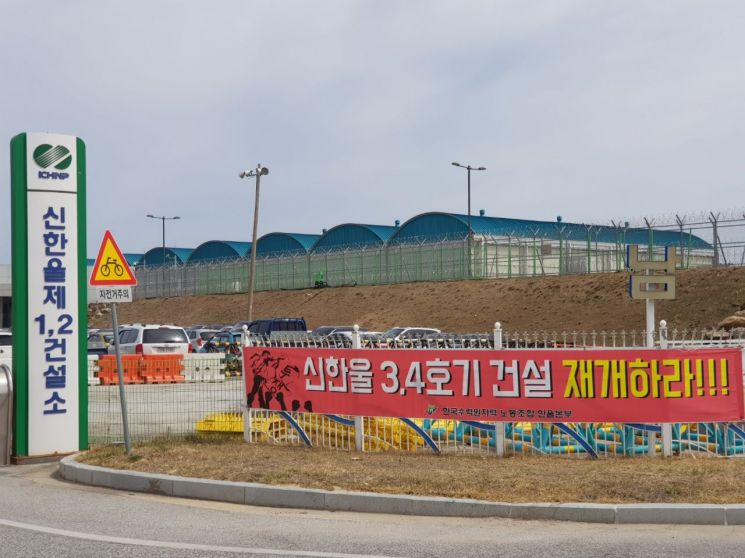 On the 24th, a banner demanding the resumption of construction of the canceled Shin Hanul Units 3 and 4 was displayed near the site of Shin Hanul Units 1 and 2, located in Buk-myeon, Uljin, Gyeongbuk.
The Uljin community is angry at the current administration's one-sided nuclear phase-out policy. Past governments persuaded residents opposing nuclear power to build Hanul Unit 1, which began operation in 1988. While six nuclear reactors currently operate in Uljin, the economic center of the region shifted from agriculture and fisheries to nuclear power. The government is now pressing the nuclear phase-out accelerator against Uljin residents who have built their livelihoods based on nuclear power. Shin Hanul Units 1 and 2, scheduled to start operation in April 2018, have been halted for three years, and the fate of Units 3 and 4 has been left to the next administration. All social and economic losses incurred so far have fallen solely on Uljin residents. According to a survey conducted by Uljin County Office, 80% of Uljin residents support the construction of Shin Hanul Units 3 and 4. At the Shin Hanul Units 1 and 2 site visited by the reporter, several banners demanding the resumption of construction, such as "Resume Shin Hanul Units 3 and 4 construction" and "The Blue House must immediately withdraw the energy transition policy," fluttered in the wind.
Uljin County Council member Jang Yudeok emphasized, "The government unilaterally broke its promises and thoroughly ignored the opinions of the local residents, who are the parties concerned. We will pursue the procedural illegality of the nuclear phase-out to the end and, if necessary, file a constitutional complaint."
Replacing nuclear power were solar and wind power. Beyond the coastal road connecting Hupo, Yeongdeok, and Pohang, mountains, fields, and rooftops filled with solar panels were visible. It was not difficult to find wind turbines either. The government's energy transition policy was penetrating Uljin and various parts of Gyeongbuk, seemingly indifferent to the collapsed local economy caused by the nuclear phase-out.
© The Asia Business Daily(www.asiae.co.kr). All rights reserved.


















