Domestic Researchers Develop Nano-Optical Tweezers
Doctoral Team Seo Mina & Yoo Yongsang, KU-KIST Convergence Graduate School
KIST "New Pathway for Detecting Biomarkers in Liquid Samples like Saliva and Sweat"
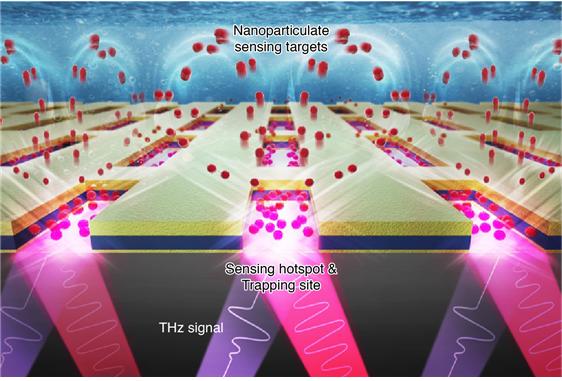 Schematic of a novel photo-electrical tweezer concept combining nanoparticle trapping and terahertz (THz) wave amplification technology. Photo by Korea Research Foundation
[Asia Economy Reporter Kim Bong-su] A nano-optical tweezer technology capable of collecting and analyzing microplastics in water has been developed by domestic researchers.
The National Research Foundation of Korea announced on the 30th that a research team led by Dr. Min-A Seo and Dr. Yong-Sang Yoo from the Korea Institute of Science and Technology (KIST) and the KU-KIST Graduate School of Converging Science and Technology at Korea University developed a nano-optical tweezer technology that simultaneously functions as tweezers capable of capturing micro-sized substances ranging from tens to hundreds of nanometers, such as microplastics and biopolymers, and as a sensor capable of real-time quantitative and qualitative analysis.
Unlike mechanical tweezers that use the principle of a lever, this is an electrical tweezer and at the same time an optical sensor using light of a specific wavelength, expected to open new avenues for detecting underwater micro substances or biomarkers in liquid samples such as blood or bodily fluids.
The research team developed a novel optical-electrical tweezer combining nanoparticle trapping and terahertz wave (THz) amplification technology. Terahertz waves, which vibrate one trillion times per second, have very long wavelengths and low optical energy, making them harmless to the human body and used in non-destructive testing. However, due to their characteristics of being mostly absorbed by water and having low sensitivity to trace substances, they have not been utilized in research for capturing and analyzing underwater micro substances.
The research team devised a method to prevent signal loss underwater while amplifying the signal to increase sensitivity by tens to hundreds of times. They integrated an electrical tweezer technology that traps ultra-trace nanoparticles with a highly sensitive optical sensor that uses terahertz wave changes amplified by a metasurface. This technology utilizes the principle that the transmittance or resonance frequency of terahertz waves changes according to the refractive index, which varies depending on the presence and aggregation degree of micro particles.
To avoid terahertz wave absorption by water during this process, a reflective sensor system that does not pass through water was adopted. Additionally, a metasurface sensor with nanometer-sized microstructures was used to actively trap particles while simultaneously monitoring them. By maximizing the terahertz wave signals subtly altered by the refractive index of micro particles, it enables non-contact monitoring of ultra-trace micro particles without preprocessing such as fluorescent labeling.
As a result, the research team secured sensitivity capable of detecting ultra-trace micro particles at about 1 p.p.m. (parts per million, one-millionth) present in approximately 40μl (microliters). This can also be applied to tracking and analyzing ultra-trace biomarkers at the p.p.b. (parts per billion, one-billionth) level typically found in liquid samples such as blood or saliva.
This research was published on the 24th in the international journal in the field of materials science, Advanced Science.
© The Asia Business Daily(www.asiae.co.kr). All rights reserved.

















