MOEF Guidelines Within 2.8% but Generously Set Based on Staffing Standards
LH Sets Last Year's Average Employee Salary Increase Rate at 19.1% in Budget
[Sejong=Asia Economy Reporter Joo Sang-don] It has been revealed that government-affiliated public enterprises are budgeting employee salary expenses higher than the actual payment amount. According to the government's budget formulation guidelines, public enterprises cannot increase regular employee salaries by more than 2.8% annually, but a budgeting practice of 'let's just increase it first' continues. Since the amount budgeted but not actually spent is treated as unspent funds, there are concerns that this encourages budget inefficiency. In particular, Korea Land and Housing Corporation (LH), which showed severe moral hazard amid employee speculation controversies, was found to have increased the regular employee salary budget by nearly 20% compared to the previous year during the budget formulation process.
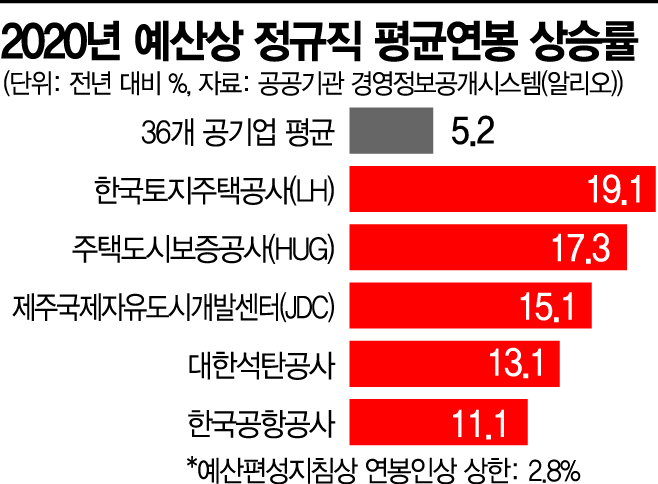
On the 29th, Asia Economy conducted a full survey of 36 market-type and quasi-market-type public enterprises through the public institution management information disclosure system Alio. According to the survey, the average salary of general regular employees in the budget last year was 77,671,000 KRW, which is 5.2% (3,815,000 KRW) higher than the 73,856,000 KRW recorded in the 2019 settlement (excluding management evaluation performance bonuses). Performance bonuses are not included in the total salary under the public enterprise budget formulation guidelines for last year.
The public enterprise that reflected the highest increase rate was LH. Last year, LH's average employee salary was set at 81,012,000 KRW, which is 19.1% higher than the previous year's 68,025,000 KRW. An LH official explained, "The employee salary budget was set based on staffing levels, not actual headcount."
The second highest salary increase rate was set by Housing and Urban Guarantee Corporation (HUG) at 17.3%. A HUG official said, "As the organization size has recently grown, the staffing level of grade 4 employees, which serves as the basis for the employee salary budget, has increased. Since grade 4 employees' salaries are higher than the overall average, the budget reflects 240 employees, but the actual headcount is about 200, so the actual increase rate is significantly lower." Although the number of employees promoted to grade 4 based on years of service can be anticipated, the budget was prepared based on the maximum staffing level.
In 2020, five public enterprises, including LH and HUG, recorded employee average salary increase rates exceeding 10% in their budgets: Jeju Free International City Development Center (JDC) at 15.1%, Korea Coal Corporation at 13.1%, and Korea Airports Corporation at 11.1%, among others.
Both LH and HUG stated that, according to the Ministry of Economy and Finance's '2020 Public Enterprise Budget Formulation Guidelines,' they prepared the employee average salary budget based on staffing levels, and the actual increase rate is kept within 2.8%, so there is no problem. This is because the budget formulation guidelines clearly state that "the total personnel expense budget is, in principle, based on staffing levels."
However, not all public enterprises prepare employee average salary budgets based on staffing levels like LH and HUG. Among the 36 companies, including Korea Hydro & Nuclear Power and Korea Expressway Corporation, half (18 public enterprises) have employee average salary increase rates that do not exceed 2.8%. An official from a public enterprise pointed out, "We prepare the budget based on the increase standard for the relevant year, i.e., 2.8%, not staffing levels. If personnel expenses are based on staffing levels, it ultimately exceeds the budget formulation guideline standards, causing additional revision needs and increasing the scale of unspent budget."
© The Asia Business Daily(www.asiae.co.kr). All rights reserved.

















