Regulation Eased in High-Priced Management Areas 'Up to 90% of Market Price'
Daegu Hillstate Manchon 84㎡ Priced at 899.26 Million KRW
Concerns Over Price Reversal with Controlled Capital Region Ceiling Price Areas
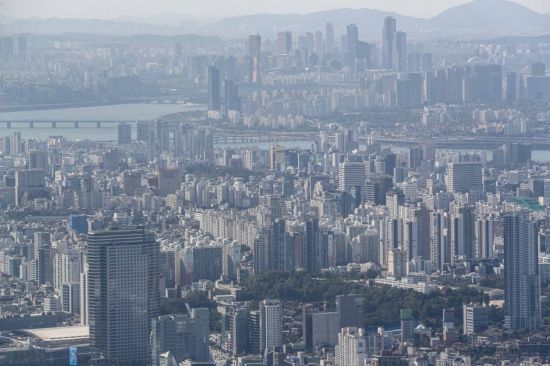
As apartment sale prices in high-priced management areas can now be set up to 90% of the surrounding market prices, sale prices in major provincial cities have started to fluctuate. Concerns are also being raised about the possibility of a price inversion between areas subject to the sale price ceiling system in the metropolitan area and high-priced management areas in the provinces. The sales market is experiencing mixed reactions.
According to the Korea Real Estate Board's subscription website on the 28th, Hyundai Engineering issued a resident recruitment announcement on the 26th for 'Hillstate Manchon Station,' scheduled to be supplied in Manchon-dong, Suseong-gu, Daegu, and officially began sales. The sale price for an 84㎡ (exclusive area) apartment (26th floor and above) was set at 899.26 million KRW. Including the 30 million KRW expansion cost, it reaches 920 million KRW.
For the 136㎡ unit, the price is 1.35573 billion KRW (26th floor and above) with an expansion cost of 42 million KRW. Based on the 84㎡ size, this is the highest sale price ever recorded for mid-sized apartments in Daegu. Previously, the highest sale price for mid-sized apartments in Daegu was for the 'Suseong Beomeo W' complex, sold in 2019, with the 84㎡ type priced in the 700 million KRW range.
The sharp rise in sale prices is due to changes in the high-priced sale price review system.
The Housing and Urban Guarantee Corporation (HUG) relaxed the criteria for reviewing high-priced sale prices on the 22nd of last month, allowing the sale prices of newly supplied apartments in high-priced management areas to be raised up to 90% of the surrounding market prices.
High-priced management areas are generally selected among regulated zones such as speculative overheating districts or adjustment target areas. Most of the metropolitan area (with some exceptions), as well as Busan, Daegu, Gwangju, Daejeon, Ulsan (Nam-gu and Jung-gu), Sejong, and Cheongju, which are adjustment target areas, are included.
Until now, high-priced management areas have been very popular among actual buyers by supplying multi-family housing at prices much lower than the surrounding market prices despite strong real estate regulations. This was often referred to as 'lottery sales.' However, since the relaxation of the high-priced sale price review criteria on the 22nd of last month, it is expected that 'lottery sales' will become rare in high-priced management areas.
Kim Byung-ki, team leader at Real House, explained, "With the significant relaxation of the sale price review criteria in high-priced management areas, the sale price regulations have effectively become meaningless," adding, "The actual sale price setting level is not much different from non-regulated areas, and strong real estate regulations still apply."
The heat of the subscription market has also changed due to the sharp rise in sale prices in high-priced management areas. 'Beommul Ilseong Truel,' which received first-priority subscription applications on the 15th in Suseong-gu, known as the 'Gangnam of Daegu,' recorded a single-digit competition rate of 8.2 to 1 on average.
There are also forecasts that the apartment sale prices in major provincial cities, including Daegu and Busan, have risen significantly, potentially causing a price inversion with major areas in Seoul where sale prices are controlled.
In Busan, for example, the price per 3.3㎡ of apartments in popular areas like Haeundae approaches 40 million KRW, whereas it has been controlled below 18 million KRW until now. With the 90% ceiling applied, sale prices could rise up to 36 million KRW.
On the other hand, as of November last year, the average sale price per 3.3㎡ for apartments in Seoul was around 27 million KRW. For instance, the Gangdong Millennial Jungheung S-Class, which issued a recruitment announcement in July last year, had a sale price per pyeong of 25 to 26 million KRW.
Concerns are also growing that relaxing sale price controls will raise the threshold for homeownership, increasing dissatisfaction among actual buyers. If the sale price exceeds 900 million KRW, mid-term loans through public guarantees cannot be obtained. Buyers must directly finance about 60% of the sale price as mid-term payments along with the down payment. This has led to criticism that apartment subscriptions have effectively become a league for cash-rich individuals only.
Ko Jun-seok, adjunct professor at Dongguk University, said, "The purpose of real estate loans is to support those who lack cash immediately to secure housing," and added, "It is necessary to prepare measures to support mid-term loans even if the sale price exceeds 900 million KRW, especially for young people, early career workers, and those without homes."
© The Asia Business Daily(www.asiae.co.kr). All rights reserved.
!["The Woman Who Threw Herself into the Water Clutching a Stolen Dior Bag"...A Grotesque Success Story That Shakes the Korean Psyche [Slate]](https://cwcontent.asiae.co.kr/asiaresize/183/2026021902243444107_1771435474.jpg)
















