Electric Vehicle Price Downsizing as a 'Strength'... Technological and Cultural Limitations Remain Challenges
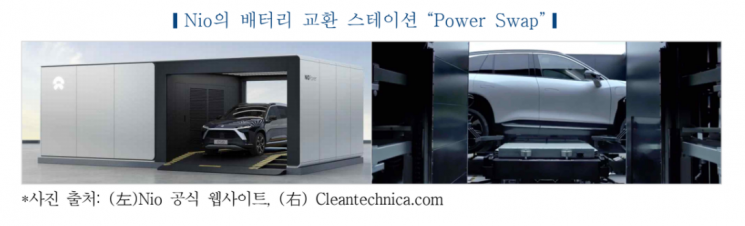
[Asia Economy Reporter Yoo Je-hoon] The Chinese automotive industry is steadily attempting to commercialize 'battery swap-type' electric vehicles (EVs). Some speculate that Chinese EV companies may be considering the lock-in effect in markets such as low-development countries through this approach.
According to the report "China's Battery Swap-Type Electric Vehicles and Their Potential" published on the 29th by the Korea Automotive Technology Institute, major automakers such as Nio, Shanghai Automotive Industry Corporation (SAIC), and Beijing Automotive Industry Corporation (BAIC) are promoting the commercialization of battery swap-type EVs. In Nio's case, it has shown swift movement by establishing Wuhan Weining Battery, a joint venture with battery company CATL for battery services.
Battery swap-type EVs operate by removing the driving battery pack with reduced residual capacity and installing another fully charged battery pack, securing sufficient driving range within minutes. This is similar to smartphones with removable batteries.
The Chinese government has been actively promoting battery swap-type EVs since shortly after the COVID-19 outbreak. The State Council of China initiated this by issuing a recommendation policy for EV battery swap stations in its work report last May, resulting in a total of 555 battery swap stations established nationwide by the end of last year.
Battery swap-type EVs are purchased at a vehicle price excluding the battery, which accounts for a significant portion of the EV cost, and operate by subscribing to battery swap services from service providers. From the consumer's perspective, the reduced battery price allows purchasing an EV at a price comparable to internal combustion engine vehicles, and the risk related to battery lifespan and performance degradation is relatively lower.
However, battery swap-type EV technology has yet to stand out in the global automotive industry. Although the advantage of lowering prices is clear, there are distinct economic and cultural limitations. First, for battery swap-type EVs to become widespread, the shape and interface of battery packs must be standardized, which imposes technical development constraints.
The Korea Automotive Technology Institute stated, "Due to standard specification constraints, technical attempts to improve battery performance may become difficult," adding, "Especially if cell-to-chassis integration technology is realized, the business competitiveness of battery swap-type EVs could decline."
There are also considerable economic and cultural constraints. Considering the battery swap facility price and maintenance costs, which range from approximately $500,000 to $1.7 million, sufficient utilization rates must be guaranteed. However, if charging speeds improve, users may decrease, worsening profitability. Additionally, there is skepticism about whether such subscription services would be an attractive option for consumers accustomed to full vehicle ownership.
In fact, the global automotive industry has not accelerated the commercialization of battery swap-type EVs. Renault, Tesla, and others previously pursued similar business models but reportedly failed to commercialize them fully.
The Korea Automotive Technology Institute emphasizes the need to focus on why the Chinese industry is accelerating the commercialization of battery swap-type EVs despite clear pros and cons. Combining charging stations and battery swap systems can further accelerate EV popularization and explore the potential of intelligent power grids through battery swap stations.
In particular, the lock-in effect related to the future car market can also be considered. If China exports EVs and battery swap business models as a package to countries with insufficient charging infrastructure, it can preempt the market and solidify entry barriers against competitors.
The Korea Automotive Technology Institute stated, "In some developing countries where power supply is unstable, it may be more reasonable to pre-charge batteries when power is available and swap them as needed rather than consumers charging EVs themselves," adding, "If China's battery swap system becomes the standard in those countries, consumers may become locked into that service and potentially avoid other EVs without battery compatibility."
© The Asia Business Daily(www.asiae.co.kr). All rights reserved.
!["The Woman Who Threw Herself into the Water Clutching a Stolen Dior Bag"...A Grotesque Success Story That Shakes the Korean Psyche [Slate]](https://cwcontent.asiae.co.kr/asiaresize/183/2026021902243444107_1771435474.jpg)
















