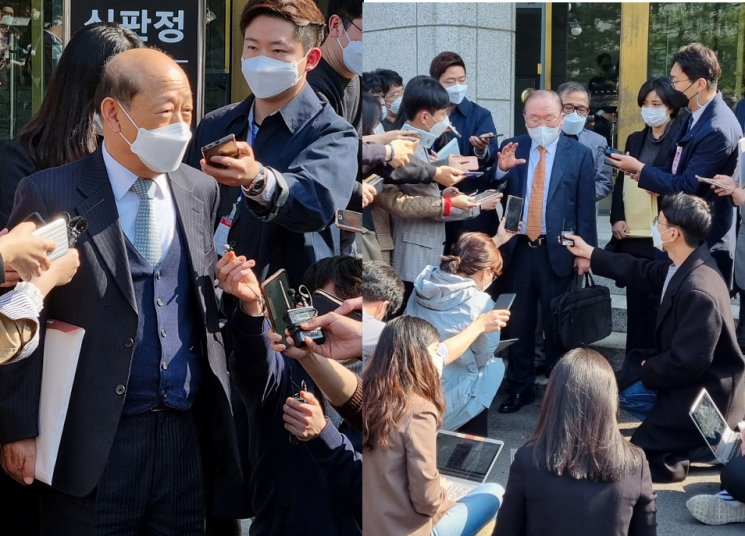
 Attorney Song Doo-hwan (left), representative of the petitioner in the impeachment trial case of former Busan High Court Chief Judge Lim Seong-geun, and Attorney Lee Dong-heup, representative of the respondent, are answering questions from the press after the preparatory hearing at the Constitutional Court in Jaedong, Jongno-gu, Seoul on the 24th. Photo by Choi Seok-jin
[Asia Economy Reporter Choi Seok-jin] The first preparatory hearing for the impeachment trial request against former Busan High Court Chief Judge Lim Seong-geun was held on the 24th.
The Constitutional Court concluded the preparatory hearing with one session on the day and decided to hold a full hearing to proceed with substantive trial once the submission of evidence, including investigation and trial records of former Chief Judge Lim, is completed.
The Constitutional Court held the first preparatory hearing for former Chief Judge Lim’s impeachment trial case from 2 p.m. in the small courtroom.
The preparatory hearing is a procedure to organize the issues of the case and the list of evidence to be submitted by both the petitioner and the respondent before the full trial begins.
Organizing Issues: Constitutional and Legal Violations of Judicial Involvement and the Benefit of Impeachment Trial After Term Expiration
At the preparatory hearing, presiding Justice Lee Seok-tae and Justices Lee Young-jin and Lee Mi-seon attended. Under the direction of Justice Lee Young-jin, Justice Lee Seok-tae took charge of organizing the trial issues, and Justice Lee Mi-seon handled the organization of evidence.
Yoon Ho-jung, Chairman of the National Assembly’s Legislation and Judiciary Committee and the National Assembly’s impeachment prosecutor, was unable to attend due to parliamentary schedule. On the petitioner’s side, lawyer Song Doo-hwan (former Constitutional Court Justice) served as the lead counsel, accompanied by lawyers Yang Hong-seok, Lee Myung-woong, Shin Mi-yong, and Kim Yong-gi.
On the respondent’s side, representing former Chief Judge Lim, lawyers Lee Dong-heup (former Constitutional Court Justice), Yoon Geun-soo, Kang Chan-woo, and Kim So-yeon were present.
Justice Lee Seok-tae, who first organized the issues, confirmed the grounds for impeachment as stated in the prosecution resolution submitted by the petitioner.
According to this, the petitioner listed as grounds for impeachment that former Chief Judge Lim’s involvement in three trials?the defamation case of Kato Tatsuya, former Seoul bureau chief of Sankei Shimbun; the gambling charges against baseball players Oh Seung-hwan and Lim Chang-yong; and the arrest and injury charges against lawyers from the Minbyun during the Ssangyong Motor protests?violated Article 1 of the Constitution on the principle of popular sovereignty, Article 7 on the professional civil servant system, Article 12 on due process, and Articles 101 and 103 on judicial independence and independence of judges.
Additionally, the petitioner included as grounds the act of modifying the judgment content before registering the judgment document after the verdict was announced in the arrest and injury case, which violates Article 38 of the Criminal Procedure Act (Form of Judgment), which stipulates the immutability of judgments that "judgments must be made by a judgment document prepared by a judge."
The petitioner argued that even though former Chief Judge Lim lost his judicial status due to term expiration, it is necessary to uphold constitutional order by confirming that his actions violated the Constitution, and therefore a substantive judgment on this case should be made.
On the other hand, the respondent’s side argued that regarding the gambling charges against the baseball players, former Chief Judge Lim had already received a disciplinary action of 'reprimand,' and filing impeachment on the same grounds after disciplinary action violates the principle of ne bis in idem, so the Constitutional Court should dismiss the impeachment trial request.
They also claimed that since former Chief Judge Lim retired due to term expiration and cannot be dismissed, the interest in requesting the trial has disappeared, making substantive judgment inappropriate.
During the issue organization process, the petitioner and respondent strongly contested the grounds alleging that former Chief Judge Lim, while serving as the senior criminal presiding judge at the Seoul Central District Court in 2015, influenced other judges’ rulings under the direction of Lim Jong-heon, then Deputy Chief of the Court Administration Office.
The petitioner claimed that former Chief Judge Lim used his position as senior presiding judge to effectively influence the outcome or content of trials, while the respondent countered, "Former Chief Judge Lim did not use his position to demand modifications of reasons or parts of the judgment from the presiding judge, but rather suggested reviewing the matter again as it seemed somewhat inappropriate."
They further argued, "The allegation that the respondent directly intervened in the trial or induced the trial outcome is not true."
Meanwhile, the respondent argued that the requirements for grounds of impeachment related to professional civil servants, due process, and judicial independence are not clearly defined in terms of what specific violations they entail.
Regarding the petitioner’s claim that the involvement in the arrest and injury trial violated Article 38 of the Criminal Procedure Act, lawyer Yoon Geun-soo stated, "From the court’s practical standpoint, it does not violate Article 38, which establishes the immutability of judgments. Even after registering the judgment document, if a judge wishes to modify it, such modifications and registrations are widely practiced in court procedures."
He added, "I don’t know how many years were investigated, but about 4,000 similar cases were confirmed."
Lawyer Lee Dong-heup also emphasized, "The original judgment document is the paper with the seal; the electronically registered judgment is not the original."
The respondent also argued, "Judges, like the president, can only be impeached for 'serious violations' of the Constitution or laws."
In response, petitioner’s lawyer Song Doo-hwan said, "I think the prosecution resolution overall points out which constitutional or legal violations correspond to the facts, but each individual ground does not sufficiently specify which law is violated, so the legal team is conducting additional review. We are making minor adjustments without disturbing overall consistency and will submit the finalized version later."
Organizing Vast Case Records and Need for Evidence Submission... Expected to Take Over Three Weeks
Following the issue organization, the evidence organization process focused on how to receive and submit the vast amount of trial and investigation records related to former Chief Judge Lim from the court and prosecution to the Constitutional Court.
Justice Lee Mi-seon adopted as evidence the prosecution indictment, judgment documents, disciplinary records, and records related to the National Judges’ Representative Meeting submitted by the petitioner last month along with the preparatory documents.
Justice Lee Mi-seon stated that she had sent a request for certified copies of records to the Seoul Central District Prosecutor’s Office and the court, but no decision on approval or denial has been made yet.
However, Justice Lee Mi-seon suggested that since many investigation records are unrelated to former Chief Judge Lim and many court records have already been submitted as evidence, it might be better to review the court trial records first and then decide whether it is necessary to review the investigation records.
Petitioner’s lawyer Song responded, "Since the facts are expected to be disputed extensively between the petitioner and respondent, it seems essential to receive and review the investigation records."
Respondent’s lawyer Lee Dong-heup countered, "It’s a matter of evaluation; there is not much difference in facts," but Song replied, "Among the three cases, some have significant factual differences, and some do not."
The two sides also debated the examination of judges who were witnesses in former Chief Judge Lim’s criminal trial. The petitioner reportedly applied for six witnesses.
The respondent argued that detailed witness examinations have already been conducted for some witnesses in the criminal trial, and examining other witnesses at the Constitutional Court before the criminal trial could affect the criminal proceedings.
Petitioner’s lawyer Song said, "We do not want to be seen as suddenly applying for witnesses during the trial. We will disclose potential witnesses in advance and obtain criminal case records. If we find no further testimony beyond what is already available, we will not insist on unnecessary witness applications."
The respondent said they plan to request factual inquiries about the membership list, executive composition, and other details of specific research groups within the National Judges’ Representative Meeting.
Petitioner’s lawyer Song responded, "We will follow the court’s ruling, but I think this is not an issue that would affect this trial," expressing a negative stance on admitting the National Judges’ Representative Meeting-related materials as evidence.
The respondent explained, "The prosecution resolution states that the National Judges’ Representative Meeting also resolved that impeachment is necessary, so the composition of this group is meaningful."
The petitioner said some of the submitted judgment documents are anonymized and will replace them with real-name judgments if necessary.
When Justice Lee Mi-seon asked, "How long will the request procedure take?" petitioner’s lawyer Song replied, "If the court decides quickly, copying will take about 4 to 5 days. Due to personal information protection, court clerks spend a lot of time anonymizing documents, so it’s hard to predict, but it will probably take at least three weeks."
He added, "We heard the court records amount to about 19,000 pages, and the prosecution records exceed 200,000 pages. Sending all that would require a truck."
Song expressed difficulties, saying, "Even though the Constitutional Court officially requests the court to send certified copies of records, in reality, the court makes the requesting counsel apply separately for copying, decides on approval or denial, and does not expedite the process."
He asked the court for help, saying, "If the Constitutional Court could urge that this is necessary not only for one party but also for the smooth operation of the Constitutional Court, it would strengthen the petitioner’s position and help expedite the process."
Justice Lee Young-jin said, "I am aware of the procedural objections and want to proceed as quickly as possible. Continuing preparatory hearings is to organize matters in advance for the main trial, but since submitting evidence might be difficult, I think we should end the preparatory hearing today and accept evidence in writing, then open the hearing immediately to proceed."
Dispute Over Submission of Participation Solidarity’s Opinion Letter... Press Conference Urging Impeachment Acceptance in Front of Constitutional Court
At the end of the preparatory hearing, respondent’s lawyer Lee Dong-heup raised issues with an opinion letter submitted earlier this month by Participation Solidarity to the Constitutional Court.
He argued that under the Constitutional Court Act and rules, only in cases of constitutional review or constitutional complaints can interested parties or public institutions submit opinion statements, so a private organization submitting an opinion letter in an impeachment trial is improper.
Lee emphasized, "The Constitutional Court has rule-making authority within the limits not conflicting with the Constitution or other laws, but interpreting the subordinate rules of the Constitutional Court Act as allowing opinion letters in all Constitutional Court trials contradicts the purpose of the main law," and requested the court to clarify its firm and clear stance.
In response, petitioner’s lawyer Song said, "There may be cases where the right to submit opinions is stipulated by law in specific lawsuits or constitutional cases, and cases without special provisions. The absence of explicit provisions does not mean no one can submit opinions. All citizens and organizations should be able to express opinions on the exercise of public authority."
He added, "Participation Solidarity’s opinion letter is completely unrelated to the petitioner’s legal team," but emphasized, "How much weight to give to the opinion letter is entirely at the court’s discretion. The court should not refuse to read it or decide that it should not influence the decision."
In response to Song’s argument, lawyer Lee Dong-heup said, "Whether opinion letters can be submitted in all cases depends on legislative precedents. When our Constitutional Court Act was created, the National Assembly narrowed the scope to only constitutional complaints and constitutional review cases."
Meanwhile, before the Constitutional Court’s preparatory hearing began that day, the 'Judicial Scandal National Conference,' led by Participation Solidarity, held a press conference in front of the Constitutional Court’s main gate urging acceptance of the impeachment request against former Chief Judge Lim.
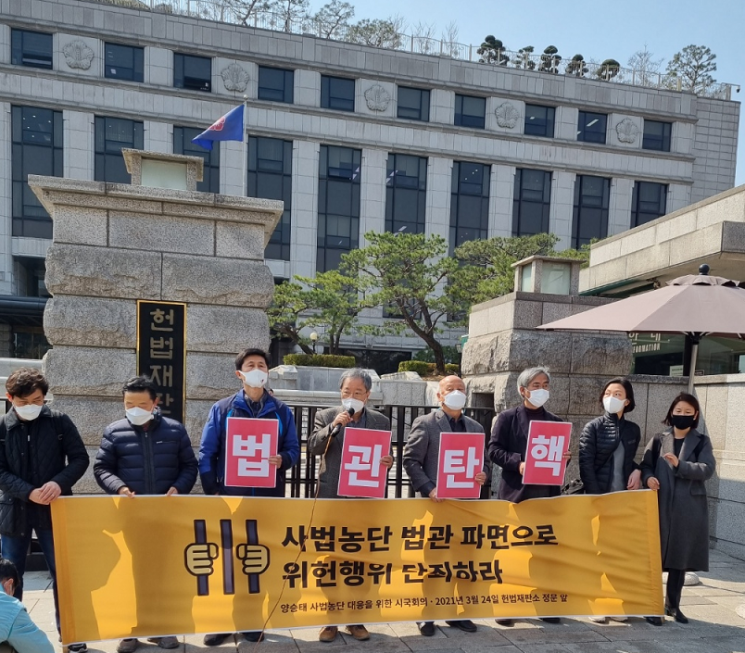 On the 24th, in front of the Constitutional Court in Jaedong, Jongno-gu, Seoul, the 'Judicial Farming Crisis Meeting' held a press conference urging the acceptance of the impeachment motion against former Chief Judge Lim./Photo by Choi Seok-jin
Plan to Hold Full Hearing Once Evidence Is Organized... Attention on Constitutional Court’s Decision Format and Content
Former Chief Judge Lim was acquitted in the first trial of his criminal case based on the legal principle that 'there is no abuse of authority without authority.' However, the National Assembly judged that his involvement in trials violated the Constitution and passed the impeachment motion on the 4th of last month.
At the time the National Assembly filed the impeachment trial request, former Chief Judge Lim was still a sitting judge, but his term expired on the 28th of last month.
Since former Chief Judge Lim is no longer a judge, even if the Constitutional Court finds grounds for impeachment, it is difficult to issue an order accepting the impeachment trial in the form of 'removing Judge Lim Seong-geun.'
However, since the Constitutional Court decided not to dismiss the case and to hold a full hearing, it is widely expected that instead of dismissal, the court will make a substantive judgment by declaring in the decision’s reasoning that former Chief Judge Lim’s involvement in trials was an unconstitutional act infringing judicial independence, or by applying the decision retroactively to a time before his retirement.
© The Asia Business Daily(www.asiae.co.kr). All rights reserved.
![Clutching a Stolen Dior Bag, Saying "I Hate Being Poor but Real"... The Grotesque Con of a "Human Knockoff" [Slate]](https://cwcontent.asiae.co.kr/asiaresize/183/2026021902243444107_1771435474.jpg)












