New and Renewal Contracts with Similar Trends
Gap Widens After New Lease Act Enforcement
Nearly 150 Million KRW Difference in Seocho District
Assemblyman Kim Sang-hoon: "Renting is Harder for Ordinary People"
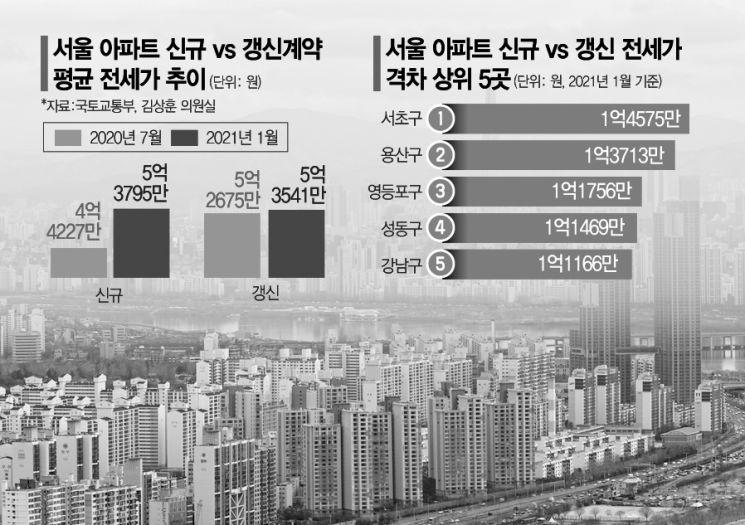
[Asia Economy Reporter Kim Hye-min] Since the implementation of the new Housing Lease Protection Act at the end of July last year, the phenomenon of dual pricing in Seoul apartment jeonse (long-term lease) has been confirmed through statistics. Over the past six months, the average difference in jeonse price increases between contract renewals under the right to request contract renewal and new contracts reached 82.25 million KRW. In some autonomous districts, the jeonse price gap widened to as much as 150 million KRW, significantly increasing the burden on tenants.
According to the trend of newly signed and renewed apartment jeonse prices in Seoul, received by Kim Sang-hoon, a member of the People Power Party, from the Ministry of Land, Infrastructure and Transport on the 23rd, the average jeonse price for newly signed contracts in Seoul apartments as of January this year was 537.95 million KRW. This is an increase of 95.68 million KRW (21.6%) compared to 442.27 million KRW in July last year, just before the lease law was enforced. During the same period, the average jeonse price for renewed contracts rose by 8.66 million KRW (1.6%) from 526.75 million KRW to 535.41 million KRW.
Considering that from January to July last year, the trend for new and renewed contracts was similar and jeonse prices fell by about 10 to 20 million KRW, the difference is even more pronounced. Existing tenants were able to avoid sharp jeonse price increases by raising the deposit by a maximum of 5% under the lease law, but the burden on new tenants who had to find new jeonse homes has increased, as confirmed by the statistics. Kim pointed out that this balloon effect only raised the entry barrier to the jeonse market.
In some autonomous districts such as the Gangnam area and Ma-Yong-Seong (Mapo, Yongsan, Seongdong districts), the price gap between new and renewed apartment contracts was even larger. Seocho-gu is a representative example. The average jeonse price for newly signed apartment contracts in Seocho-gu in January this year was 942.36 million KRW, which was 145.75 million KRW higher than that of renewed contracts (796.61 million KRW). In August last year, the gap was only 1.4 million KRW.
In Gangnam-gu as well, until August, the first month of the lease law enforcement, the jeonse price for newly signed apartments was 13.69 million KRW cheaper than for renewed contracts, but in January this year, it was 111.66 million KRW more expensive. During the same period, in Seongdong-gu, the jeonse price for renewed contracts rose by 6.25 million KRW, while newly signed contracts increased by 148.27 million KRW, bringing the price gap close to 115 million KRW. Yongsan-gu and Yeongdeungpo-gu also saw differences exceeding 100 million KRW.
Kim said, "Due to the forced enactment of the Lease 3 Act by the government and ruling party, the jeonse living conditions for ordinary people have become harsher," adding, "Although the jeonse market is said to be stabilizing and declining this month, the government is overlooking the fact that jeonse prices have already risen too much."
© The Asia Business Daily(www.asiae.co.kr). All rights reserved.
![Clutching a Stolen Dior Bag, Saying "I Hate Being Poor but Real"... The Grotesque Con of a "Human Knockoff" [Slate]](https://cwcontent.asiae.co.kr/asiaresize/183/2026021902243444107_1771435474.jpg)
















