[Report] Leading Smart Factory Solution Developer 'Telstar Hommel' Pyeongtaek Factory
Remote Control of Regional Factories for Quality Management... Self-Developed 'Digital Twin' Solution
"Aiming to Realize a Value Chain Cluster Based on Smart Factory Construction"
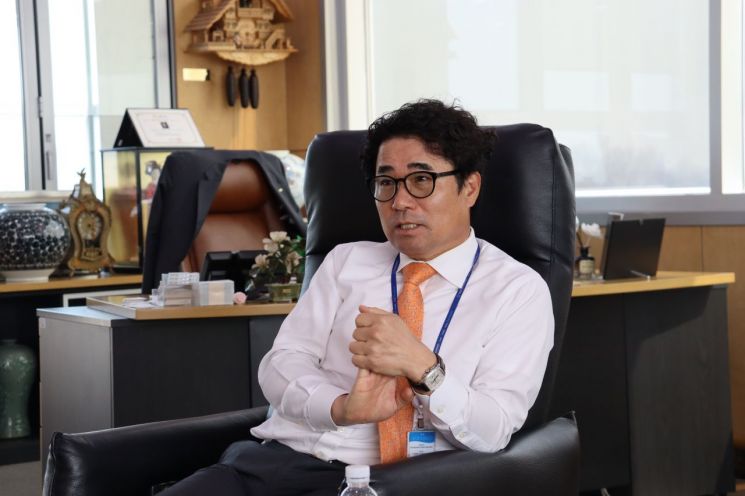 On the 24th of last month, Lim Byung-hoon, CEO of Telstar Hommel, who was inaugurated as the new president of the Innobiz Association, emphasized that the goal is to establish a collaborative system centered on Innobiz member companies after building smart factories, covering everything from raw material supply to manufacturing, distribution, and even research institutions. Photo by Innobiz Association
[Pyeongtaek, Gyeonggi Province = Asia Economy Reporter Kim Heeyoon] At the Telstar Hommel factory located in Gyeongju, Gyeongbuk, two robots are busily welding car door frames with lasers, and a mobile robot quickly transports them to the next process. All manufacturing processes of the robot continuously cutting car doors for the Hyundai Motor Santa Fe with lasers are broadcast in real time through the ‘LINK5’ display on the first floor of Telstar Hommel’s headquarters in Pyeongtaek, Gyeonggi Province.
Next to the actual screen, a 3D display shows the manufacturing process implemented in a virtual digital space. Byung-hoon Lim, CEO of Telstar Hommel, introduced the self-developed 'Digital Twin' solution and explained, “Through this screen, production processes can be controlled remotely from places other than the site via the virtual space, and in case of any issues, the cause can be immediately identified and resolved.”
Telstar Hommel, a factory automation equipment manufacturer, acquired an automobile parts factory in Gyeongju to practically demonstrate smart factory construction and digitalization of manufacturing sites. Manufacturing equipment data operated in the factory is collected in real time and stored in a 5G-based cloud. Changes in manufacturing processes or fluctuations in production volume can be predicted or adjusted in advance by applying artificial intelligence (AI) and big data technologies.
Originally, Telstar Hommel grew as a company supplying factory automation equipment to Hyundai Motor Group. However, as the automobile industry entered the electric vehicle era, the engine and transmission business that had continued for 30 years faced the risk of disappearing entirely. CEO Lim recalled, “If we had been complacent with our existing business, the company’s future would have been uncertain. By challenging ourselves to move beyond manufacturing quality control equipment such as measuring and inspection devices to turnkey assembly line business, and integrating ICT technology to build smart factory solutions, we were able to pioneer a new core business.”
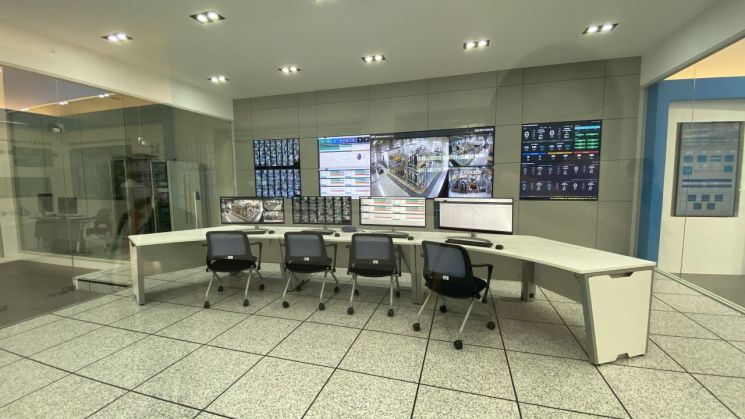 All manufacturing processes of the robot welding automotive door frames at Telstar Hommel's Gyeongju plant are being broadcast in real-time through the 'LINK5' display on the first floor of Telstar Hommel's headquarters in Pyeongtaek, Gyeonggi Province. Remote control of the Gyeongju plant is possible from here. Photo by Kim Heeyoon
Smart factories change the quality of labor, not reduce jobs
The introduction of smart factories has brought significant changes to the working patterns in manufacturing sites. Even after building smart factories, personnel who used to commute between Gyeongju and Pyeongtaek now all work remotely, with the Gyeongju factory being operated remotely from Pyeongtaek. The increase in minimum wage and the implementation of the 52-hour workweek system became a catalyst for robots to quickly replace simple repetitive tasks in manufacturing sites.
Regarding concerns about job losses raised by some, CEO Lim emphasized, “Smart factories transform factory workers engaged in simple repetitive labor into knowledge workers, so rather than reducing jobs, they have a greater effect on changing the quality of jobs.” He added that at Telstar Hommel’s Gyeongju factory, robots handle simple labor, while humans are assigned to advanced tasks such as managing automation equipment. The manufacturing line at the Gyeongju factory employs 3 to 4 workers who mainly replenish fallen parts or manage manufacturing robots.
The COVID-19 crisis last year became an opportunity for Telstar Hommel. As the smart factory construction projects for small and medium-sized enterprises accelerated, companies possessing integrated comprehensive solutions and experience from hardware such as robots, sensors, and equipment to data management software were rare. Furthermore, with CEO Lim inaugurated on the 24th of last month as the 10th president of the Innobiz Association (Small and Medium Business Technology Innovation Association), presenting the smart factory platform as a blueprint for future manufacturing companies, the role is expected to expand further.
Meanwhile, Telstar Hommel, the chair company of the Innobiz Association’s ‘Smart Factory Consortium,’ plans to lead the ‘value chain cluster’ based on smart factories in line with the global manufacturing trend requiring small-lot, multi-variety production. CEO Lim stated, “Our goal is to establish a collaborative system centered on Innobiz members after building smart factories, covering everything from raw material supply to manufacturing, distribution, and research institutions. First, within this year, we plan to build a smart factory for kimchi production and supply replicated factories worldwide to demonstrate an example of the value chain cluster,” expressing his ambition.
© The Asia Business Daily(www.asiae.co.kr). All rights reserved.


















