Concerns Grow Over Cargo Truck Safety Issues
Over 40,000 Annual Overloading Cases Detected in Last 5 Years
Nicknamed 'Potential Murderers' and 'Time Bombs on the Road'
Multiple Factors Including Industry Practices and Vulnerable Employment Conditions
Experts Urge Government to Expand Safety Freight Rates to Reduce Accidents
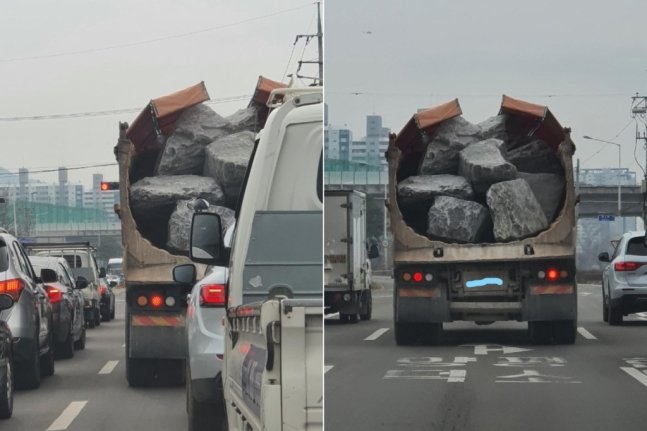 On the 4th, a dump truck loaded full of rocks was seen driving on a road in Namyangju, Gyeonggi Province. / Photo by Internet Community Capture
[Asia Economy Reporter Lim Juhyung] Concerns are growing over overloaded freight vehicles that do not comply with safety standards, following an incident involving a dump truck carrying a massive rock driving on the road. Some have strongly criticized such vehicles, calling them "potential murderers" and "time bombs on the road." In fact, cases of overloaded freight truck drivers being caught have not decreased in recent years. However, since overloaded vehicles are a complex issue involving industry practices and drivers' employment conditions, there are calls for active government intervention.
Earlier on the 4th, a post titled "I saw a potential murderer on my way to work" was uploaded to an online community. The author of the post said that while driving on a road in Namyangju, Gyeonggi Province, they saw a vehicle precariously carrying a huge rock in the cargo bed and criticized, "I almost cursed the moment I saw the truck."
Photos attached to the post show the truck carrying a large rock across the entire cargo bed without any safety devices. The rock fills the outer side of the truck and looks dangerously close to rolling off at any moment.
Netizens who saw the photos criticized the truck driver, saying things like, "If that spills, it will cause tremendous damage," "It's no different from a time bomb on the road," and "I hope they catch and punish them quickly."
As the controversy grew, the Northern Gyeonggi Provincial Police Agency launched an investigation and arrested the truck driver on the 17th. The driver told the police, "The hinge was broken, so I couldn't use the safety device," and "I had no choice but to drive because I couldn't miss the job opportunity."
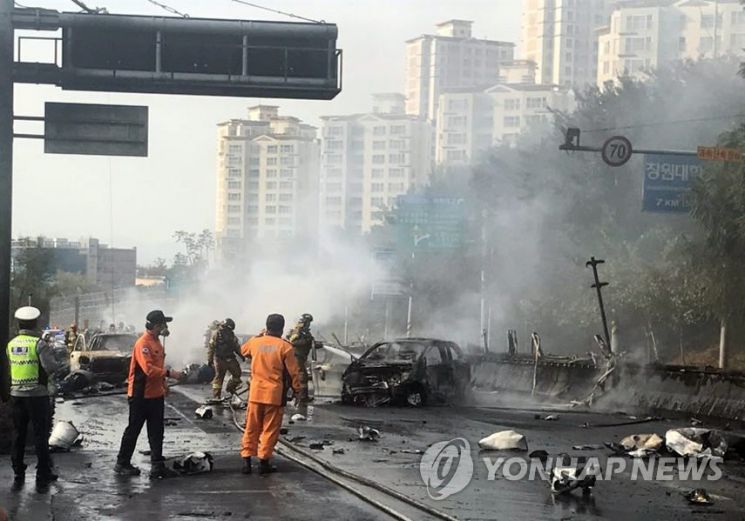 The accident site where a 5-ton truck carrying engine oil in drums exploded in front of Changwon Tunnel on the Jangyu direction between Changwon and Gimhae, Gyeongnam, in 2017, resulting in three deaths. / Photo by Yonhap News
This is not the first time freight truck drivers have engaged in such "dangerous driving." In particular, the act of "overloading," where freight trucks carry cargo exceeding the recommended load weight, has been caught multiple times before.
In 2019, a freight truck driver, Mr. A, was caught for carrying over 100 tons of stone on a 25-ton truck for four years and bribing a public official in Jeonbuk to avoid inspection.
In November 2017, a freight truck exploded in the Changwon Tunnel, Gyeongnam, killing three people including driver Mr. B and injuring five others. At that time, drums loaded on the overloaded truck fell onto the opposite lane, worsening the damage.
Overloaded freight trucks are dangerous because cargo can spill when driving on sharp curves or suddenly stopping, potentially harming nearby people or vehicles. There are also safety concerns because the truck body is burdened by the heavy load. If the truck cannot bear the cargo weight and the brake system fails, it can lead to chain collision accidents.
Cases of overloaded freight trucks being caught on the road have not decreased. According to data from the Ministry of Land, Infrastructure and Transport, from 2015 to 2019, the average number of overloaded freight truck detections was 46,000 per year, consistently exceeding 40,000 annually over five years. The cumulative number of deaths from freight truck accidents during the same period was 1,143, higher than taxis (970) and buses (784).
The problem is that the cause of overloaded freight trucks is not solely the truck owners' fault. Since it is a complex issue involving subcontracting practices unique to the freight transport industry and the employment status of freight truck drivers, who are practically self-employed, it is pointed out that road enforcement alone cannot solve the problem.
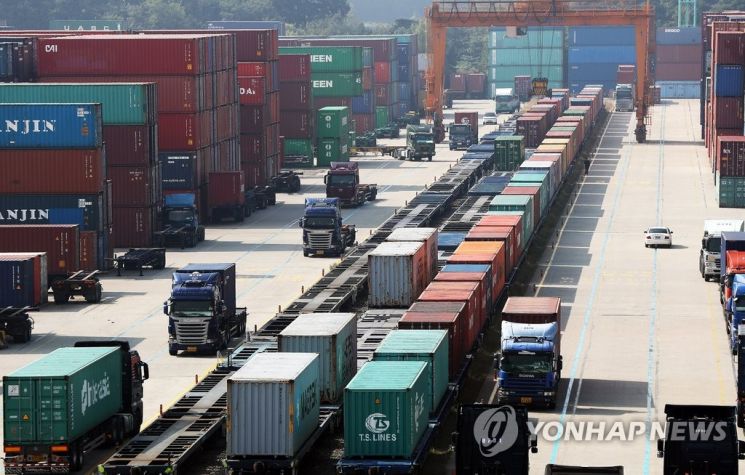 Trucks are busily moving at Uiwang ICD (Inland Container Depot) in Bugok-dong, Uiwang-si, Gyeonggi-do. / Photo by Yonhap News
The domestic freight transport market is largely divided into contractual relationships between cargo owners (clients) and truck owners (drivers). The cargo owner subcontract the transport to the driver who operates the vehicle.
Meanwhile, in Korea, truck owners are employed as special-type workers (special employment). Special employment workers are those who find customers themselves, provide labor, and receive payment accordingly. Since they are practically one-person self-employed, their bargaining power with cargo owners is low, and the market is highly competitive, which risks lowering their pay.
As a result, there is concern that truck owners may overload their trucks and drive recklessly to earn more pay.
Therefore, since January last year, the government has implemented the "Freight Truck Safety Freight Rate System" for certain cargo. The safety freight rate system is a system that announces the minimum freight rates truck owners should receive, considering cargo weight and transport distance. The core is to standardize truck owners' pay so that cargo owners do not demand unreasonable subcontracting conditions.
Experts have suggested expanding the current safety freight rate system to cover all cargo.
A representative from the Freight Transport Solidarity Headquarters explained, "Special employment freight truck drivers did not have a system to determine minimum freight rates like the minimum wage for regular workers, so during economic downturns like now, truck owners inevitably face harsh conditions. The safety freight rate system prevents this and holds cargo owners more accountable." He added, "Research shows that as actual freight rates increase, safety accidents decrease."
He continued, "Currently, the safety freight rate system applies only to cement and import-export containers, which covers only about 20,000 out of 410,000 domestic freight trucks," and emphasized, "Expanding the list of cargo subject to the safety freight rate system so that as many drivers as possible can benefit will help reduce safety accidents."
© The Asia Business Daily(www.asiae.co.kr). All rights reserved.



















