T map Ends Free Data Benefits for Its Customers
Consumers Protest... Concerns Over Paid App Usage
Taxi and Freight Drivers' Worries Grow
Monthly Real-Time Traffic Data Usage
Equivalent to 3 Minutes of YouTube, 20 Minutes of Music Playback
Large Data Volume Is Map Data... Wi-Fi Download Available
[Asia Economy Reporter Minyoung Cha] "It's the tyranny of the platform. They are basically telling us to use unlimited data plans." (From an interview with taxi driver A)
T map Mobility, which spun off from SK Telecom at the end of last year and declared its ambition to become an all-in-one mobility service company, has recently been embroiled in controversy over 'platform tyranny.' This is because it announced that starting from the 19th of next month, SK Telecom customers will no longer receive free data benefits when using the 'T map' application, raising concerns about potential data bill shocks. Critics claim that after attracting customers with free benefits and securing the top spot, T map is now attempting to switch to a paid model.
The issue lies with map data... Wi-Fi download available
On the 11th, T map announced via an app notice that it would end the so-called 'zero-rating service' of providing free T map data to SK Telecom customers. Going forward, SK Telecom customers will also have data deducted when using T map, just like existing KT or LG Uplus members. Under current Fair Trade laws, if the newly spun-off T map Mobility does not pay its parent company for service usage, it could face discrimination disputes. The news of switching a previously free service to a paid one has sparked strong backlash, especially among related industry workers such as taxi and freight drivers, who claim they are being forced into unlimited data plans.
However, current consumer concerns are somewhat exaggerated. First, the data required when customers use T map mainly consists of two types: real-time traffic information data and map data. For real-time traffic information, T map customers use an average of 48MB per month. This amount is equivalent to watching 3 minutes of YouTube videos or playing 20 minutes of music. Even taxi drivers, who use the service heavily, consume about 85MB per month on average.
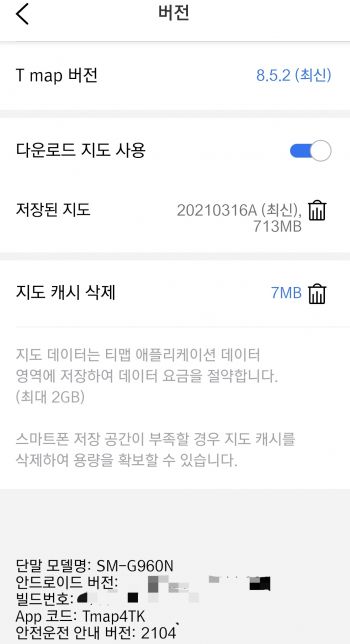 You can download maps by going to Menu - Settings - Version within the T map app. Photo of the app screen
The larger portion of data usage comes from map data. This issue can be resolved by downloading maps in advance via Wi-Fi. Users can go to the main screen's top-left menu - Settings - Version, then select 'Use downloaded maps.' As of the 21st, the latest version was updated on March 16. Downloading takes about 3 to 5 minutes, and the new map cache is stored in T map's internal data storage, which can hold up to 2GB. Since 1GB equals 1000MB, 2GB means 2000MB, so the storage capacity is quite ample.
According to company estimates, only about 0.2% of actual T map users are expected to incur additional data charges. For pay-per-use customers, the charge is set at 0.011 KRW per 0.5KB. Since 1MB equals 1000KB, using the average T map consumption of 48MB would cost approximately 1,081 KRW. T map plans to provide 100MB free of charge for six months as customer compensation.
This is when T map faces heavy criticism
There are claims that T map, having secured the number one navigation spot through free benefits, is now leveraging its market share to implement paid policies. From the company's perspective, this is somewhat unfair. SK Telecom launched T map in 2011 for its own customers, and after gaining popularity among drivers, it offered paid services to KT and LG Uplus customers with a monthly fee of 4,000 KRW and data deduction conditions. By the time T map made its monthly subscription fully free in 2016, its market share among all telecom navigation services had already exceeded 70%.
Big data platform issues such as personal information collection and usage in services like restaurant and insurance recommendations have also come under scrutiny. T map Mobility explained that for driving habits, only information with individual consent is collected and analyzed in cooperation with insurance companies. For restaurant recommendations, only the higher-level purpose is analyzed, and related personal information such as age or gender is not collected.
Regarding these suspicions, a T map Mobility representative stated, "Revenue compared to fixed expenses is significantly low," adding, "After the spin-off, we are in the process of developing various services based on T map, such as taxi and designated driver services, to generate revenue. Navigation itself is not a profit-making business."
© The Asia Business Daily(www.asiae.co.kr). All rights reserved.


















