Ministry of Science and ICT: "Launch service provider is analyzing the cause of the issue... Future launch schedule to be determined"
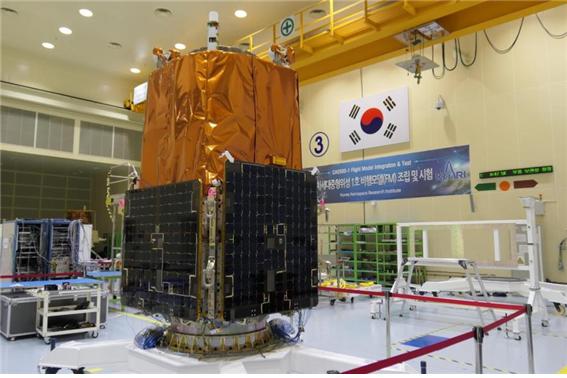
[Asia Economy Reporter Kim Bong-su] The Ministry of Science and ICT announced on the 20th at around 3:07 PM (Korean time) that the launch of the ‘Next-Generation Medium-Sized Satellite 1’ scheduled at the Baikonur Cosmodrome in Kazakhstan was postponed due to an issue with the Russian Soyuz 2.1a launch vehicle.
The launch service provider for the Next-Generation Medium-Sized Satellite 1, JSC Glavkosmos, discovered a problem in the control system of the upper stage (Fregat) of the Soyuz launch vehicle during the final inspection before launch, leading to the postponement of the launch schedule.
The Ministry of Science and ICT stated, “All functions of the Next-Generation Medium-Sized Satellite 1 are being maintained in normal condition,” and added, “Currently, JSC Glavkosmos is analyzing and inspecting the cause of the Soyuz launch vehicle’s launch suspension and will decide on the future launch schedule after completing the review.”
The Next-Generation Medium-Sized Satellite 1 was moved to the Baikonur Cosmodrome after assembly was completed in January and had finished launch preparations including over 50 days of functional checks, fuel loading, and integration with the launch vehicle.
Weighing 500 kg and measuring 1.86 m in width and 2.89 m in length, the Next-Generation Medium-Sized Satellite 1 is a medium-class low Earth orbit satellite mostly developed domestically from design to parts manufacturing and assembly. Even the core component, the optical payload (satellite camera), was built with domestic technology except for the photodetector.
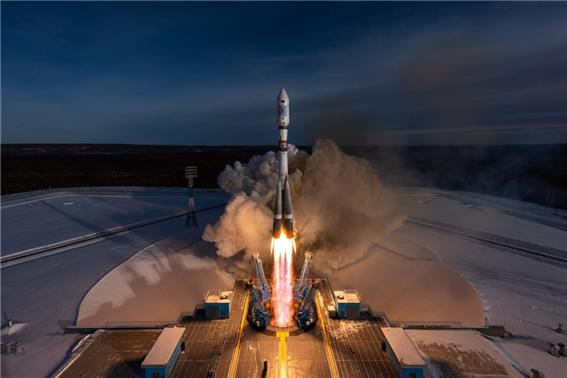
After launch, the Next-Generation Medium-Sized Satellite 1 will undergo an initial six-month operation phase in an orbit at an altitude of 497.8 km and plans to provide standard imagery to users starting from October. It will perform its mission passing over the Korean Peninsula daily at 11 AM, with a lifespan of four years. It is expected to provide precise ground observation images for national land and resource management such as map making, and for disaster and emergency response including coastal, wildfire, and flood monitoring.
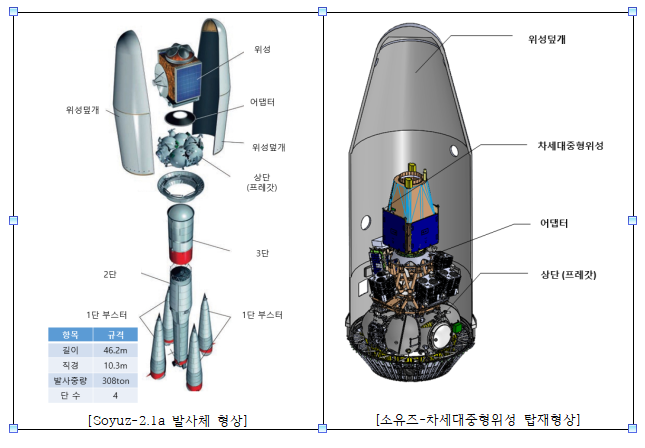
The problematic Soyuz 2.1a launch vehicle consists of a three-stage liquid rocket (using liquid oxygen/kerosene) and an upper stage (Fregat Upper Stage, using hydrazine/UDMH). It measures 46.2 m in length and 10.3 m in diameter, with a launch weight of approximately 308 tons. It has the capability to launch satellites with a total mass of 4.8 tons into sun-synchronous orbit and can carry multiple satellites simultaneously into orbit.
© The Asia Business Daily(www.asiae.co.kr). All rights reserved.

![User Who Sold Erroneously Deposited Bitcoins to Repay Debt and Fund Entertainment... What Did the Supreme Court Decide in 2021? [Legal Issue Check]](https://cwcontent.asiae.co.kr/asiaresize/183/2026020910431234020_1770601391.png)
















